
Natick’s school year ended a couple weeks ago, with the last day of classes held on June 14th. For Johnson Elementary School, though, the public school year wasn’t the only thing ending. Johnson, Natick’s smallest and oldest school, is now closed for good.
We look back here at why the school closed, and what’s next.
Discussions and decisions
Discussions about closing Johnson have been floating around town government for decades. Johnson is older and smaller than Natick’s other elementary schools, which already lands it halfway on the chopping block. What’s more, because of its age, the school is not ADA-compliant or energy-efficient. Updating the school to fix these problems would be “prohibitively expensive,” as Jefferson Wood, Johnson fourth grade teacher and co-president of the Education Association of Natick, Natick’s educators’ union, said.
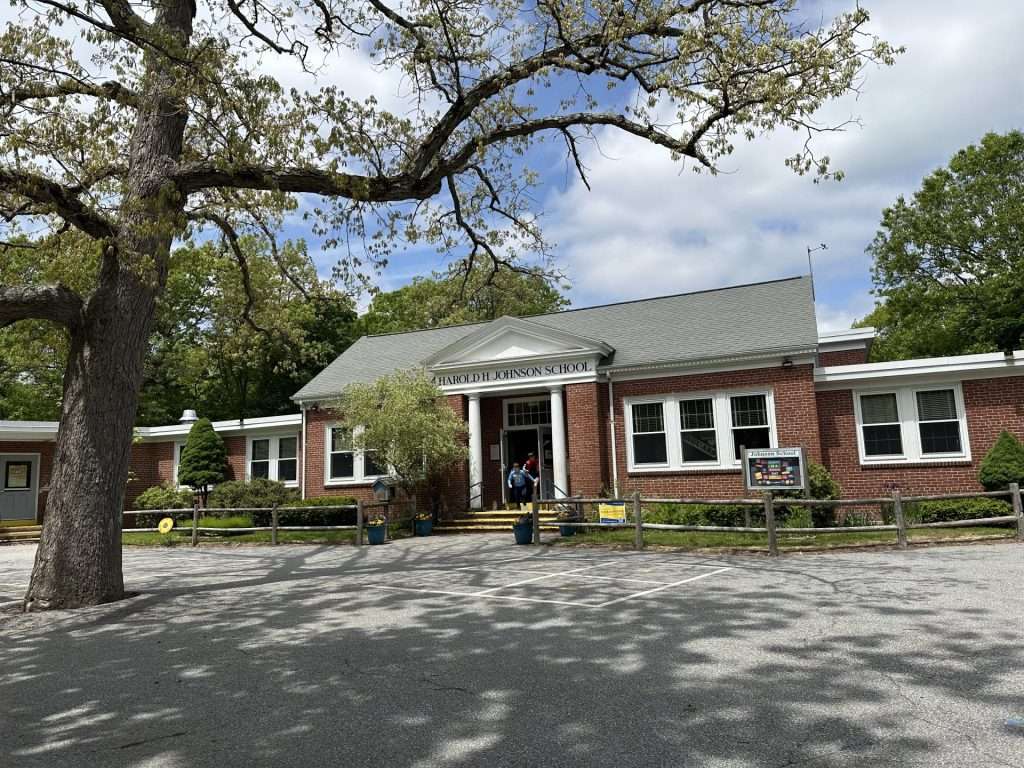 Students charge out of Johnson Elementary School for recess.
When current School Committee Chair Shai Fuxman first joined the body, he asked then-members about what the biggest challenges facing the Committee would be. Almost everyone he asked brought up that this iteration of the School Committee would have to decide whether to close Johnson.
After so many years of discussion, the decision fell on that School Committee, two and a half years ago, because there were more risks at the time, Fuxman said. These risks included failing infrastructure and the likelihood of not being able to provide an ADA-compliant building to a student who needs one.
“When it got to us to decide, it just felt that to keep postponing the decision… just set us up for more risks,” Fuxman said. “We made the decision that there is never going to be a good time to close a school and so just kicking the can forward wasn’t going to help anyone.”
The Committee ended up deciding to close Johnson and to apply to rebuild and expand Memorial Elementary School, which is also old and in need of an upgrade. Rebuilding both schools would have been too expensive, Fuxman explained. As such, the School Committee determined that it made more sense to rebuild Memorial than Johnson because Memorial is on a larger plot of land. This will allow the new, larger building to be constructed on the current field while school remains in session in the current building. The same technique was used to rebuild Kennedy Middle School several years ago.
The School Committee was fully transparent that Johnson’s fate was a topic of discussion, Wood said, but the discussions were happening on the heels of the worst of the COVID-19 pandemic. Given the shock permeating the Johnson community when the decision was announced, Wood is unsure how aware people were that the closing of Johnson was a very real possibility.
Wood also wishes that the School Committee had brought in a greater variety of people to speak on the issue, though he is aware that the pandemic presented limitations.
Enrollment numbers
Wood has concerns about how the decision to close Johnson and rebuild Memorial will play out.
“The mere fact that they are looking to expand [Memorial] is an acknowledgement that there is an expectation that [Natick’s elementary-age population is] going to grow again,” Wood said. “So the closing of a building now seemed irresponsible… And I find that the argument that was used as the primary argument was not just unconvincing but factually inaccurate.”
The primary argument to which Wood referred is that population decline in Natick is such that the town will no longer need a fifth elementary school.
One reason why Johnson has stayed open this long is that Natick’s population had been expanding for decades. In fact, modulars were built at some Natick schools to accommodate the growing enrollment.
The town pointed to declining elementary school enrollment as evidence that it would be okay to close Johnson, but Wood believes that they used too small of a sample size, and that the town will struggle to accommodate all its students in the future now that they have only four elementary schools.
“I still feel that the district as a whole is going to have some fallout from the closing of Johnson,” Wood summarized.
Fuxman acknowledged that the possibility of another increase in Natick’s elementary-age population is a concern. He said that the data projects that four schools will be enough for the next several years, but beyond that, the School Committee cannot tell the future. This is a concern and a risk, he said, but there would have been concerns and risks associated with keeping Johnson open, too.
“[N]either the decision to close it or to keep it open was a slam dunk,” Fuxman said. “There were so many pros and cons on both sides; it was truly a very difficult decision.”
According to a study Fuxman has seen, 300–500 students is the target enrollment for an elementary school. Natick’s four other elementary schools had about 500 students each this past school year, even with Johnson in operation—though Johnson enrolled far fewer students than it usually does this past year. Fuxman doesn’t want the four other elementary schools to have many more than 500 students each in the future, even though they will enroll more former Johnson students then.
Neighborhood schools versus modern schools
The merits of neighborhood schools versus larger, more modern ones also played a role in the discussions about whether to close Johnson.
Johnson is one of the last ties to Natick’s legacy of neighborhood schools. Natick used to be full of these smaller, more community-oriented schools, but the town shifted to a larger-school model decades ago.
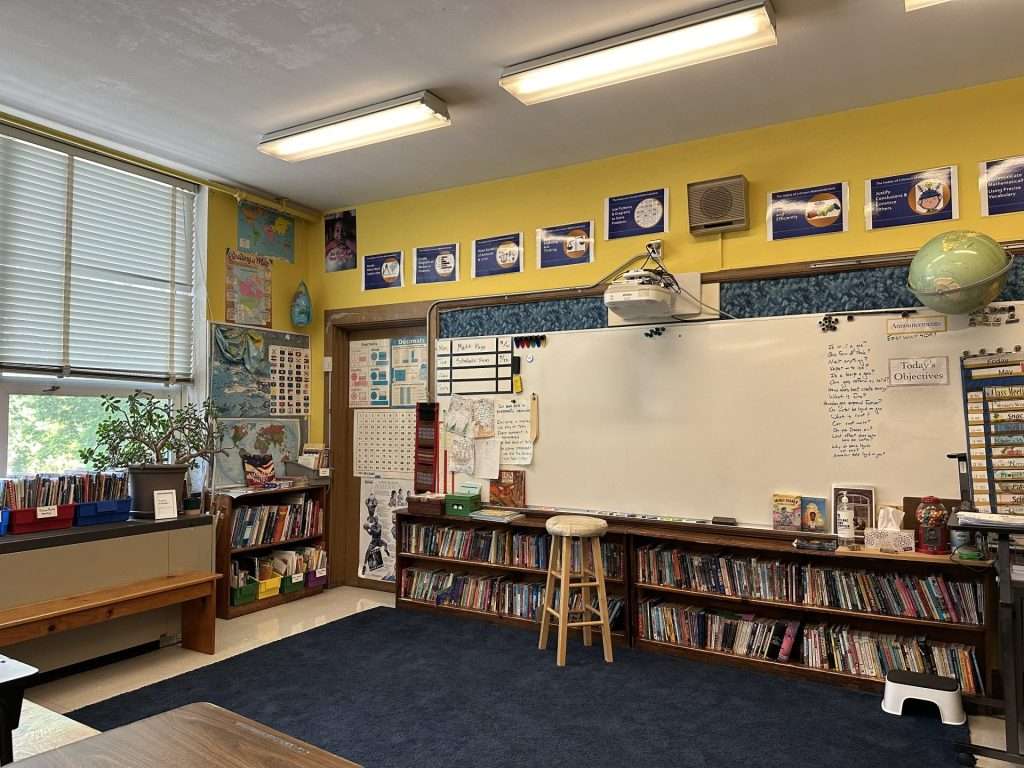 Jefferson Wood had been teaching in this classroom for 26 years.
Education has changed in the years since Johnson was built, Fuxman explained. The schools that Natick has constructed more recently, such as the new Kennedy Middle School, are modern buildings that fit a newer approach to education. For instance, the new Kennedy has specialized rooms, such as an aquaponics lab, and more space for collaboration.
The modern approach also includes far more staff than schools usually had when Johnson was built 75 years ago. For example, schools now need special educators, instructors specializing in subjects like art and music, occupational therapists, and more. It is expensive to replicate this across a larger number of schools, Fuxman said, so it makes sense to have larger schools in order to invest in the staff who are needed there.
Members of the Johnson community, however, treasure their experience with the small, neighborhood school model.
At Johnson, almost every teacher knows almost every student by name—and knows about some of their interests and personality both inside and outside of the classroom. About 95% of Johnson students walk to school, which creates and strengthens the school’s characteristic tight-knit community. Students and parents alike get to know each other while walking to the building and mingling with each other and with Johnson staff outside on the blacktop before and after the school day.
Even new additions to the Johnson community, such as Charleen Belcher, who served as Johnson’s school librarian for the past school year only, felt this camaraderie.
“It’s like a family,” Belcher said. “I’ve only been here since the end of August and I feel that I know each and every one of these kids—and, obviously, I know all of my coworkers.”
School Committee members, some of whom are part of Johnson families, are aware of the strength and unique nature of Johnson’s community.
“Johnson is a very special school,” Fuxman said. “I know a lot of people in the Johnson community say that and I have learned to believe that and to experience that by talking to them… Johnson really represents the center of a very close-knit community the way that other elementary schools don’t because they pull from bigger areas.”
Wood made it clear that the decision to close Johnson is about more than shutting down a building—in fact, many Johnson parents and alumni agree that the building is too old. Rather, the decision is about shutting down a community.
“The community reaction was never about keeping a 75-year-old building,” Wood said. “Everyone recognized the weaknesses, the disadvantages, the problems of the building. But I don’t think anyone thought we were just going to shut the building down and dismember the community.
“And [‘dismember’ is] a harsh word that’s exactly what has happened,” Wood continued. “The redistricting of the Johnson neighborhoods has been painful. We did it in what really feels like the worst possible way—a slow amputation of our community. It proved beyond the shadow of a doubt that there was not a complete, clear, and comprehensive plan.”
Phase-out process
Over the past two years, Johnson has been closing through a phase-out process. During the 2022–2023 school year, Johnson stopped accepting new kindergarteners, diverting them instead to other elementary schools. This practice stayed in place for the past school year (2023–2024), meaning that Johnson enrolled only second- through fourth-graders this past year.
This phase-out process was actually supposed to last one more year. However, many families pulled their kids out of Johnson prematurely. They did this for a variety of reasons, including ensuring that all the kids in their family were at the same school, easing the burden of school transitions for their children, and having the most choice possible with regards to the school to which their kids would relocate.
Because of this, Johnson enrolled only 51 students this past year, split up between two small fourth grade classes and one combined second- and third-grade class. Due to the already-low enrollment, the community decided it would be best for everyone to close Johnson a year early instead of leaving it open for 2024–2025 as well.
According to Fuxman, the School Committee decided to close Johnson through a phase-out plan because they were aware that there were unknowns, such as if and when families would decide to pull their kids out of Johnson. As such, they wanted to have as smooth a transition process as possible that gave families the flexibility and choice they needed. Although the School Committee couldn’t plan for everything, they have never taken their eyes off the transition process, Fuxman said.
Having experienced the slow phase-out process, Wood thinks that the School Committee genuinely did make this plan with the Johnson community’s best interests in mind, but it did not work out the way they hoped.
“[The phase-out process has been] a barely mitigated disaster made worse in many ways by good intentions,” Wood said.
These good intentions were giving members of the Johnson community choice over their next steps. However, Wood believes this degree of choice made the phase-out process messy. For instance, the parents who pulled their kids out sooner and the teachers who left earlier (especially kindergarten and first-grade teachers, neither of whom were needed at Johnson this past year) had greater choice over where they would end up.
There are also logistical concerns. For example, if the majority of Johnson families chose to divert their kids to the same elementary school, that school could become overcrowded. On the other hand, if a neighborhood becomes completely split between different elementary schools, it could sever neighborhood cohesion and community, and create a complicated busing situation.
Further, Wood likens the phased closing to salt in the wound. It was especially difficult for him to have a school without kindergarteners. This was hard for his fourth-grade students too; they remembered having fourth-grade buddies when they themselves were kindergarteners, but there were no new kindergarteners to whom they could pay that forward.
“This year we’ve done the best we could to not make [school] feel like a museum, but that was hard to do,” Wood said. “The loss of the community in this deliberate pace was unnecessarily painful. And that alone is probably the greatest fault I can find with the School Committee and their vote. Closing down a 75-year-old building—I have problems with that. But the way they did [it] was poorly done.”
Brenna Turner, who served as Johnson’s Interim Principal this past school year, agrees that the final year of Johnson was difficult, describing it as an “emotional rollercoaster.”
“[For] staff, students, families, there’s been highs and lows,” Turner said. “I do think people are going through a grieving process.”
Next steps
The School Committee has handed over control of the Johnson building to the town, which recently held a forum to begin planning for the building’s future.
The closing of Johnson has created some distrust between the Johnson community and the School Committee, and repairing this is a priority for the Committee. They have started working on this already, and Fuxman has put it on the agenda for Dr. Melissa Spash, the incoming superintendent.
In addition, former Superintendent Dr. Anna Nolin and former Interim Superintendent Dr. Bella Wong worked with principals at Natick’s other elementary schools on supporting former Johnson students. Specifically, they want to ensure that former Johnson students are making friends and feeling a sense of belonging at their new school. Fuxman said this will continue to be important in the coming years.
“We want to make sure every single student in every single one of our schools, when they walk in the school building, feels that this is their home, this is their school home where they belong,” Fuxman said. “That might be a little bit more challenging for students who had a strong connection to a different school.”
Despite all the logistics and emotions involved in the Johnson closing process, Turner is confident that Johnson students will do well wherever they end up in the new academic year.
“I think the kids will be more easily transitioned than the grown-ups,” she said. “Kids are always more resilient.”
For more on Johnson’s closing:
- Johnson students and staff document their school’s legacy
- Johnson Peacemakers perform “music with a message” one last time

As articulate as always, Mr. Wood!
Thank you for this comprehensive review of the Johnson closure!
Former and would-be Johnson students living on the same street are now attending 3 different schools (Brown, Memorial, and Lilja). As a result, some families are being divided at the middle school level, as well.
Whoever made this decision has, I suspect, without knowledge or experience, made the decision to break apart neighborhoods and forever changed the culture of this tihjy knit community. Unfortunately, kids living a few doors away must wait until high school to attend school together.
So sad. All the children that walked to school, will be on busses, that will need to be purchased. Adding more traffic congestion to the downtown . Why cant a new school be built on the land at Johnson , not South Natick?
I’ve heard roomers, that developers have their eye on the land. Yeah!! More condos for downtown Natick!!
Town should have spent the money to update going to cost them a lot more in the very near future and what happened to the current staff school budget should be reduced and also shortage of bus drivers
Excellent reporting, Ella.