
Special to Natick Report from the Natick Historical Society’s. Written by Trudi Reisner & Niki Lefebvre.
Did you know that today’s Clark’s Block was not the first Clark’s Block in Natick? The original block stood for just two years before it burned in the Great Fire of 1874. The fire destroyed thirty-seven other buildings, including the Town Hall, Fire Station, grocery stores, banks, retailers, and the Post Office. Incredibly, no one perished in the fire, but the devastation to the town was unimaginable.
Nathaniel Clark could have given up his business in Natick after the fire, but he didn’t. Instead, he rebuilt the block right away–and expanded it. When the new block was finished in 1875, it was called one of the finest buildings in Middlesex County.
 Old Clark’s Block (center) before the 1874 fire, c. 1872 (NHS Collections)
 Clark’s Block rebuilt after the 1874 fire, c. 1875-80 (NHS Collections).
Natick was a rural hamlet when Nathaniel Clark first came to Natick in the 1820s. After the railroad arrived in 1834, Natick began booming with industry. In 1836, just two years later, Clark opened the town’s first grocery store near where Clark’s Block stands today.
Throughout his life, Clark took on several more business ventures. He served the town as Treasurer for eighteen years, overseeing aid disbursements to Union soldiers and their families. Clark served on the board of Natick Savings Bank and earned the regard of locals for helping people in times of adversity.
When Clark’s Block reopened in 1875, five times as many people lived and worked in Natick as in the 1830s. Natick was a growing town with promise, potential, and ambition. Clark built a business block that fostered continued growth and distinguished Natick for future generations.
Some of the original stores in Clark’s Block on the first floor included Edward Clark, grocer and son of Nathaniel Clark; E.M. Marshall, watchmaker and jeweler; a barber; Miss C.H. Travis, milliner (hatmaker); and Daniels & Twitchell, druggists. On the second story were the rooms of the Natick National Bank and the Five-Cents Savings Bank; O.J. Washburn, dentist; Judge Null’s law office and District Courtroom; and the Natick Citizen Printing and Editing Company.
On the third story were four halls, the largest of which was the Concert Hall. The hall measured more than 100 feet long and accommodated an audience of 1,200. Natick used the hall for Town Meetings, and local organizations held benefits there to raise money and provide entertainment. Concert Hall also held a memorial service for the 18th Vice President of the United States, Natick’s Henry Wilson. There was even a basketball game in Concert Hall: Natick versus Marlboro on January 30, 1903!
Today, Clark’s Block includes Paper Fiesta, Brandt Jewelers, Orangetheory Fitness, and other businesses and services. The block continues to thrive in Natick Center, just as Nathaniel Clark must have hoped it would nearly 150 years ago. Almost 150 years later, Clark’s Block continues to anchor downtown Natick.
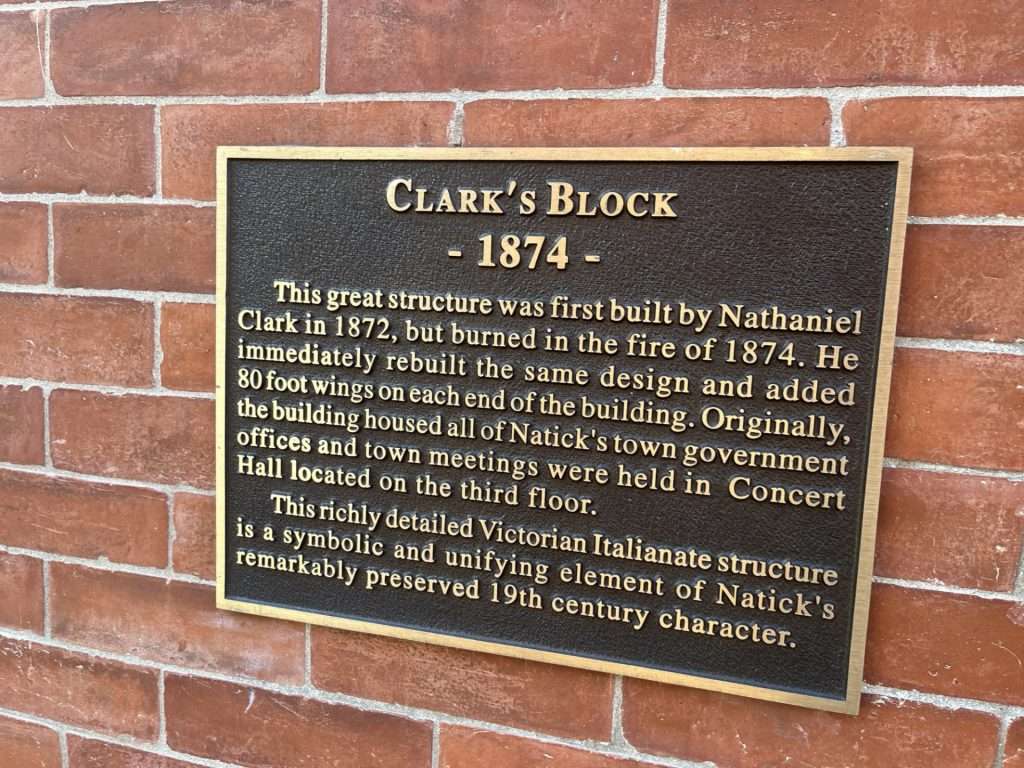 Clark’s Block plaque on Summer Street
More history posts:
- When Natick was Crowned Home of Champions, and Firefighting was an Olympic Sport
- Building and Celebrating the Soldiers’ Monument in Natick (1868 – present)
- Natick’s Great Fire of 1874: Looking back 150 years later
- Natick history: The South Natick fire of 1872
- President George Washington’s Morning Ride Through Natick
Support Natick Historical Society


