
During the first night of Natick Fall Annual Town Meeting, the School Committee got its $2.6m in funding for a Memorial Elementary School building project feasibility study and schematic design, capital funding for trucks and more was approved, and Select Board cleanups got OKs.
A recording of the Oct. 21 session is posted on Natick Pegasus.
An unofficial vote count is available online as well. Natick Town Meeting has up to 180 members, 18 per precinct, and the highest number of votes cast on night #1 per this tracker was 117 on the Memorial study funding.
We’ll be following up with night #2 coverage from Oct. 23.
Next Tuesday, Oct. 28, Town Meeting will feature discussion and voting on, among other things, Natick’s first ever distribution of Community Preservation Act funds for projects, including the big one—$750k requested for the proposed 5 Auburn St. housing development.
Memorial School funding & regret over not becoming an architect
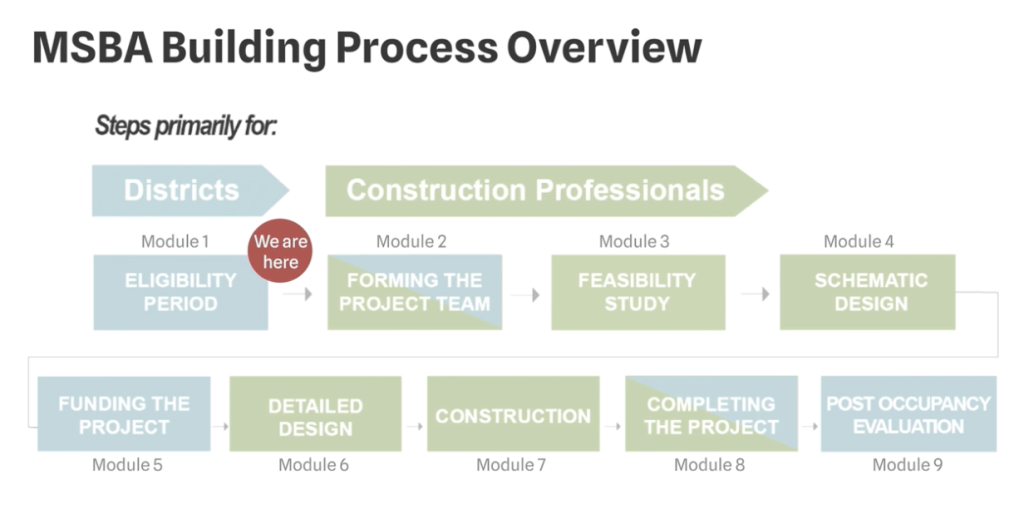
The first meaty topic undertaken by Town Meeting was Article 10, via which the School Committee sought $2.6m to fund a feasibility study and schematic design related to a proposed Memorial Elementary School building project. The School Committee and School Department are going through the exhaustive Massachusetts School Building Authority (MSBA) process that can score the town millions in renovating or rebuilding the outdated school building at Eliot Street. Supt. Dr. Melissa Spash and Memorial Principal Karen Ghilani were among those who made their case before Town Meeting that funding at this point is critical for Natick keeping its place in the MSBA process.
Spash cited the overcrowding and obsolete spaces within the current Memorial building that made the school system eligible for the MSBA process, and Ghilani added color, such as by detailing issues like a leaky roof and crumbling concrete.
Ghilani said the building, originally designed to handle up to 348 students, is now serving 436, and spaces have had to be stretched for different purposes. There’s a lack of space for multilingual learning and some special education programs.
The feasibility study would test designs to support 600 K-4 students and a pre-school, and look at the possibility of using geothermal for heating and cooling.
Assistant Superintendent for Finance Matt Gillis went over the numbers, including $1.8m of the requested $2.6m for an architect. Architects typically score about 10% of the overall project cost, he said.
The motion under Article 10 easily secured the required two-thirds vote with a 111-6 tally, though even supportive Town Meeting members did have a critical thing or two to say about the process.
Some Town Meeting members took issue with how reimbursement rates from the MSBA were displayed, and Gillis clarified this issue. Questions were also raised about the need for more school space in light of enrollment projections being flat to a slight decline, especially in light of enrollment data being used not long ago to justify closing Johnson Elementary School.
And then there was that $1.8m for the architect…
Town Meeting member Steve Merlino, whose daughter attended Memorial more than 20 years ago, said “I don’t need at $2.6m study to know the building is trash… and $1.8m for an architect? Boy, I wanna go back to school.” He asked if the study could be skipped, but was told no, the MSBA requires it, and the idea is that getting MSBA acceptance would more than pay off in the end.
We don’t regret being journalists rather than architects. But you can help us to close the very wide salary gap by making a tax-deductible donation to Natick Report.
Another big ticket item: Capital equipment and improvement
Article 9 covered capital equipment and improvement, with requests totaling about $8.9m between two motions, which passed by votes of 112-2 and 111-3-1. Money is being targeted for a fire engine and police cruisers, a sander vehicle, water meter and main replacement, tree inventory (to identify possible issues—about 50 public shade trees go down per year), and more.
 2011 sander to be replaced
Deputy Town Administrator Jon Marshall said the requests under this article adhere to a 5-year capital plan, and the town makes requests at both spring and fall Town Meetings. There were 27 projects left following spring Town Meeting, and the town came forward with 12 of them for the fall, in part because lead times on some vehicles has shrunk and in part because other funding sources were available to pay for roadway work.
Town Meeting member Frank Foss asked about what’s become of some of the $7m tax override money that was to be used to get capital spending back on track. Marshall said $1.2m is going to the capital stabilization fund, to which Foss expressed concern. “We’re kind of just banking this, we’re just saying we’re going to set this aside. When I buy something I want to get some production for it and I want to see it. I’m really expecting that we’re going to see a plan for next spring of where that $3m or so that we were expecting for capital is going to be spent, or there are going to be some serious questions of what’s going on.”
Another concern on capital spending was raised by Town Meeting member Julie McDonough about strategic investments in fields and playgrounds. “It feels like we’re only repairing those things that are in desperate need of repair,” she said, pointing to shrinking year-over-year investments.
Town Meeting member Julian Munnich raised concerns about the town’s tree planting strategy, envious of what he’s seen in other communities like Newton. He described tree plantings as being “grostesquely under-addressed in the town” as a defense against climate change locally.
Closest vote of Night #1 about a change to tech boards
The closest vote of the week at 66-40-3 was in favor of the motion under Article 12, through which the Select Board wants to have a combined Cable Advisory Board (CAB) and Information Systems Advisory Board (ISAB) since they have been co-appointing members for years.
This would involve removing the ISAB from the town by-law, and there was some argument against this because Town Meeting would be left out of the loop regarding future possible changes to the board. Select Board member Rich Sidney, in introducing the article, said this change would give the Board more flexibility around a combined board, such as allowing it to appoint more or fewer members based on the number of qualified candidates willing to take part. The Select Board’s Linda Wollschlager emphasized that not every committee (such as the Transportation Advisory Committee) for which the Select Board appoints members is within the bylaw and that the Board already has the ability to appoint ad hoc committees at any time.
Among Town Meeting members who said they would vote against this change was Dan Sullivan, who said given rising cybersecurity threats against municipal governments and requirements for digitalization, he would look to to bolster the ISAB rather than remove it from the bylaw.
Article 11, under which the Select Board sought to amend the bylaw regarding its appointments to committees required under law, also passed. The vote was 76-14-2. Among those supporting this was Town Meeting member and chair of the soon-to-be-sunsetted Charter & Bylaw Review Committee Paul Griesmer, who said “Hallelujah!” The table was “so outdated and riddled with errors,” he said, and now all the correct info is in one place. Some lamented that the process for updating the information wasn’t cleaner, and encouraged Town Meeting to vote for referral back to the sponsor; that motion failed to pass.
Following the votes on Article 11, Mr. Sidney raise to move that the nearly 3-hour meeting be adjourned, and it was.
More:
- Night #2: Grass could get greener; Path paved for West Natick redevelopment
- Night #3: Community Preservation funds flow to 5 Auburn; Get ready for more downtown signs
Stay in the loop by signing up for our free weekday email newsletter
