
The Natick Select Board heard an update on June 10 about the Main Street improvement project from transportation and town officials, followed by a public question-and-answer session with residents and board members.
The update outlined the goals and rationale behind the project — which would affect the corridor between Cottage Street and Middlesex Avenue in Natick Center — and reviewed four potential design concepts.
Transportation and Economic Development Planner Morgan Griffiths said the project aims to address aging roadway infrastructure while improving sidewalk quality and safety for pedestrians, cyclists and drivers.
Instead of “simply repaving,” Griffiths said, the town has an opportunity to pursue broader improvements, such as expanding cycling networks, providing better access to the MBTA station and more.
“This infrastructure need opens up a unique timing window of opportunity,” Griffiths said. “This intentional maintenance strategy effectively buys us the time we need to design and implement a larger, comprehensive project that solves multiple town goals at once.”
The first design concept, named Mill and Overlay, would focus on repaving the sidewalk. It is projected to cost $2 million, funded entirely by the town.
“[The Mill and Overlay] completely misses out on safety, pedestrian, bicycle or streetscape upgrades,” Griffiths said.
The second concept, named Limited Bike, would maximize sidewalk space and add six parking spaces. Because it does not include dedicated bicycle infrastructure, the $11 million project would not qualify for Transportation Improvement Program (TIP) grant funding and largely rely on local funding.
The third option, Hybrid, would fully reconstruct the pavement, add bike lanes and maintain the current parking spots. However, it would reduce sidewalk width in seven of the corridors’ 10 segments, and add about $250,000 annually in specialized snow removal costs.
The fourth option, named Enhanced Bike, would add bike lanes and wider sidewalks, but at the cost of switching entirely to parallel parking and resulting in a net loss of 14 parking spaces.
Both the Hybrid and Enhanced Bike concepts are estimated to cost about $11 million and are eligible for full TIP grant funding, which “could scale with any future inflation or cost increases,” Griffiths said.
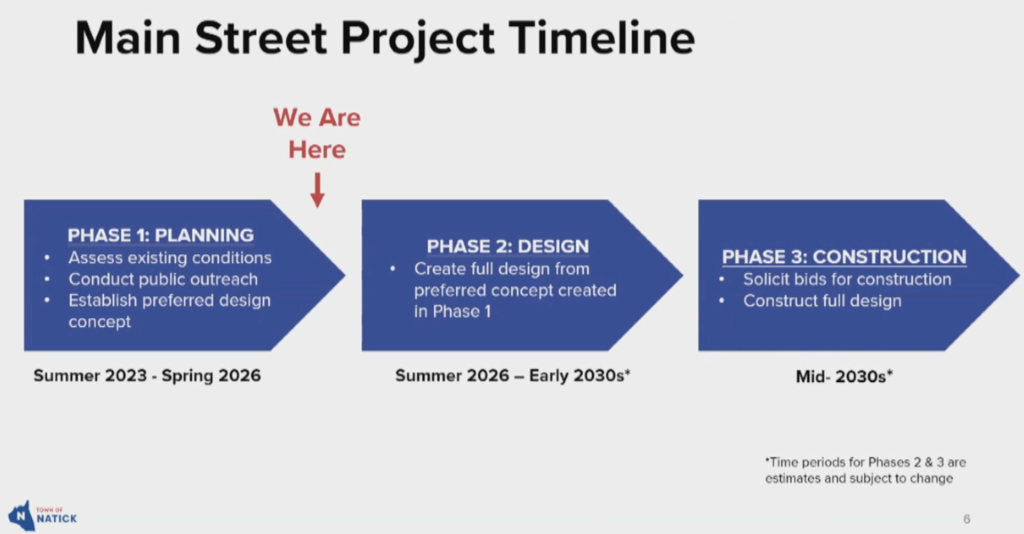
After the Select Board directed the project team in June 2025 to focus on the Hybrid concept, officials assembled a 15-member working group of town staff, committee members, residents and business owners to evaluate the proposal.
The group met five times over several months to review the concept before voting on whether to endorse it. The final vote was 8-7 in favor of a refined Hybrid plan.
“This narrow margin underlines the very real competing community priorities along this corridor, because their vote shouldn’t be taken out of context,” Griffiths said.
Several residents raised concerns about the cost, duration and scope of the project, particularly the addition of bike lanes.
Rick Devereux, a resident present at the meeting, expressed concerns that adding bike lanes would further crowd an already constrained corridor. He urged officials to consider alternatives that would widen sidewalks and preserve parking.
“These bike lanes, if they’re only five feet, are going to be crowded with vehicles that go different speeds,” Devereux said. “I just think it’s too much stuff to not look seriously at an alternative.”
Residents also took to social media with their concerns. Brian Lucenta, a member of the Natick Talks Facebook group and Town Meeting, shared an email he sent to the Select Board and the Main Street Project Working Group, encouraging other members to send their own.
“The community is not asking for bike lanes on Main Street,” Lucenta wrote. “They were asking for everything else this project is sacrificing to make room for them.”
A lack — or reduction — of parking space is also a point of concern for residents, with business owners citing the lack of free short-term parking as an issue for customers and delivery truck access, wrote Lucenta.
In a statement to Natick Report, Griffiths wrote he is “hopeful that the June 10th meeting helped ease concerns” from residents.
“Ultimately, we do not want to lock into a single path without thoroughly weighing the pros and cons of each approach,” Griffins wrote.
The working group is expected to present a report detailing its deliberations and recommendations to the Select Board on June 24. Board members and residents will have an opportunity to ask questions and provide additional feedback.
The board could vote on a preferred design as early as its July 8 meeting if members feel prepared to move forward, Board Chair Kathryn Coughlin said.

Why don’t leave it alone there is really anything downtown now when 27 is finished it is just a pass thru there are a lot of other things town can do like saving money
How many people who bicycle through Natick, actually stop and shop?
There are already too few parking spaces for shoppers, as they are taken by employees of the town. Where is all this money coming from? Another. OVERRIDE?