
Natick Fire Chief Jason Ferschke told the Select Board at its July 22 meeting that the fire department handled a record number of calls last year, and is on a pace to exceed that this year (see slides from presentation). Ferschke presented alongside Assistant Chief Christopher Hampton.
The number of fire-related calls has bounced up and down in recent years, but emergency medical services (EMS) calls have risen steadily and accounted for a much larger percentage of the 6,557 overall calls last year.
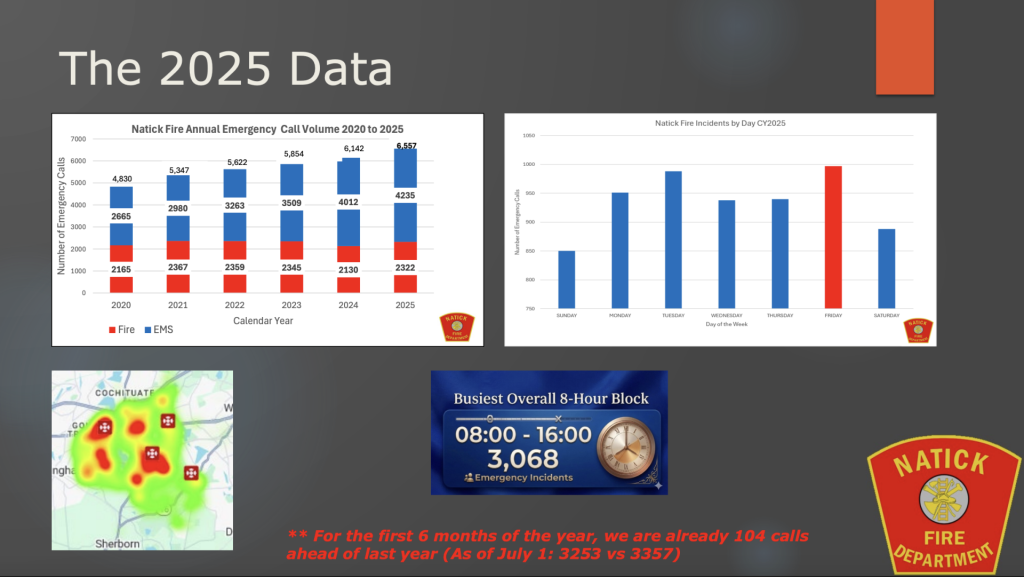
Ferschke, responding to a question from Select Board member Kristen Pope about where the increase in calls is coming from, pointed to a healthcare system under “significant strain” that’s having a trickle down effect on EMS operations. More education is needed, he said, to help people figure out when to head to the emergency room vs. an urgent care center.
Also during the annual update, Ferschke said the department is currently seven members short, following a big retirement year and in the face of general recruiting challenges for what is a dangerous and tough job. The department’s vacant slots have decreased from 14 or 15 over the past year, he said.
A newish challenge faced by firefighters are incidents involving lithium ion batteries. The department recently responded to a fire involving an energy storage system in a shed. Guidance on how to combat such fires keeps changing, Hampton said.
One way that firefighters learn beyond the classroom is by connecting with contractors about buildings that are going to be torn down to see if the department can use them for hands-on training.
“We do not train in the house until the electricity and gas (if applicable) are disconnected and any other necessary mitigation (like asbestos removal) has occurred. This usually means we usually have a very brief window—days to a week—before the structure is torn down,” Ferschke told us recently when we asked about this process. “This is a great opportunity for our personnel to conduct training with more realistic handling of hoses through a building, cutting holes in roofs, and other skills that benefit from true hands on training. Even if we had a full training facility at our disposal training like this is important as it as close to being realistic without setting the building on fire. We do not conduct live fire evolutions in these buildings. There is a significant process involved with live fire evolutions makes it too challenging to conduct them in acquired buildings.”
Highlights of late include the arrival of a new ladder truck and engine. Also, the department has started a Community Risk Reduction program that gets firefighters interacting with kids, older adults, and other groups (this program used to operate as the SAFE TEAM).
Looking ahead, the fire department is working on a strategic plan, and has launched an online survey to gather community input.
Is this news to you? Please consider supporting our work with a tax-deductible donation.

Another factor in increased calls for service is in other towns EMS is called to move or pick up fallen residents (no medical emergency) to save the facility staffing costs or liability. Other towns are now charging those facilities for this added non emergency use of fire departments
Unbelievable! So that’s an EMS or Fire call every hour and 20 minutes 24-7-365!!
Hard to believe