
Troy Smith became Natick’s first-ever director of equity, inclusion & outreach in mid-2023 following a year-plus search during which the town started, stopped and restarted its recruiting effort and changed the title from chief diversity officer to director of EIO. By the end of last year, Smith’s tenure had ended, as the American Plan Rescue Act (ARPA) grant money used to fund the position had run out and the town decided not to finance the position through other means.
Publicly, Smith’s departure was a quiet one. His name even remained on the town’s employment directory until this summer, when we started asking about whatever became of him and the position (the position does live on in the town’s job classification and pay plan). Smith continues as a professor and program coordinator at North Shore Community College, where he has worked for decades.
Reporting on the end of Smith’s position in Natick, the climate for DEI jobs regionally, and what comes next for Natick on this front proved difficult. We reached out to the town administrator, Smith, the Select Board, a School Committee member, the Finance Committee, past Equity Task Force members, a local nonprofit that had heralded Smith’s hiring, the Massachusetts Municipal Association (local government trade group) and its chief equity officer, that official’s successor as DEI director in Arlington, Mass., the Racial Equity Group (which did a DEI survey for the MMA), and a Natick Public Schools employee who worked with Smith. Of those, we heard back from the Select Board, Finance Committee, a school employee, a School Committee member, a non-profit leader, and a couple of former Equity Task Force members.
Of those who did get back, there was consensus that the work that this position was established to undertake was important to continue, though hardly anyone was willing to comment publicly. Whether it was the political climate, it being summertime, messages not getting through (mainly emails or LinkedIn), or that people truly had nothing to say on this, we can’t say.
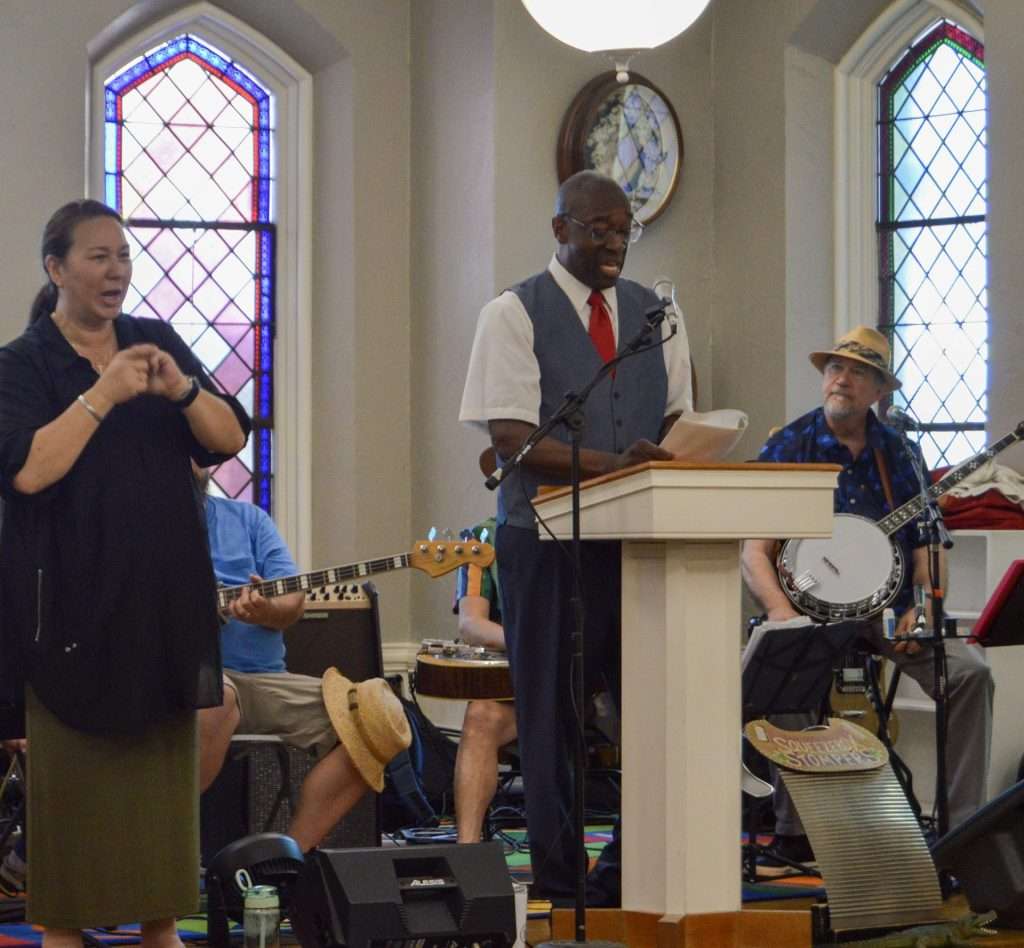 Troy Smith speaking at a Juneteenth event
Here’s what we do know: Town of Natick officials say they intend to continue the sort of work Smith was hired to do. During his stint as EIO director, Smith worked internally with HR on diversity efforts, and externally spearheaded cultural events such as a remembrance of the 60th anniversary of the March on Washington, was visible at others, such as the annual Martin Luther King, Jr. Community Celebration, and helped take Town Hall on the road to West Natick (we interviewed Smith in February, 2024 to check in on his early progress as director of EIO).
Audi Lynch, Natick’s METCO director, told us that he valued Smith’s partnership as Lynch started into his job fostering belonging, strengthening relationships, and supporting students and families across the school district.
Select Board Chair Kathryn Coughlin wrote to us that the board “made a deliberate choice not to continue budgeting for a grant-funded position in the middle of a request to the voters for a $7 million override. One of the most frequent and fair criticisms directed at both the town and the schools is that we continue funding grant-funded positions after their original grant support runs out, which increases the town’s operating budget and pension liabilities year over year. Given that we were asking taxpayers to approve a substantial override, the Board thought it would have been inconsistent and inconsiderate to simultaneously absorb a grant-funded position that had always been understood as time-limited.”
The town addressed questions about about ARPA-funded initiatives in a rolling FAQ during the lead-up to the override vote.
Coughlin said “ARPA funding was designed to support time-limited initiatives that targeted support for populations disproportionately impacted by the Pandemic. The position produced real programming and outreach during Troy’s tenure targeting and supporting these populations. What it didn’t produce was a structure that could sustain itself once grant funding ended without competing directly against core town services for General Fund dollars.”
According to the town’s annual reports, Smith was paid about $300k over his two-and-a-half years with Natick.
At a board retreat earlier this year, members discussed a commitment to embedding diversity, equity, inclusion, and outreach values into policy and human resources practices, in part by reviewing how other Massachusetts cities and towns handle this. Town administration is also looking for ways to incorporate equity and inclusion work into existing job functions in areas such as HR and Community Services.
Cody Jacobs is leading the Select Board’s research in coordination with Town Administrator Jamie Errickson. Coughlin says she has also connected Jacobs with a select board member in Sharon, which has a volunteer committee with representatives from town bodies that reports back to the select board.
“That structure, which encourages broader participation with a direct reporting line to the Select Board, and no dependency on a single grant-funded role, may be a more sustainable model for Natick to consider and, in my opinion, is consistent with the recommendations outlined by the Equity Task Force when it proposed a DEI committee,” Coughlin says.
Indeed, Natick formed an Equity Task Force in 2020, in the wake of George Floyd’s murder in Minnesota, and the group recommended that Natick establish a standing DEI committee. But the town struggled to find enough candidates for what would have been a 7-member body, so decided to hold off until a director was hired, and then revisit the idea. The Select Board asserted over the summer of 2021 that it would sponsor a Fall Town Meeting article that would pave the way for Natick to hire its first chief diversity officer. Town Meeting in fall of 2021 OK’d funding for the position, and Smith was hired. The standing committee was not established, but some version of it might have life yet.
If you believe it’s important for news like this to be covered, please consider supporting our work via a tax-deductible donation or reach out to if you’re with or know of an organization that would support us through grant funding. Thank you.

Excellent article, Bob. Thank you.
I truly appreciate your article, Bob. Thank you!