
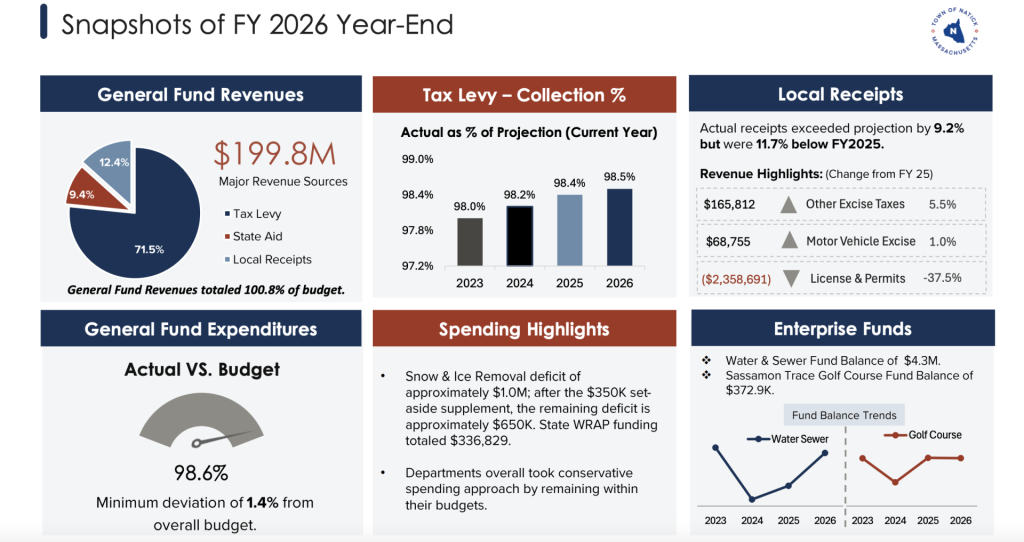
Ari Sky, deputy town administrator/finance director, at a Natick Select Board meeting earlier this month shared a wrap-up of FY26 finances and an updated outlook. The board will continue with financial discussions, including about possible amendments to the town’s financial principles and FY28 expenditure guidelines, at its Sept. 30 meeting.
For FY26, ended in June, revenue was a bit above budget and up 5% year-over-year (the town has upped its game in collecting taxes) and expenses were a little below, though took a hit due to higher than usual snow and ice removal costs in light of the stormy winter. Local receipts were down 11% vs. the previous fiscal year, in part due to the fact there was a huge construction project the year before by MathWorks from which the town reaped big building fees.
In looking at the five-year forecast (begins in FY28…we’re now in FY27), Sky pointed out the town’s current plan for covering its OPEB (other post-employment benefits) liability from all pension savings based on the town’s financial management principles, and suggested this “very aggressive approach” is worth taking a fresh look at (the pension liability is expected to be paid off in 2030). He later laid out three possible approaches to funding the town’s $100m+ OPEB liability, noting that there is no state requirement on how to handle this.
The five-year forecast also includes phasing out the use of free cash for operating costs starting in FY30, and this aligns with the state’s recommendations on using what’s referred to as “one-time money” that can’t be counted on annualy. Moving away from using free cash for operating expenses should give the town more flexibility in funding capital ones, like for fire trucks, buildings, and more (one Select Board member noted that Natick has smaller free cash numbers than in the past due to intentionally conservative budgeting).
The literal bottom line, in red, for the forecast shows a negative balance throughout, ranging from about $2.5m to $5.5m.

Select Board member Cody Jacobs asked about what the town (and schools) might be looking like operationally if their budgets were limited to 4% or 5%. Sky, speaking about the town itself, said it would require austerity and doing “less with less.” He added: “There would be less of an ability to fund great ideas.” Deputy Town Administrator Jon Marshall, in talking to various department heads, said projected revenue wouldn’t be a match for inflation and the rising cost of parts and materials, resulting in necessary cuts.
Select Board Chair Kathryn Coughlin did speak to ongoing efforts made on the town side to increase revenue, such as by reviewing building and other fees.
Sky returned to position the challenge facing Natick as a math program, with relatively predictable revenue and disproportionate growth in expenses.
Expand your reach (and support local news) by advertising on Natick Report

Leave a Reply