
After months of frequently impassioned public discussion on the possible future of Natick Center’s streets and sidewalks, the Select Board on Sept. 9 voted to recommend bringing a “hybrid” concept featuring dedicated bicycle infrastructure along Main Street to an initial design phase. This would involve accepting half a million dollars in state grant money for design work going toward a project not anticipated to hit the construction phase until the 2030s.
The board voted unanimously following a roughly 2-hour discussion that followed a recent 2-plus hour session on the topic, and numerous public forums before that. The board’s recommendation was in line with that of a working group that reviewed four options and reported back to the Select Board earlier this summer.
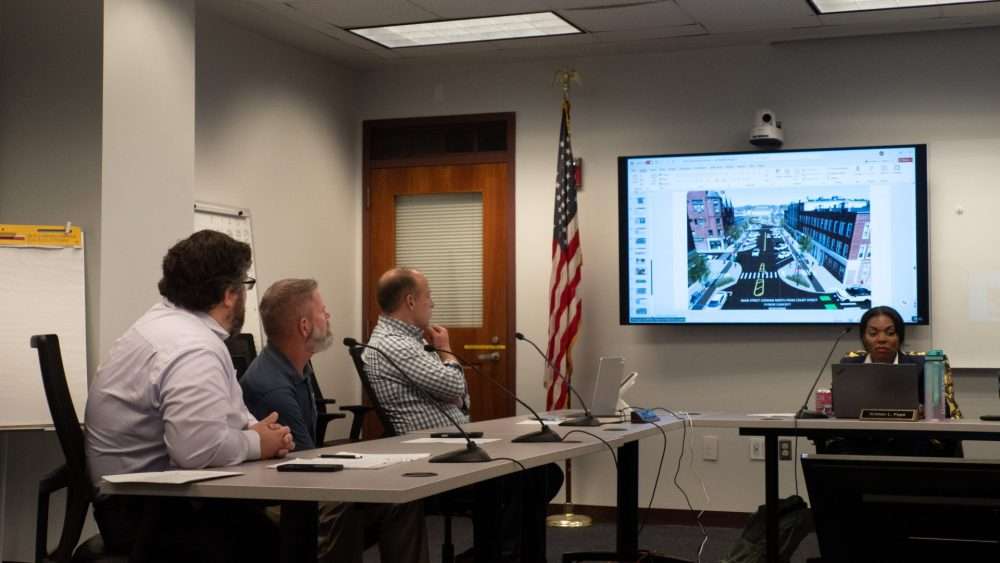 Town Engineer John Digiacomo, Highway & Sanitation Supervisor Brian Cassie, Town Administrator Jamie Errickson & Select Board member Kristen Pope (photo by Kevin Keane)
The board has bent over backwards stressing that the decision they were making was to bring one of four concepts to the 25% design phase. So some design work would be done, with consultants and town staff addressing a series of questions and concerns before a complete design and construction plan would be approved. Just because the hybrid concept at the outset describes dedicated bicycle infrastructure, doesn’t mean that the town couldn’t eventually go with a plan without such infrastructure after weighing results of the initial design work.
“This decision tonight is going to give direction to town administration, engineeering, and public safety as to what we want to see,” said Kathryn Coughlin, the board chair.
The $2m needed to just mill and repave the downtown stretch would come from town coffers. The more elaborate concepts, including the hybrid one and others with more or less bike infrastructure, are estimated to have $11m construction costs that would be covered via grants. One catch to certain funding involves having bike lanes, but there may be ways around that in light of rights of way/easement issues downtown that could dictate bike lanes that avoid Main Street.
You can help support Natick’s only dedicated daily news source with a tax-deductible donation of way less than $11 million.
Before voting on Wednesday, the board sought additional input from public safety departments in town that had expressed concerns about the hybrid concept. Reps from the police, public works and engineering had all voted against recommending the hybrid concept during the working group process.
Deputy police chief Brian Lauzon said his earlier “no” vote wasn’t for or against bike lanes, but rather the concept’s shortcomings in addressing overall pedestrian and vehicle (including bike) safety. Strategically placed blinking beacons and/or bump-outs that make it easier for drivers and cyclists to see pedestrians are key considerations for the police, Lauzon said. The deputy chief also cited a lack of planning for how delivery vehicles would navigate a redesigned Natick Center and consideration of police resources that would be needed to patrol potential increased use of e-bikes if new bike lanes are introduced. Emergency vehicle maneuvering in a redesigned downtown and the streets around it also warrants more thinking, the deputy chief said.
Another concern raised by Lauzon is what the expected traffic flow will be downtown under a redesign. He said speed isn’t the issue downtown, but that aggressive driving is seen on side streets as operators scheme to avoid getting stuck in the mess in the middle. One goal of the project has been to get ahead of what’s anticipated to be worsening traffic downtown. Of course the challenge with traffic analyses is that they are, as Town Administrator Jamie Errickson noted, part art and part science (and from what we’ve seen from various project development teams, part wishful thinking…).
Concerns were raised by the DPW’s Brian Caissie about squeezing the space in Natick Center and where the buffers would be for piling snow during and after storms if bike lanes are added. Separately, Town Engineer John Digiacomo talked about whether bike lanes would really be part of the optimal use of limited real estate downtown. Paying for town or third-party resources to manage snow removal in a redesigned downtown would also be something for Natick to figure out.
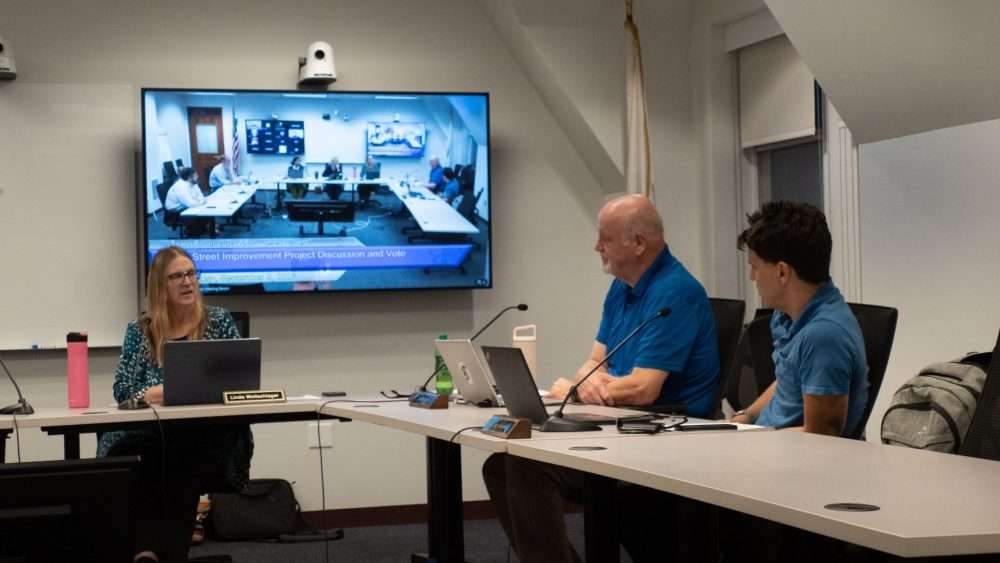 Select Board members Linda Wollschlager, Bruce Evans and Cody Jacobs (photo by Kevin Keane)
In deliberating, Select Board member Cody Jacobs favored the hybrid design, calling it a compromise approach, including the preservation of more parking spaces than the enhanced bike concept that has business owners upset about the likely loss of more than a dozen spaces. “The vast majority of the things proposed in the hybrid concept are things a lot of people want, are things that everybody wants…,” he said, adding that he sees getting big grant dollars for massive downtown improvements to be a big opportunity for Natick.
As members Kristen Pope and Bruce Evans said, after Coughlin asked about what the downsides of going forward with a 25% design might be, just getting going on concept will give the town options and the opportunity to address questions more specifically. Member Linda Wollschlager acknowledged the challenges of choosing a concept, and her issues with bike lanes, especially in light of rising e-bike use (state rules for e-bikes are on the way). Having said that, she said the board owes it to the town to explore some of the possible improvements, including updated traffic signals. Evans, on the bike lanes, expressed his concern about “unintended consequences” of introducing them on such a busy strip.
In the end, Coughlin said that what the town ends up with, regardless of which direction Natick goes, is a plan “that we’re not paying for that will lay out what we could be doing to improve downtown for businesses and residents…”
Please send news tips, photos, ideas to natickreport@gmail.com

I have noticed many of the retail businesses on the west side of Main Street are not handicap accessible. As part of such improvements, external ramps are often used in historic downtowns (see Clark’s block entry on Summer Street) but if employed will reduce sidewalk widths considerably.
HC access should be addressed in further studies…
Seems like other projects that not cost taxpayer’s any money then they look for extra money
Is a plan that we are not paying for…
Stop it, your killing me with laughter
This redesign is going to add more money to our plowing budget and we will likely lose parking spaces!
Downtown has a nice grid network of streets. It would be fairly easy to direct bikes off Main in the center of town to parallel side streets (really just one street over). Why disrupt small business parking and create more congestion that will just redirect to side streets when there are simple alternatives.