• Sign up for free email newsletter
  • Advertise
  • Events calendar
  • Donate to support our work
  • About us (contact us)
 

Natick Report

Since 2020: More than you really want to know about Natick, Mass.

  • Restaurants, sponsored by Tama Sushi & Hibachi
  • Camps, sponsored by NEOC
  • Private Schools—sponsored by Fay School
  • Public schools, sponsored by Sexton
  • Preschools, sponsored by Longfellow, Wellesley
  • Letters to the editor
  • Guidelines for letters
  • Sports schedule & results
  • Embracing diversity
  • Charities/Community
  • Arts
  • Kids
  • Business
  • Environment
  • Top 10 things to do
  • History
  • Seniors
  • Deaths
  • Government meetings
  • Natick Center Cultural District—restaurants, shops, services

Top Stories

 
  • —Natick Outdoor Store sold to longtime employee
  •   —Private education opportunities at open house events near Natick
  • —Halloween happenings


Advertisements


Revolutionary War Traveling Memorial comes to Morse Institute Library; Research roundtable set for June 10

June 5, 2026 by Jennifer Richards

Revolutionary War Traveling Memorial

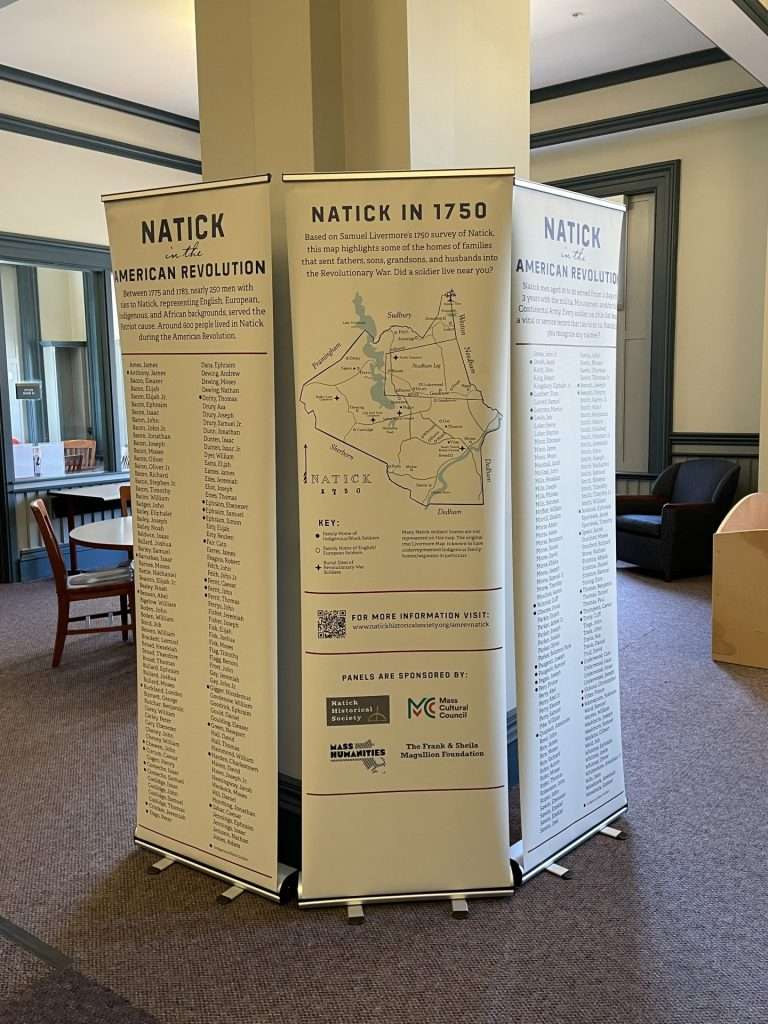
The Natick Historical Society’s new Revolutionary War Traveling Memorial is now on display in the Morse Room at the Morse Institute Library, just in time for the 250th anniversary of the signing of the Declaration of Independence.

The Traveling Memorial honors 249 men with ties to Natick who fought in the American Revolutionary War. It consists of three retractable banners that feature an honor roll with all 249 names and an adapted historical map that shows the family homes and burial sites of some of those soldiers. A QR code on the display will link visitors to a soon-to-be-available online resource featuring additional information and short biographies of 30 + soldiers.

This project anchors a larger initiative, Natick in the American Revolution, which is funded by Mass Humanities, Mass Cultural Council, and the Frank and Sheila Magullion Foundation. The goal of the initiative is to revisit and update a list of Natick’s Revolutionary War soldiers first compiled in 1913 by a local chapter of the Daughters of the American Revolution. After four months of delving into the archives, the Research Team has generated an updated honor roll and a wealth of additional sources and information about Natick soldiers. Their work will enable the Natick Historical Society to create not only the Traveling Memorial and companion website, but also primary source curricular materials for Natick High School.

One of the most complex and challenging questions facing the Research Team has been: what does it mean to be from Natick? Town boundaries shifted frequently in the latter half of the 1700s, and many people moved regularly or mustered from other towns. The Research Team also paid close attention to records that identified soldiers of Indigenous and/or African backgrounds. At least 44, or 18% of Natick’s soldiers, were men who were recorded as having Indigenous and/or African backgrounds. Natick’s Revolutionary War soldiers were, in fact, a far more diverse group than many may realize.

All are invited to meet the Research Team and learn more about Natick’s Revolutionary War soldiers–and the research that went into uncovering their stories at the Revolutionary War Research Roundtable on Wednesday, June 10th at 7 pm in Lebowitz Hall, Morse Institute Library. The Research Team includes Pamela Ellis, Mia Kheyfetz, Sean Osborne, and Fran Weisse. They’ll share stories from the project and discuss the tips, challenges, and surprises they found on their research journey. History Professor Brenna Greer will moderate the conversation.

The Traveling Memorial will occupy many public spaces in Natick over the coming year. Today, you can find it at the Morse Institute Library. Check the Natick Historical Society’s social media to follow it to its next location.

By Jennifer Richards, Archivist, Natick Historical Society
Filed Under: History

Advertisement


A Revolutionary War treasure conserved: Captain James Mann’s Natick Muster Roll

April 23, 2026 by Jennifer Richards

muster roll
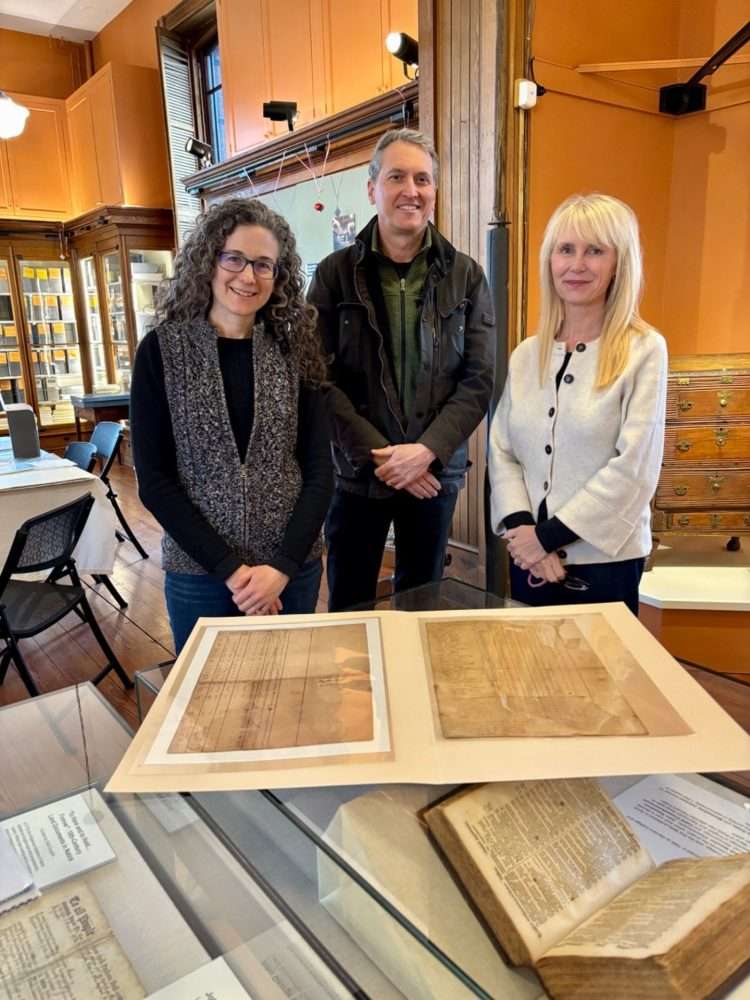
Natick Historical Society’s Niki Lefebvre and Jennifer Richards (left and right) with Jonathan Goodrich of the Northeast Document Conservation Center, with the conserved Natick muster roll.
 

With support from the town’s Community Preservation Act (CPA) funds, one of Natick’s most remarkable Revolutionary War documents now has a new lease on life. After months of planning and careful treatment, the Natick Historical Society’s 1775 muster roll of Captain James Mann’s company has been conserved by the Northeast Document Conservation Center, or NEDCC. Top-notch conservators stabilized the fragile original and produced a high-resolution digital image and a full-scale facsimile, making it possible to share the document more widely while better protecting the original.

The project began moving through the Town of Natick’s CPA process in 2025. In June, the Historical Society submitted a letter of intent stating that the muster roll is a rare and locally significant Revolutionary War artifact in urgent need of conservation. The proposal moved forward under the Historic Preservation category, with the goal of digitizing, conserving, and preserving the document through NEDCC. By September, the Society was before the Community Preservation Committee seeking support for the full scope of the work, including conservation, imaging, and a facsimile for display. The final cost of the project came to $5,105, covering conservation treatment, digital imaging, return courier service, and insurance.

The roll itself is extraordinary. Dated June 17, 1775—the day of the Battle of Bunker Hill—it records the service of Captain James Mann’s company of Natick men who marched on the alarm. The document names 42 soldiers and notes their ranks, towns, miles traveled, and pay. Most were privates who earned five shillings, while Captain James Mann earned eleven. The company traveled about thirty miles on foot over two days. Many of the names on the roll—Morse, Bacon, Sawin, Broad, Loker, and Fisk—are still familiar in Natick today.

What makes the roll especially important is that it is the only surviving record of the presence of forty-two Natick men at Bunker Hill. When Massachusetts compiled its major published Revolutionary War service records in the late 19th century, this document was still in private hands, so these men were left out of the official state record. The roll also includes a sworn statement dated December 30, 1775, when Captain James Mann affirmed its accuracy before Justice of the Peace I. Holton.

The  survival of the muster roll is a story in itself. In 1900, after the death of Mary D. Mann of Boston, Colonel William Nutt found the original roll among her effects and presented it to the South Natick Historical Society at a Field Day Meeting on May 30, 1900. Ida H. Morse, Captain James Mann’s great-great-granddaughter and the Society’s curator at the time, was there for the donation and later recorded the story of the roll.

By the time the roll reached NEDCC, over 125 years later, it was in rough shape. It had been folded in half and in thirds, and a center fold had split it into two pieces. The lower half was made up of two overlapping papers. There were tears, small losses, moderate soiling, heavy darkening, and a pronounced tideline stain. Tests also confirmed the presence of unstable iron gall ink. Conservators documented the roll, cleaned and washed it, stabilized the ink with calcium phytate and calcium bicarbonate, repaired tears with toned Japanese paper and wheat starch paste, flattened it, and rehoused it in a protective polyester sleeve and archival folder. It was then digitized at 600 ppi, and a 1:1 facsimile was created for display and research.

muster roll
Before-and-after views of the 1775 muster roll conserved by NEDCC
 

This project is also part of a larger Revolutionary War initiative at the Natick Historical Society. In January, the Society received a $12,250 Mass Humanities grant for Natick in the American Revolution, which will research nearly 250 soldiers with ties to Natick through a traveling memorial, an online exhibit, and student resources. Captain James Mann’s conserved muster roll will be one of the project’s centerpiece documents.

As Natick reflects on the 250th anniversary of the American Revolution, Captain James Mann’s muster roll restores a missing piece of local history. Members of the public who wish to see the document can do so on the first night of Natick Town Meeting, April 28, 2026.

On one sheet of paper are the names of forty-two Natick men who answered the call on June 17, 1775. The conserved muster roll will be presented at Town Meeting on April 28. Thanks to this conservation project, the service of those men — and the document that proves it — will endure.

Jennifer Richards is the archivist at Natick Historical Society.  


More Natick history: St. Patrick’s Church Rose Over a Decade

Filed Under: History

Advertisements


Natick history: St. Patrick’s Church Rose Over a Decade

April 2, 2026 by Jennifer Richards

Research by Cindy Tripp, Written by Jennifer Richards
 

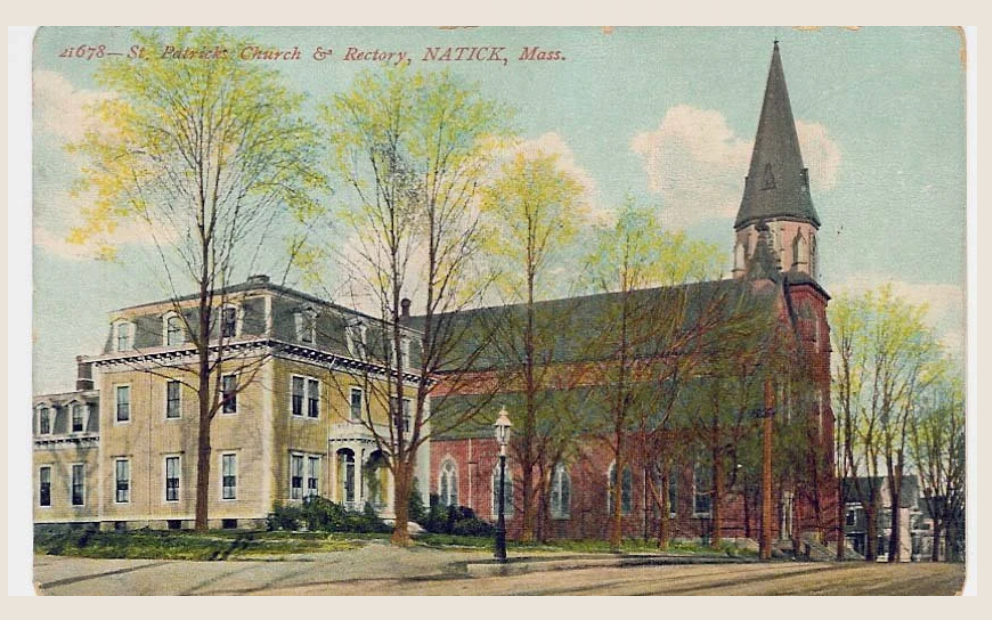
The story of St. Patrick’s Church is one of vision, sacrifice, and persistence — a project that unfolded over more than a decade and reflected the strength of Natick’s growing Catholic community.

While the Natick Historical Society does not hold original design drawings or construction plans for the present church, local records, newspaper accounts, and archival materials help tell the story of how one of Natick’s most recognizable landmarks came to be.

St. Patrick’s Parish was founded in 1856 by Father John Walsh. That same year, he purchased a church building from the Universalist Society on the site of what is now Natick Town Hall. That earlier structure served Natick’s Catholic residents until the parish was ready to build a larger and more permanent church.

St. Patrick’s Church and Rectory, Natick, Mass., hand-colored postcard. NHS Collections.


A major turning point came after Father Walsh’s death in 1890, when Father Delaney became the parish’s second pastor. At just thirty-nine, he immediately began work toward the construction of the present St. Patrick’s Church.

A local newspaper reported in 1890 that James Murphy, “the celebrated ecclesiastical architect,” had been seen measuring the site east of the Catholic rectory and called it the most favorable location in town for a “grand church edifice.”

Murphy, of Providence, R.I., was one of New England’s leading church architects. Born in County Tipperary, Ireland, in 1834, he came to the United States as a young man and trained under Patrick Keely before establishing his own successful career.

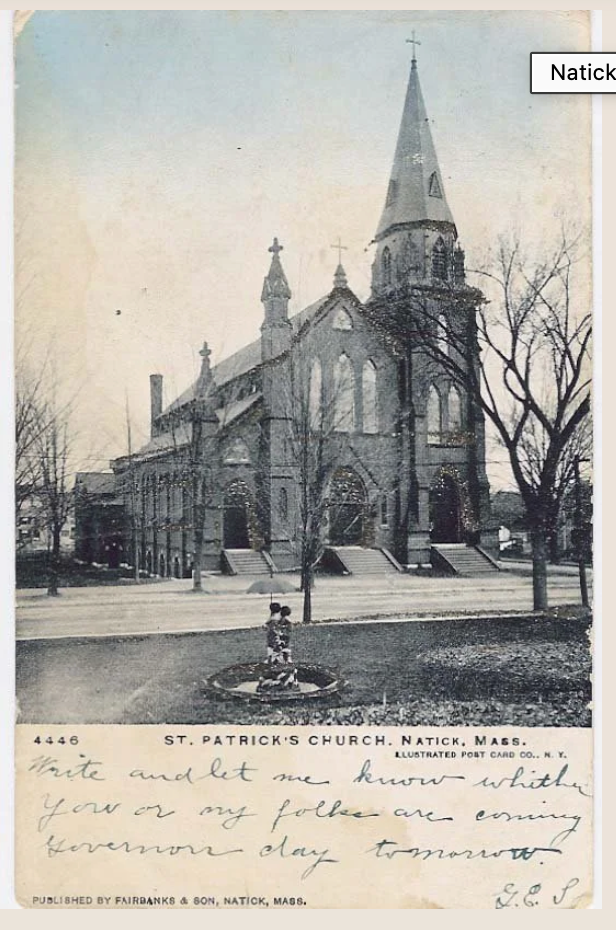
Plans for St. Patrick’s were ambitious. An 1892 newspaper article described the building as Gothic in style, built of brick with Longmeadow stone and granite trim. It was planned at 152 feet long and 71.6 feet wide, with a tower and spire rising 172 feet. Its stained-glass windows were created by the Mayer Company of New York and Munich, Germany.

church natick
St. Patrick’s Church, Natick, postcard published by Fairbanks & Son of Natick. NHS Collections.


The cornerstone was laid on May 29, 1892. Made of polished Quincy granite and donated by John Whalen, it contained a copper box filled with parish artifacts, newspapers, coins, a donor roster, and a commemorative plate.

The project was funded through donations, and one of the most notable early supporters was Natick resident John Everett, whose $50 contribution was the largest recorded gift at the time. An Irish immigrant and one of the founders of St. Patrick’s Parish, Everett was presented with a solid silver trowel used during the cornerstone ceremony.

Construction proceeded in stages as funds became available. When financing ran short in 1893, the lower church was roofed over so Mass could still be celebrated there. The first Mass was held on June 18, 1893.

The upper church was finally completed and opened on October 12, 1902. Originally expected to cost $60,000, the final total reached $200,000.

  • Read the full story on the Natick Historical Society website.
  • Have a research question for us?

Filed Under: History, Religion

Advertisement


Marion Louise Pooke: A Natick Daughter in War-Time Paris

March 16, 2026 by Jennifer Richards

In November 1919, just months after returning from France, Natick’s Marion Louise Pooke addressed the Natick Woman’s Club with a talk titled With the A.E.F. in France. Drawing on her experiences overseas at the end of World War I, Marion offered her audience a vivid account of hardship, service, and the fragile hope that followed the war’s end. More than a century later, her words still bring that moment to life.

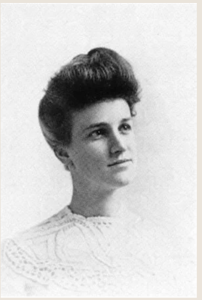
Marion Louise Pooke, Smith College yearbook portrait. Natick Historical Society Collections.

Marion Louise Pooke (1883–1975) was the youngest daughter of Charles Augustus Pooke and Georgette Custer Pooke of 26 Winnemay Street in Natick. The family was deeply rooted in the community, and Marion’s story is also closely connected to one of Natick’s most important educational institutions: Walnut Hill School. Marion and her sisters, Helen and Florence, attended Walnut Hill before going on to Smith College. For Marion, Walnut Hill formed part of the foundation of a life shaped by art, study, and wider horizons. She later continued her training at the Massachusetts Normal Art School and the School of the Museum of Fine Arts, Boston, and built a serious career as an artist.

But Marion’s life extended far beyond the studio. In the aftermath of World War I, she went to France, where she joined relief efforts connected with the American Expeditionary Forces. Her 1919 lecture reveals a woman who was observant, intelligent, and deeply affected by what she saw. Rather than offering only a patriotic summary, Marion described the war and its aftermath through lived experience: ruined landscapes, exhausted civilians, and the emotional strain of service. Her account adds an important local voice to the larger history of American women overseas during the war.

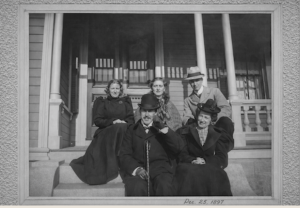
Pooke Family Group Portrait at 26 Winnemay Street, Christmas Day, 1897

The Natick Historical Society preserves a rich collection of Pooke family materials, including glass slides, decades of family correspondence, diaries, lectures, photographs, and travel negatives. Together, these materials document not only Marion’s wartime experience but also the broader story of a remarkable Natick family whose lives connected local history to international art, education, and travel. They reveal Marion as both an artist and a witness, while also preserving the voices and relationships that shaped the family across generations and continents.

Marion’s connection to Walnut Hill School makes her story especially meaningful in Natick. She was part of a generation of young women whose education prepared them to move confidently into artistic, intellectual, and public life. To share this extraordinary story more fully, the Natick Historical Society has published a new online feature on Marion Louise Pooke. The webpage includes photographs, family history, artwork, and selections from her manuscript With the A.E.F. in France, offering a fuller portrait of her life in Natick and abroad.

Readers can explore the full story at the Natick Historical Society website.

At the Natick Historical Society, stories such as Marion Pooke’s remind us that local history is never only local. Sometimes, from a house on Winnemany Street and classrooms at Walnut Hill, it reaches all the way to wartime France.


More Natick history articles


Please support local news with a tax-deductible donation to Natick Report

Filed Under: History

Advertisements

Love in Wartime: Letters of Albert Smith & Emma Cummings preserved at Natick Historical Society

February 12, 2026 by Jennifer Richards

The Civil War letters of Albert Smith to his fiancée, Emma Cummings, provide a firsthand record of how romantic love was sustained during wartime. Preserved in the Shirley Brown Collection (2018.25), the correspondence documents Smith’s service with the 8th Massachusetts Light Artillery in 1862 and his ongoing relationship with Emma Cummings during that period.

Smith wrote to Emma frequently from camps in New Jersey, Virginia, and Maryland. His letters make clear that her correspondence played a central role in his ability to endure military life. Writing from Fairfax Seminary in July 1862, he explained:

“I never wrote letters with so much pleasure, as I have, to you, since I have been away. Now, I know, that what I write is appreciated. I hope I shall continue to receive such sweet, loving letters as I have, so far. They are the best medicine a soldier can take. They go to the right spot.”

Smith’s letters are often sentimental and emphasize the reassurance he drew from Emma’s correspondence during periods of danger, fatigue, and constant movement.

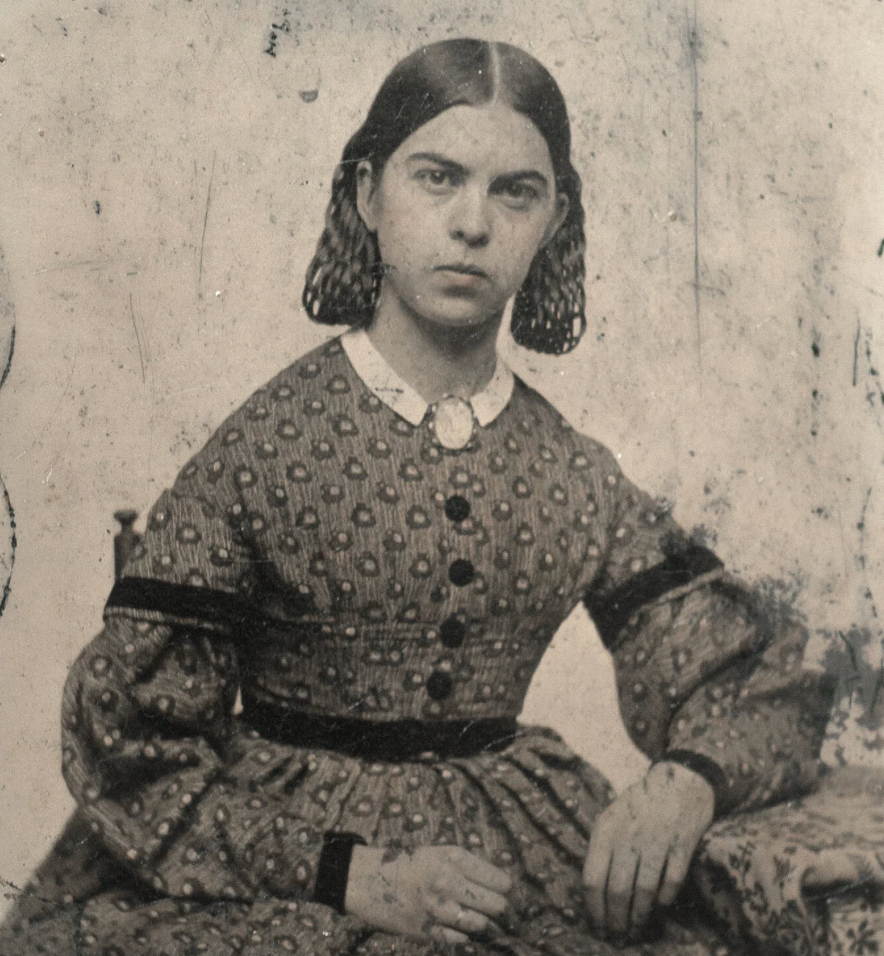
Smith kept Emma’s letters and her small tintype in the pocket of his jacket, rereading them during quiet moments and while standing night guard. After surviving a serious railroad accident in June 1862, in which he was thrown from a train into a canal, Smith wrote that his greatest distress came from believing these items had been lost:

“The jacket I care nothing about… but in the pocket were your letters and miniature. I would give the jacket away for the sake of them.”

When he later recovered them, his relief was immediate. Writing from Washington only days later, he told Emma:

“I had the good fortune to find my jacket, this morning, with your letters and picture. The letters were wet, but the miniature is just as good as ever, and looks ten times as pretty… You can’t think how I missed it.”

(Emma Cummings, tintype portrait, c. 1860s. Referenced in Albert Smith’s 
Civil War letters. Shirley Brown Collection (2018.25.)
(Emma Cummings, tintype portrait, c. 1860s. Referenced in Albert Smith’s Civil War letters.
Shirley Brown Collection (2018.25.)


Throughout the correspondence, Smith repeatedly connected the hardships of military service to his attachment to Emma. Writing from Virginia in August 1862, he described nights spent on guard duty and the isolation of army life:

“Whenever I turn in before I go to sleep, I begin to think of home, and darling Emma. You are ever in my thoughts. I pity any young man in the service, who has not a sweetheart to correspond with. It is a great blessing. I could not feel content without it.”

Albert and Emma married in 1863 and settled in Natick, continuing the affection evident in their letters. Albert worked as a shoemaker and carpenter and built the family home at 9 Waban St. As their family grew, he later helped build a house for their son at 10 Pitts St., an adjacent lot, allowing family members to live in close proximity. Albert and Emma raised ten children and remained in Natick.

Readers can explore selected letters, photographs, and additional context from the Shirley Brown Collection on the Natick Historical Society’s website.


More Natick history articles


Filed Under: History, Holidays

Tip us off!

Please send news tips, photos, ideas to natickreport@gmail.com

Please support your local news source with a tax-deductible donation by scanning the QR code or by clicking on it.

natick report QR code

Advertisements

Categories

  • Animals
  • Art
  • Bacon Free Library
  • Beyond Natick
  • Books
  • Boston Marathon
  • Business
  • Camps
  • Careers
  • Charity/Fundraising
  • Community
  • Construction
  • COVID-19
  • Education
  • Election
  • Embracing diversity
  • Employment/careers
  • Entertainment
  • Environment
  • Fashion
  • Fire
  • Food
  • Gardens
  • Government
  • Health
  • History
  • Holidays
  • Housing
  • Humor
  • Kids
  • Legal
  • Letters to the editor
  • Media
  • Military
  • Morse Institute Library
  • Music
  • Natick Election 2022
  • Natick Historical Society
  • Natick History Museum
  • Natick Mall
  • Natick Nest
  • Natick track
  • Neighbors
  • Obituaries & remembrances
  • Older adults
  • Opinion
  • Outdoors
  • Override
  • Parents
  • Police & crime
  • Real estate
  • Recycling Center
  • Religion
  • Residential property sales
  • Restaurants
  • Schools
  • Shopping
  • South Natick Dam
  • Sports
  • Technology
  • Theater
  • Town election 2021
  • Town Election 2023
  • Town election 2024
  • Town election 2025
  • Town Election 2026
  • Town government meetings
  • Town Meeting
  • Transportation
  • Travel
  • Uncategorized
  • Vacation
  • Veterans
  • Volunteering
  • Voting
  • Weather
lion publishers
  • Bluesky
  • Facebook
  • Instagram
  • Twitter

Sign up now for free email newsletter & stay in the Natick loop

* indicates required
Our newsletter is free, though we gladly accept contributions to support our work.

Most Read Posts

  • Natick Halloween happenings, 2026 edition
  • Pre-Patriots game flyover zooms above Natick, birds freak out
  • Indigenous Peoples Day 2026 Natick—what’s open and closed, nearby events
  • Business buzz: Natick Outdoor Store sold to longtime employee; Former car dealeship site on market; Donation supports Autism Welcoming Center
  • First post-spillway kayak trip on Charles River in South Natick a rough ride

Click image to read The Swellesley Report

The Swellesley Report

Upcoming Events

Oct 13
5:00 pm - 6:00 pm

Know your neighbor (community cider social)

Oct 13
6:30 pm - 7:30 pm

Natick Fall Annual Town Meeting orientation (online)

Oct 15
10:30 am - 2:30 pm

Natick community flu clinic

Oct 16
8:00 am - 1:00 pm

Rotary Club of Natick’s Brett Conaway Cup Charity Golf Tournament

Oct 17
10:00 am - 11:15 am

Explore Wellesley Town Forest on Oct. 17

View Calendar

Privacy policy

© 2026 Natick Report
Site by Tech-Tamer · Login