• Sign up for free email newsletter
  • Advertise
  • Events calendar
  • Donate to support our work
  • About us (contact us)
 

Natick Report

Since 2020: More than you really want to know about Natick, Mass.

  • Restaurants, sponsored by Tama Sushi & Hibachi
  • Camps, sponsored by NEOC
  • Private Schools—sponsored by Fay School
  • Public schools, sponsored by Sexton
  • Preschools, sponsored by Longfellow, Wellesley
  • Letters to the editor
  • Guidelines for letters
  • Sports schedule & results
  • Embracing diversity
  • Charities/Community
  • Arts
  • Kids
  • Business
  • Environment
  • Top 10 things to do
  • History
  • Seniors
  • Deaths
  • Government meetings
  • Natick Center Cultural District—restaurants, shops, services

Top Stories

 
  • —Park improvement funding now up to Town Meeting
  •   —Scenes from OldTown Fall Fair
  • —Town government meetings for week of Oct. 5


Advertisements


Meet the 2026 Natick Select Board candidates

March 11, 2026 by Admin

Natick depends on the active participation of its citizens in governance of the Town. Natick voters on Tuesday, March 31, 2026, will cast their ballots for candidates, including those running for Select Board.

There are two candidates running for two open three-year terms on the Select Board, which serves as the chief executive board of the Town. The five-member board is vested with all the municipal authority not specifically retained by the Town’s legislative body, Town Meeting.

The Select Board candidates, in ballot order, are:

  • Kristen Pope
  • Cody Jacobs

Natick Report invited the candidates to inform voters about their priorities for the Town of Natick. We thank both candidates for participating.


Kristen Pope

 
Natick Report: Please introduce yourself to Natick Report’s readers and share a bit about why you are running for Select Board.

Kristen Pope
Kristen Pope

Hello Natick Neighbors — I’m Kristen Pope. Serving on the Natick Select Board for the past three years has been one of the greatest honors of my life. Together, we’ve expanded representation in town government, brought new voices to the table, strengthened fiscal stability, supported economic development, advanced thoughtful policy, and kept civic engagement at the center of our work. I believe that together, there is more we can accomplish to keep Natick strong and united—and that’s why I’m running for a second term.

Serving Natick is personal. Nearly nine years ago, my family chose this town because of its welcoming spirit—from Peace Flags to Natick Days to a deep culture of service. After serving on the Personnel Board for three years, I stepped forward to bring collaborative leadership and broader representation to the Select Board. In addition to my Select Board service, I’m a leader at Harvard University, an entrepreneur, a mom, a wife, and Board Chair of United Way Tri-County. These roles—combined with my experience on the Select Board—have strengthened my ability to think strategically, steward public resources responsibly, and stay grounded in what matters most: people.

Like many of you, I understand the challenges we face—affordability, housing, financial stability, infrastructure, and long-term planning. These issues require thoughtful leadership and unity. I remain committed to fiscal responsibility, accessibility in town government, and preserving the spirit that makes Natick special. On March 31, I ask that you cast one of your two votes for Select Board for Kristen Pope.

Natick Report: Natick is partnering with Framingham on a regional dispatch center to achieve operational and cost efficiencies. What other opportunities, if any, do you see for Natick to partner with nearby communities?

Kristen Pope: Beyond Natick’s partnership with Framingham, we already currently participate in a number of successful shared-service arrangements. Natick provides Veterans Services to Dover; we engage in regional public health initiatives, we participate in mutual aid agreements for public safety, and collaborate on sustainability efforts and infrastructure projects such as the sewer connection with Sherborn.

Looking ahead, there may be additional opportunities worth exploring. One area that’s often discussed across the state is regionalization of assessor services. As the pipeline of certified assessors continues to shrink due to retirements and private-sector competition, municipalities are facing increasing cost pressures and recruitment challenges. A shared professional assessor model—where each town maintains its own Board of Assessors for policy oversight while sharing professional staff—has been implemented successfully in parts of the Commonwealth.

With that in mind, any new regional arrangement needs thoughtful analysis. Here are some factors to consider: compatibility with potential partner communities, cost allocation, governance structure, and service quality impacts. Most regional agreements require Town Meeting approval, and some may require legislative action. We should remain open to studying opportunities where they could enhance both efficiency and service delivery.

Natick Report: Traffic analyses for individual housing and other projects typically conclude that impacts will be minimal. The lived experiences of neighbors often suggest otherwise, as they point to cumulative traffic increases from multiple projects in Natick and nearby communities. How should the Select Board and town account for cumulative traffic impacts when evaluating growth across town?

Kristen Pope: Project-specific traffic studies are conducted as part of the Planning Board and Zoning Board of Appeals review processes, and the Select Board does not oversee those analyses. However, the Select Board does serve as Roadway Commissioners and has a broader responsibility to consider long-term infrastructure needs across the community.

Over the duration of my first term, I’ve learned that traffic in Natick is not solely driven by individual developments. A significant portion is regional through-traffic, influenced by state highways, commuter patterns, and development in surrounding communities.

In my observation, the appropriate approach is twofold. First, it’s important that we continue to ensure that local boards are asking thoughtful questions about traffic mitigation and cumulative impacts during project review. Second, at the Select Board level, a part of our focus needs to be on long-term corridor planning and infrastructure investment. The Main Street Corridor work is one example of this broader view—planning for how we want our downtown to function decades from now.

We also need to advocate for regional and state investments in multimodal transportation—rail, bus, bicycle, pedestrian, and roadway improvements. Strengthening non-automobile transportation options will be helpful to address congestion in a sustainable way. One of the things I love most about Natick is how we plan for generations ahead, and mobility is one of those ways.

Natick Report: What new steps would you like to see the Select Board take to help boost economic development in Natick?

Kristen Pope: As it relates to economic development the Select Board’s most direct influence on economic development is through policy, zoning support, and the overall regulatory environment we help shape. In recent years, the Board undertook a comprehensive rewrite of Natick’s alcohol licensing policies, working closely with members of the business community. The Board has also supported zoning amendments adopted by Town Meeting that encourage greater investment in Natick Center, West Natick, and the Golden Triangle.

The Select Board appoints an Economic Development Committee and supports professional staff within the Community and Economic Development Department who focus on business retention and attraction. We also review policies related to parking, traffic, and infrastructure that affect the business climate.

Looking forward, I would support a review of peer communities that have experienced notable commercial revitalization—like Hudson or Marlborough— to better understand which strategies may be applicable to Natick. This could include examining zoning reforms, permitting practices, corridor investments, and licensing frameworks. The goal would not be to replicate another community, but to identify best practices that align with Natick’s character and long-term vision.

Natick Report: Town Meeting currently votes on an Omnibus budget via one or several motions. What do you think of the concept of breaking out some of the larger departmental budgets into their own articles or motions to give Town Meeting an opportunity to perhaps dive deeper into spending and revenue? (Wellesley this spring, for example, is splitting its town and school budgets at Annual Town Meeting.)

Kristen Pope: After some research, I learned that Natick Town Meeting voted on multiple separate budget motions by department pre-pandemic. Following recommendations from the Town Meeting Practices and Rules Committee—created around 2017–2018 to evaluate how Town Meeting could operate more efficiently—the Town transitioned to a consolidated omnibus budget motion beginning in 2021. That process was undertaken by Town Administration in coordination with the Finance Committee and legal counsel.

Under the current structure, Town Meeting votes on a consolidated operating budget motion, with separate articles for capital and library funding. Also, Town Meeting Members retain the ability to move to divide the question if they wish to separate out specific departments for deeper discussion.

I see both sides of this issue. A consolidated motion improves efficiency and reflects the detailed vetting already conducted by the Finance Committee. At the same time, some communities—such as Wellesley—choose to separate major components like town and school budgets to allow for more focused debate.

If Town Meeting expressed interest in revisiting either the previous or Wellesley structure, it would be best to do so through a deliberate process that considers efficiency, transparency, and governance norms. In my view, the format should serve the needs of Town Meeting while maintaining clarity and fiscal discipline.

Natick Report: How should voters reach you if they want more information?

Kristen Pope: krislpope@gmail.com


Cody Jacobs

 
Natick Report: Please introduce yourself to Natick Report’s readers and share a bit about why you are running for Select Board.

Cody Jacobs, Select Board candidate
Cody Jacobs

Cody Jacobs: I live in West Natick with my wife and two kids (one at Brown, one at Kennedy). I’m an experienced town government volunteer, most recently serving as Secretary of the Finance Committee. I’m running because I love this town. Like others before us, my family chose Natick to raise our kids because it’s a place with wonderful neighborhoods, great schools, a vibrant local business community, and beautiful open spaces. I know these things didn’t happen by accident—Natick has a tradition of people stepping up to volunteer their time to serve and make our community better for the next generation. I’m excited for the opportunity to do my part in that tradition.

My priorities include: 1) real affordable housing options, 2) a thoughtful approach to the future of the Johnson School and Cole Center properties grounded in a long-term vision for our community, 3) a flexible approach to governance that helps innovative businesses thrive, and 4) advancing equity and inclusion.

I also want to hear from voters about their hopes and concerns, and if I’m elected, I will always be willing to listen to you. I look forward to working with—and learning from—other members of the Select Board and getting things done for Natick.

Natick Report: Natick is partnering with Framingham on a regional dispatch center to achieve operational and cost efficiencies. What other opportunities, if any, do you see for Natick to partner with nearby communities?

Cody Jacobs: I’d like to see us continue to collaborate with neighboring communities on economic development opportunities. I’m excited about the continuing reinvention of the Golden Triangle area and the West Natick corridor along 135. Both of those areas could benefit from working with Framingham to create opportunities for community-serving businesses to succeed.

We already are part of a collaborative with other Metrowest communities to purchase healthcare for town employees, but healthcare costs have risen much faster than inflation and are a key Town budget driver that we need to get under control. I’d like Natick to work with the other communities to identify additional options for pooling our resources to bring costs down.

Finally, and I know we’ve done this in the past, we need to work together on ways to help residents save on energy costs. Especially with threatened cuts to the MassSave program, municipalities need to get creative and be intentional to help save our residents money and also meet our Net Zero goals.

Natick Report: Traffic analyses for individual housing and other projects typically conclude that impacts will be minimal. The lived experiences of neighbors often suggest otherwise, as they point to cumulative traffic increases from multiple projects in Natick and nearby communities. How should the Select Board and the town account for cumulative traffic impacts when evaluating growth across town?

Cody Jacobs: Traffic is a real issue and while we need more housing and commercial development, we cannot close our eyes to the impacts these developments can have on our communities. We need to be thoughtful about distributing development opportunities throughout Natick so these burdens aren’t disproportionately placed on any one area. We also need to prioritize making our streets safe for all users. Finally, we need to encourage development patterns that give people necessary services and amenities within walking distance from where they live so we can spend less time in traffic.

Natick Report: What new steps would you like to see the Select Board take to help boost economic development in Natick?

Cody Jacobs: I’m looking forward to helping the Select Board on its continuing modernization of town policies—that’s key to attracting businesses. We must continue to support the work of our Community and Economic Development staff and the Planning Board to update and simplify our zoning by-laws. These steps will allow more diverse kinds of economic development in Natick. The Board can also support economic growth by making our economic hubs more walkable, which will increase foot traffic and make these areas more attractive for the kinds of restaurants and other services people want.

Natick Report: Town Meeting currently votes on an Omnibus budget via one or several motions. What do you think of the concept of breaking out some of the larger departmental budgets into their own articles or motions to give Town Meeting an opportunity to perhaps dive deeper into spending and revenue? (Wellesley this spring, for example, is splitting its town and school budgets at Annual Town Meeting.)

Cody Jacobs: If we are serious about affordability, it is important that we carefully vet every budget so we are not putting more pressure on taxpayers than necessary. This is why the Finance Committee scrutinizes every department budget, including through sub-committee meetings that take a deep dive on each one. I’ll take that lens with me to the Select Board, which has its own review of the budget and helps the Town Administration set budget priorities.

As far as the workings of Town Meeting, I think it’s squarely within the province of the Moderator and, ultimately, Town Meeting itself to decide how to structure its votes. A little background here is that, until relatively recently, the budget was voted in the way that this question suggests—in separate motions department by department. Starting a few years ago, Town Meeting has been voting the omnibus budget as one motion in order to make Town Meeting run more efficiently, and most members have reacted positively to the change. That said, members are always free to make motions to separate out any (or all) individual department budgets if a separate debate and vote is desirable.

Natick Report: How should voters reach you if they want more information?

Cody Jacobs: My website is codyfornatick.com and my e-mail is codyfornatick@gmail.com; I would love to hear from you!


More: Meet Natick’s School Committee candidates

Filed Under: Election, Government, Town Election 2026

Advertisement


Meet the 2026 Natick School Committee candidates

March 10, 2026 by Admin

Natick depends on the active participation of its citizens in governance of the Town. Natick voters on Tuesday, March 31, 2026, will cast their ballots for candidates including those running for School Committee, a contested race.

The Natick School Committee is an elected town-wide board. Among other things, it approves Natick’s school budget, appoints the Superintendent, and establishes educational goals and policies for Natick’s schools as a whole.

There are three candidates running for two 3-year seats on the School Committee. In ballot order, they are:

  • Matt Brand
  • Donna McKenzie
  • Matthew Welch

Natick Report invited candidates to inform voters about their priorities for the Town of Natick.


Matt Brand

.
Natick Report: Please introduce yourself to Natick Report’s readers and share a bit on why you are running.

Matt Brand, School Committee candidate
Matt Brand

Hello. I am Matt Brand and am excited to be running for reelection for my 3rd term on Natick’s School Committee. I have served in Natick on various volunteer boards and committees over the years but really fell in love with serving this community when I got elected for the first time to the School Committee. Over the years, we have achieved so much on the committee. We have gone through very challenging budgets, an operational override, the construction of a new school, a process we’re in the middle of potentially doing again, hiring a new superintendent, and so much more.

In my professional life, I have many years of executive leadership experience and skills, which I have always brought to the School Committee. I value open-mindedness, listening, collaboration, and compromise because I believe those things are needed in order to provide our students with the best opportunities to achieve their highest potential. I have demonstrated these leadership values and qualities over my years of service, and while I’m incredibly proud of what we’ve achieved so far, I believe there is always more work to be done and more opportunity for improvement. I believe the steady leadership I bring will continue to be a valuable asset to the School Committee and our community. I humbly ask for your vote to be re-elected for the third time on March 31.

Natick Report: A new Strategic Plan for Natick Public Schools is in the works. How would you like to see what’s included in that translate into concrete changes in the classroom?

Matt Brand: The development of the new strategic plan is an exciting process to be part of. I am one of the School Committee representatives on the steering committee for the plan. To start, it is important for a school committee to work with the superintendent and not micromanage them through (and after) the plan’s development. It is critical for the School Committee to work with district administration to develop objectives and key results (OKRs) as well as key performance indicators (KPIs) with the goal of ultimately holding the district accountable for the successful implementation of the plan.

The School Committee’s role is to support the development of this plan by bringing the voice of our community into the process. The development of this process precedes any outcomes that will result from the implementation of the new strategic plan. Strategic plans are designed to be implemented and measured over a long period of time so it will be important to work together with our community to create ambitious, but achievable, goals for the superintendent and the district.

Going through this process, collecting feedback from the community and all of its stakeholders, and collaborating with district administration is how we will ensure that the plan, whatever its final product becomes, gets successfully implemented and its changes are lasting and lead to productive outcomes for our students, educators, and our whole community.

The steering committee is just at the beginning of its work in the process but community members and stakeholders have already had many opportunities to submit surveys and start to express their desires for the new strategic plan. The community engagement has helped to define its priorities for the plan. It is these data that the steering committee will use to help define the final plan. I am excited to start working with the committee to ensure that our students feel a sense of belonging in our community, succeed academically, and graduate ready to succeed in their post-secondary plans.

Natick Report: How do you view the current educators’ contract in terms of competitiveness with peer communities — and long-term affordability for Natick taxpayers?

Matt Brand: As a parent of students in NPS, I have had the opportunity to meet my daughters’ teachers over the years. My daughters have had so many incredible teachers and that’s something that makes me feel very lucky. I hear the same kind of story from people across Natick all the time. Our educators, like so many educators all over our country, deserve more money than they often get paid and more money than communities have to give.

As a school committee member, I have been part of numerous contract negotiations and have first-hand experience working with our various unions towards agreement on new contracts. One of the things I value most about my time on the School Committee so far is that collaborative relationship. Our unions have always done a really great job of understanding Natick’s financial landscape and working with us to compromise, sometimes at their own financial expense, in order to serve the needs of our entire community. While I can’t speak for the committee, I believe the unions know that we as a committee, the district, and town administration will do everything we can to make sure that educators want to work in Natick and want to stay in Natick. We want to make sure that Natick is a great place to grow as an educator like it is a great place to grow as a student while recognizing that the schools, albeit the largest part of the town budget, are not the only part of the town budget.

As a School Committee member, I have worked hard to make sure our educators are taken care of to the best of our abilities and will continue to do that.

Natick Report: What, if anything, worries you about the use of artificial intelligence in schools, and where do you see opportunities for Natick Public Schools to embrace this technology?

Matt Brand: As a district, we have a huge opportunity to thoughtfully lead the responsible use and education around AI in schools. It is a sensitive topic for a lot of people, understandably so. Like with anything in technology, whether it is the use of social media, EdTech in classrooms, and now AI, it will be important to collaborate with all stakeholders, including students, educators, district administrators, and families to figure out what is right for us as a district and to all learn and evolve together.

Professionally, I am the Senior Vice President of Engineering for a startup that provides mental health support for students around the world. In my role, I do a lot of work with and around AI usage. I’ve found it important to help people understand that AI is a tool, not a replacement in the same way that a calculator doesn’t eliminate the need to learn how to do math.

AI is here to stay. For me, it’s not a matter of if or when we adopt it but rather how we adopt it. We have wonderful educators in our district who will need to continue to evolve, in a similar way to when COVID happened and they had to evolve to learn how to teach remotely. It will be important for the district to use AI products that have the proper guardrails in place to serve our students’ needs in a safe way. The selection of these tools is the purview of the administration but the School Committee is responsible for the policies that support that selection. Also with AI, pedagogy will change and we as a School Committee need to support that through our policies and budgeting. Educators will need to come up with new ways to challenge students and AI provides very exciting opportunities for teaching, learning, and ultimately, student outcomes.

Natick Report: Wellesley for the first time in decades is splitting its town and school budgets at Annual Town Meeting so that each can be reviewed more closely. Is this something Natick should consider in light of the growing size of these two budgets and possible deficits on the horizon?

Matt Brand: Separating the NPS budget from the rest of the town is an interesting question but ultimately feels like a question of process. Wellesley made this change because there were people in that community who believed that it would create an opportunity for more in-depth conversation and transparency. In Natick we already have that in place with a lot of opportunity for participation from members of the community.

As a member of the Natick School Committee, I have been part of the budgeting process for years. Our district goes through a rigorous process to vet the budget each year. This includes months of public School Committee meetings including the relatively new Budget Subcommittee. In parallel, the Superintendent and the Town Administrator are working together behind the scenes to make sure that they each understand the other’s needs. We, as a district, have always acknowledged that the tax payers of Natick are relying on town government, town administration, and the Natick Public Schools administration to be good stewards of our finances. I wouldn’t speak for Dr. Spash, our superintendent, or Mr. Errickson, our town administrator, but I believe, and have observed, that they both care deeply about collaboration.

As the budget process progresses each year, there are also many meetings with the Finance Committee about the NPS budget as well as an annual “tri-board” meeting that includes all members of the Select Board, School Committee, and Finance Committee. At this tri-board meeting, both the Town Administrator and the Superintendent (and their respective teams) present their budgets. Even after those meetings are finished, and before Spring Town Meeting happens, the School Committee holds a public hearing on the budget for anyone in the public to come and ask questions. Once the budget gets to Town Meeting, it has been thoroughly vetted by boards and committees and members of the public have had plenty of opportunities to learn about it, ask questions, and have those questions answered. Natick’s Town Meeting has always done a really nice job of continuing that vetting process and ultimately voting on a budget after healthy conversations and debate. It is always healthy to evaluate our process and look for ways to improve it and while separating the budget is certainly possible, I believe this change would not ultimately benefit our community given our existing and robust process.

Natick Report: How should voters reach you if they want more information?

Matt Brand: Go to https://mattfornatick.com for more information about me and my campaign. If you’d ever like to chat, please email me at mattbrandnatick@gmail.com. You get two votes for School Committee on March 31. I would be honored to have your support with one of those votes.


Donna McKenzie

.
Natick Report: Please introduce yourself to the Natick Report’s readers and share a bit of why you are running.

Donna McKenzie
Donna McKenzie (Photo by Diana Levine Photography)

My name is Donna McKenzie, and my story begins here in Natick. I grew up in our schools and spent my childhood exploring the swampy paths and skating the small tributaries that run through the conservation land behind my home. I am one of Natick’s own, and after years of studying and teaching in cities from Philadelphia to Berkeley, I returned to this town to care for my parents in the home they bought when they were just twenty.

After previously serving two terms on the School Committee, I am running again because I believe our schools are the heartbeat of our democracy. My academic path took me from Smith College to Boston College and The Graduate Theological Union where I eaned my doctorate in health care ethics. My work as a professor, chaplain, and community activist has taught me that leadership is not about the loudest voice; it is about curiosity, compassion, and a willingness to listen. Those experiences, along with years of community engagement in Natick, continue to shape my commitment to our schools and our town.

The future of our community is sitting in our classrooms today. Our students deserve an education that does more than teach them how to answer questions; it should teach them how to ask them. Every student in Natick should know they belong, they matter, and they have the tools to shape a changing world.

I try to lead through what I call gentle interrogation: listening deeply and asking thoughtful questions so our community can find the best answers together

My priorities are reflected in a framework I call my BASE:

  • Belonging: Ensuring every student, regardless of their path, feels seen, supported, and valued in our schools.
  • Achievement: Maintaining the high academic standards that Natick families expect.
  • Sustainability: Stewarding our town’s fiscal and environmental resources responsibly for the next generation.
  • Experience: Supporting the daily well-being of both students and educators so they can thrive.

In a time when public life can feel increasingly divided, I believe disagreement can still be productive, My background in bioethics and chaplaincy has taught me how to approach complex questions with both rigor and compassion.

I would be honored to earn your vote so I can continue serving the town that raised me. Together, we can ensure that every child in Natick feels they belong, they matter, and they have the opportunity to thrive. In a time when public life can feel increasingly divided, I believe disagreement can still be productive. My background in bioethics and chaplaincy has taught me how to approach complex questions with both rigor and compassion.

Natick Report: A new Strategic Plan for Natick is in the works. How would you like to see what is included in that translate into concrete changes in the classroom?

Donna McKenzie: The impact of a strategic plan lies entirely in its execution. This June, the School Committee will vote on a roadmap built from intensive data analysis and stakeholder listening sessions. Having participated in these sessions—and having helped craft our groundbreaking 2018 “Profile of a Graduate”—I know how to turn a vision into a classroom reality. My experience developing strategic plans for major healthcare systems taught me that a plan is only as good as its “mission effectiveness.” Our first strategic plan was interrupted by a global pandemic. If that taught us anything, it’s that a plan must be flexible. My doctoral work focused on the “ethics of uncertainty,” and I believe that being able to pivot with creativity is a strength, not a setback. I am ready to ensure Natick schools are not just prepared for the predictable, but resilient enough for the unknown.

Walking into a classroom based on the new plan would mean more personalized and data-driven learning as a result of the implementation of the Multi-Tiered System of Support (MTSS). In practice, this means students no longer just receive a one-size-fits-all lecture; instead, classrooms are increasingly structured around small groups and adaptive teaching methods. Students for example, would learn to read using multiple approaches including phonics. I hope our students would be reading books not just chapters and would have many writing assignments with regular and timely feedback on their work. Their instruction would go beyond a simple 5 paragraph approach that a professor would later have to help them unlearn. Their writing would not be confined to English, but they would learn to write across the curriculum in other subjects like science and history. They would learn about finances and working within budgets from a personal and systemic view. They would be studying the environment and how to respect the earth and its ecosystem. They would be working together on projects that would increase their social skills. Social-Emotional Learnng (SEL would be embedded throughout their daily schedule to address their mental health needs. There would be a focus on developing critical thinking with limits on screen time. There would be a lot of questions raised and children would know that the only stupid questions are the ones not asked. All students would be able to look at their teachers and see the faces of the many ethnicities and cultures in the world in which they will live and work.

Natick Report: How do you view the current educators’ contract in terms of competitiveness with peer communities–and long term affordability for Natick taxpayers?

Donna McKenzie: As of March 2026, the discussion around Natick’s educator contracts is shaped by the brand-new three-year agreement reached between the School Committee and the Education Association of Natick (EAN) just one year ago (March 2025).

This contract was essentially the “reason for the override” and was contingent on its successful passage—it was designed specifically to stabilize the district after several years of budget-driven staffing cuts.’

I served on the negotiating team for the previous contract and I know how delicate and complex negotiations can be. We had work to do to increase the competitiveness of our salaries then and this new contract has made improvements. Our teachers are our greatest capital and it is important to note that unlike many other districts, Natick uses interest based bargaining as opposed to adversarial bargaining This has promoted good will between the negotiating parties.{I presented a panel on this at an annual meeting of the MA Association of School Committees that generated lots of interest.].

Natick traditionally competes with “DART” (District Analysis and Review Tool) peers like Needham, Wellesley, Wayland, and Holliston. Before the recent contract, Natick was at risk of becoming a “training ground” district—hiring talented young teachers who would leave after three years for higher-paying positions in Newton or Wellesley.

The current contract (2025–2028) was designed to keep pace with those neighbors. While exact step-increase data is often proprietary until the full “Blue Book” analysis is released, the 2025 agreement was hailed by both the EAN and the School Committee as a “step forward” in recognizing educator dedication while acknowledging the town’s tight financial landscape.

Interestingly, Wellesley just approved a “level-service” budget for FY2027 with limited new funding for strategic priorities. Natick describes its proposed budget as level service too. If Natick continues to fund its current contract successfully, it may actually gain a competitive edge in retention over neighbors who are currently undergoing more aggressive “belt-tightening.” But Natick describes itself as “one town” and bargaining agreements reached with other municipal workers have not been as generous. The future financial landscape is worrisome for Natick taxpayers and affordability is a strong concern.

Natick Report: What, if anything, worries you about the use of artificial intelligence in schools, and where do you see opportunities for Natick Public Schools to embrace this technology?

Donna McKenzie: AI is a centuries old dream come true. The desire to manufacture a thinking brain stretches back to ancient mythology, although artificial intelligence as we know it began taking shape in the 1950s. Only recently, with advances such as transformer architecture developed in 2017, have computer systems become powerful enough to operate at the scale we see today. The scientist in me finds this technology genuinely wondrous. I will admit that I njoy trying to beat the bot at Wordle. AI can now summarize documents, answer questions, and even take minutes at meetings, making traditional clerking roles nearly obsolete. Yet even the companies that produce these tools warn us that AI can make mistakes and that users must double-check its responses.

My concern is that premature or excessive reliance on AI in schools could stunt the development of critical thinking, research skills, and intellectual curiosity. Early studies, including work from the Center for Democracy and Technology, suggest that AI tools may also widen inequities among students depending on access and how they are used. Public education should be helping students develop the intellectual capacity to question, analyze, and create new knowledge, not simply rely on answers generated by a computer.

I also worry about the potential for educators themselves to rely too heavily on AI to generate assignments, assessments, and classroom materials. Teaching is more than delivering content. It is a human relationship that helps students develop judgment, empathy, and social understanding. After the social disruptions of the pandemic and years of virtual learning, our students need more opportunities for real discussion, collaboration, and engagement with one another, not fewer.

There are also ethical questions that deserve serious attention. AI can amplify misinformation, facilitate new forms of bullying or exploitation, and reshape the future job market in ways we do not yet fully understand. As an ethicist, I believe we have a responsibility to approach this technology thoughtfully and with caution, especially in K–12 education.

That said, AI also offers opportunities if used carefully. It can help students explore complex data, assist with language translation, support accessibility for learners with disabilities, and help teachers analyze information more efficiently. The challenge is ensuring that these tools support learning rather than replace thinking.

Perhaps the guiding principle for our schools should be simple: technology should enhance human intelligence, not substitute for it. The old Greyhound slogan once said, “Go Greyhound and leave the driving to us.” In our schools, we might say something different: “Use your own brain. The thinking belongs to you.” Natick Public Schools should approach AI cautiously.. Let us teach our children to think first, question deeply, and build the intellectual confidence that no machine can replace.

Natick Report: Wellesley for the first time in decades is splitting its town and school budgets at Annual Town Meeting so that each can be viewed more closely. Is this something Natick should consider in light of the growing size of these two budgets and possible deficits on the horizon?

Donna McKenzie: Wellesley’s decision to split its “Omnibus” budget into separate municipal and school motions is a significant shift in local governance. For Natick, which recently passed a $7 million operating override in March 2025 to address its own structural deficit, the question of transparency versus town unity is particularly timely. With the $7 million override passed in 2025 now appearing in the permanent tax base, the Finance Committee is under more pressure than ever to show exactly where that money is going.

The town is currently in a “stabilization phase.” Moving too quickly to change the budget structure could add unnecessary chaos to an already sensitive financial climate.

A split budget might offer the “closer review” many Natick taxpayers called for during the override debates. The Wellesley Select Board is supporting dividing the budgets, but a motion to divide the budget can be made from Town Meeting floor and passed with a majority vote. While this would allow Town Meeting to add or remove items from the school budget, Town Meeting only votes a dollar amount. School Committee retains legal authority on how appropriated funds are spent.

Wellesley’s plan is unique because they are trying to fold “shared costs” (like school employee health insurance) into the school budget motion. In Natick, the “shared costs” represent the most complex part of the budget and the primary reason a split—while seemingly simple—is technically difficult to execute. Natick historically used a revenue-sharing formula. This formula took the “incremental revenue” (the new money coming in from property taxes and state aid) and divided it between the Town and Schools based on percentages (roughly 38% Town / 62% School).This provides a level of predictable balance.Since Natick is no longer using this formula, the town is effectively operating without a “safety rail” for how money is divided. This makes the Wellesley model of splitting the budget even more attractive to some in Natick because: it replaces a hidden “handshake” with a public vote: Instead of the Town Administrator deciding the split behind the scenes, Town Meeting members would decide it onthe floor.With the override now in the base budget, taxpayers are asking for more than just a “trust us” approach and want accountability for the $7 million override. Splitting the budget would force a clear accounting of exactly how much of that new money is going to the classroom vs. the town hall.

Splitting the vote though might actually undermine the “One Natick” philosophy that the Select Board and School Committee have worked hard to maintain, especially during the high-stakes override campaign.The current “Omnibus” format is designed to remind voters that the town functions as a single ecosystem—where a strong school system supports property values that fund the fire and police departments.

‘Watch and wait’ is the smartest move for Natick right now. If Wellesley proves that splitting the omnibus actually clarifies the ‘true cost’ of services without triggering a logistical crisis, we can have a much more informed conversation in 2027.

Natick Report: How can voters reach you?

Donna McKenzie: I welcome your questions and concerns and can be reached through email: dr.donnammckenzie@gmail.com
.
Additional information about my campaign is available on my website:
DonnaforNatickSchools.com


Matthew Welch

 
Natick Report: Please introduce yourself to Natick Report’s readers and share a bit on why you are running.

welch candidate
Matt Welch

Hi I’m Matthew (Matt) Welch – and I’m a Natick parent, community volunteer, and education professional with 25 years of experience working to strengthen schools and school systems—from teaching middle and high school English to leading projects that support states, schools, and districts in using research to improve. Above all, I’m the proud parent of two Natick Public Schools students. Education has been my entire professional life, and I’m excited for the chance to put that experience to work for our public schools.

Natick Report: A new Strategic Plan for Natick Public Schools is in the works. How would you like to see what’s included in that translate into concrete changes in the classroom?

Matt Welch: We cannot improve what we cannot measure. The strategic planning committee, of which I am a member, will set the priorities for our community. All of those priorities should relate in some way to benefitting students, and all of those goals should be accompanied by two things: plans for implementation and metrics to assess their progress.

Natick Report: How do you view the current educators’ contract in terms of competitiveness with peer communities — and long-term affordability for Natick taxpayers?

Matt Welch: Our salary scale’s competitiveness is reasonable when compared with other districts, and I am pleased that we have increased teacher salaries since 2020. Our teachers are truly our districts’ most valuable assets and competitive salaries mean we can retain some of the state’s best educators. Future improvements should keep us competitive while balancing rising costs with targeted changes to key points in the step and ladder chart where Natick’s salaries lag behind other districts.

Natick Report: What, if anything, worries you about the use of artificial intelligence in schools, and where do you see opportunities for Natick Public Schools to embrace this technology?

Matt Welch: Any new technology should be tied to an educational purpose or educational activity. AI-assisted tools have shown positive impacts for students when they are used to enhance some educational software, such as that used to provide students extra assistance in math. This is technology use tied to a specific educational purpose, and used to supplement (not replace) instruction by qualified teachers and other kinds of self-guided learning. But AI tools without a specific purpose or without teacher guidance offer no benefit–any many risks–to students, including problems with knowledge transfer. As many teachers are already doing, AI also exacerbates the need to clarify practices around evaluating sources of information found online and around academic integrity.

Natick Report: Wellesley for the first time in decades is splitting its town and school budgets at Annual Town Meeting so that each can be reviewed more closely. Is this something Natick should consider in light of the growing size of these two budgets and possible deficits on the horizon?

Matt Welch: No, Natick should not adopt (or, I think more accurately, return to) this split process for two reasons. First, the school committee already collaborates with the Select Board and Finance Committee to track finances. These are public meetings that already bring together multiple elected bodies to separately and publicly review school budgets. Second, as we try to increase efficiency by creating more shared services (e.g., technology, facilities, benefits), voters would be challenged to split those services and evaluate or vote on them separately.

Natick Report: How should voters reach you if they want more information?

Matt Welch: Voters can both reach out and find more information at my website, www.mattforschools.com or email directly to mattwschoolco@gmail.com


More: Meet Natick’s 2026 Select Board candidates

.
Sign up for Natick Report’s free weekday email newsletter

Filed Under: Town Election 2026

Advertisements


Here come the Natick 2026 election forums

March 5, 2026 by Bob Brown

Natick residents will get a chance to hear from candidates for town-wide office at a couple of upcoming public forums ahead of the March 31 election.

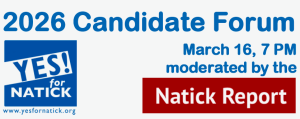
Yes for Natick candidate forumYes for Natick is hosting its annual online forum on Monday, March 16 at 7pm, and is slated to have both Select Board candidates (for two seats), all three School Committee candidates (for two seats), and two write-in candidates (both incumbents) for the Recreation and Parks Commission participating. Natick Report editors will moderate the forum, which you can register for online.

If you have suggestions for questions to ask the candidates, please them send to: YesForNatick@gmail.com

A recording of the forum will be shown afterwards on Natick Pegasus.

Yes for Natick has also posted a report online that includes self-submitted candidate information for town-wide and Town Meeting candidates.


Separately, environment-focused grassroots organization EcoNatick on Tuesday, March 24 at 7pm will host its annual online Climate Conversation. They’ll be talking with the three School Committee candidates.

Members of the public will remain muted throughout the event, but the online chat will be open for comments and questions for the candidates, which moderator Susan Simone Kang will select to be shared during the live event. The forum will be recorded and posted online later.

Natick Report next week plans to run Q&As with Select Board candidates Kristen Pope and Cody Jacobs, and with School Committee candidates Matt Brand, Donna McKenzie, and Matthew Welch.


Please support your local news source with a tax-deductible donation by scanning the QR code or by clicking on it.

natick report QR code

Filed Under: Government, Town Election 2026

Advertisement


Only Natick town-wide office race is for two School Committee seats

January 6, 2026 by Bob Brown

Tuesday, Jan. 6 at 5pm was the deadline for candidates to submit nomination papers for Natick town-wide office seats for the March 31 election, and School Committee was the only body that attracted more candidates than seats.

Incumbent Matt Brand pulled papers early. Donna McKenzie, a past School Committee member, has also entered the race and tells us: “My race is my commitment to accomplish: delivering on the potential for every student to become an engaged citizen capable of thoughtful achievement; growing belonging where students feel welcome, even celebrated; embedding the values of the district into a budget that recognizes people as our greatest capital while respecting the needs of the town as a whole; and working for responsible and sustainable policies and practices.” Rounding out the field is Matt Welch, an experienced education researcher and a former teacher.

Incumbent Kate Flathers pulled papers on Jan. 2 but did not get them certified by the Jan. 6 deadline, according to the town clerk. Flathers said that when Welch confirmed his decision to run, she was happy to step aside, stating that”his experience and insights will be invaluable as Natick navigates major decisions related to strategic planning and facilities that will shape the future of Natick schools for the next decade.”

For Select Board, incumbent Kristen Pope and past candidate Cody Jacobs are the candidates listed by the town clerk’s office each seeking one of two open seats.

Incumbent Andrew Meyer seeks to return to the Planning Board, which has one open seat. Karla Sangrey looks to do likewise on the Board of Health, which has one opening. Wendy Curran-Elassy, an incumbent on the Board of Assessors, seeks another term.

Open seats for which no candidates are listed as of 1:30pm on Jan. 6 include a 1-year term as an associate member on the Planning Board, two 3-year terms on Recreation & Parks, and one 5-year term on the Housing Authority.

New and incumbent Town Meeting candidates still have time to file their paperwork.

Post updated on Jan. 7, 2026.


Natick Report welcomes letters to the editor on Natick-oriented topics.

Filed Under: Government, Schools, Town Election 2026

Advertisements

Natick town-wide office candidates start signing up

December 12, 2025 by Bob Brown

With nomination papers for town-wide and Town Meeting seats in Natick becoming available last week, a handful of candidates have already pulled papers to run.

As of Friday around noon, five candidates across four boards had pulled papers. Four of them are incumbents.

The Select Board, which serves as the town’s executive body, has two candidates for two open seats so far. Incumbent Kristen Pope seeks a second three-year term and Cody Jacobs, who has served on the town’s Finance Committee and been a past Select Board candidate.

Also pulling papers are Matt Brand (School Committee), Andrew Meyer (Planning Board), and Karla Sangrey (Board of Health).

A new development this year: The town is posting information about those pulling papers on its website. Town Clerk Andrew Ghobrial says this is designed to bring more transparency to the election process (while we enjoy dropping by town hall to look at the candidate lists, we applaud this… Wellesley has begun doing the same this season).

For those thinking of running for town-wide office, papers must be submitted by Jan. 6.

natick town-wide offices


Natick Report welcomes letters to the editor on Natick-oriented topics.

Filed Under: Government, Town Election 2026

Tip us off!

Please send news tips, photos, ideas to natickreport@gmail.com

Please support your local news source with a tax-deductible donation by scanning the QR code or by clicking on it.

natick report QR code

Advertisements

Categories

  • Animals
  • Art
  • Bacon Free Library
  • Beyond Natick
  • Books
  • Boston Marathon
  • Business
  • Camps
  • Careers
  • Charity/Fundraising
  • Community
  • Construction
  • COVID-19
  • Education
  • Election
  • Embracing diversity
  • Employment/careers
  • Entertainment
  • Environment
  • Fashion
  • Fire
  • Food
  • Gardens
  • Government
  • Health
  • History
  • Holidays
  • Housing
  • Humor
  • Kids
  • Legal
  • Letters to the editor
  • Media
  • Military
  • Morse Institute Library
  • Music
  • Natick Election 2022
  • Natick Historical Society
  • Natick History Museum
  • Natick Mall
  • Natick Nest
  • Natick track
  • Neighbors
  • Obituaries & remembrances
  • Older adults
  • Opinion
  • Outdoors
  • Override
  • Parents
  • Police & crime
  • Real estate
  • Recycling Center
  • Religion
  • Residential property sales
  • Restaurants
  • Schools
  • Shopping
  • South Natick Dam
  • Sports
  • Technology
  • Theater
  • Town election 2021
  • Town Election 2023
  • Town election 2024
  • Town election 2025
  • Town Election 2026
  • Town government meetings
  • Town Meeting
  • Transportation
  • Travel
  • Uncategorized
  • Vacation
  • Veterans
  • Volunteering
  • Voting
  • Weather
lion publishers
  • Bluesky
  • Facebook
  • Instagram
  • Twitter

Sign up now for free email newsletter & stay in the Natick loop

* indicates required
Our newsletter is free, though we gladly accept contributions to support our work.

Most Read Posts

  • Natick Halloween happenings, 2026 edition
  • Business buzz: Natick Outdoor Store sold to longtime employee; Former car dealeship site on market; Donation supports Autism Welcoming Center
  • Scenes from Natick's Oldtown Fall Fair
  • Natick town government meetings for week of Oct. 5, 2026: School Committee covering improvement plans, budget process, enrollment
  • South Natick park improvement funding now up to Town Meeting

Click image to read The Swellesley Report

The Swellesley Report

Upcoming Events

Oct 10
4:00 pm - 5:00 pm

Free Children’s Concert: Peter & the Wolf—at Wellesley Hills Congregational Church

Oct 12
All day

Columbus Day/Indigenous Peoples Day

Oct 13
5:00 pm - 6:00 pm

Know your neighbor (community cider social)

Oct 13
6:30 pm - 7:30 pm

Natick Fall Annual Town Meeting orientation (online)

Oct 15
10:30 am - 2:30 pm

Natick community flu clinic

View Calendar

Privacy policy

© 2026 Natick Report
Site by Tech-Tamer · Login