• Sign up for free email newsletter
  • Advertise
  • Events calendar
  • Donate to support our work
  • About us (contact us)
 

Natick Report

Since 2020: More than you really want to know about Natick, Mass.

  • Restaurants, sponsored by Tama Sushi & Hibachi
  • Camps, sponsored by NEOC
  • Private Schools—sponsored by Fay School
  • Public schools, sponsored by Sexton
  • Preschools, sponsored by Longfellow, Wellesley
  • Letters to the editor
  • Guidelines for letters
  • Sports schedule & results
  • Embracing diversity
  • Charities/Community
  • Arts
  • Kids
  • Business
  • Environment
  • Top 10 things to do
  • History
  • Seniors
  • Deaths
  • Government meetings
  • Natick Center Cultural District—restaurants, shops, services

Top Stories

 
  • —Park improvement funding now up to Town Meeting
  •   —Scenes from OldTown Fall Fair
  • —Town government meetings for week of Oct. 5


Advertisements


Town seeks return of Natick Center commuter rail express trains

September 27, 2026 by Bob Brown Leave a Comment

The town has requested that the MBTA bring back express trains to Natick Center to provide commuters a faster way to get in or out of Boston. Natick Center express trains that skip Wellesley, Newton, and a Boston stop went away during the pandemic.

In a Sept. 16 letter titled “Restoration of Natick Center Express Service,” Select Board Chair Kathryn Coughlin makes the case that with ridership significantly increased since the newly accessible Natick Center station reopened in 2025/2026, the MBTA should bring back express trains here.

The West Natick station already has a handful of inbound and outbound express trains.
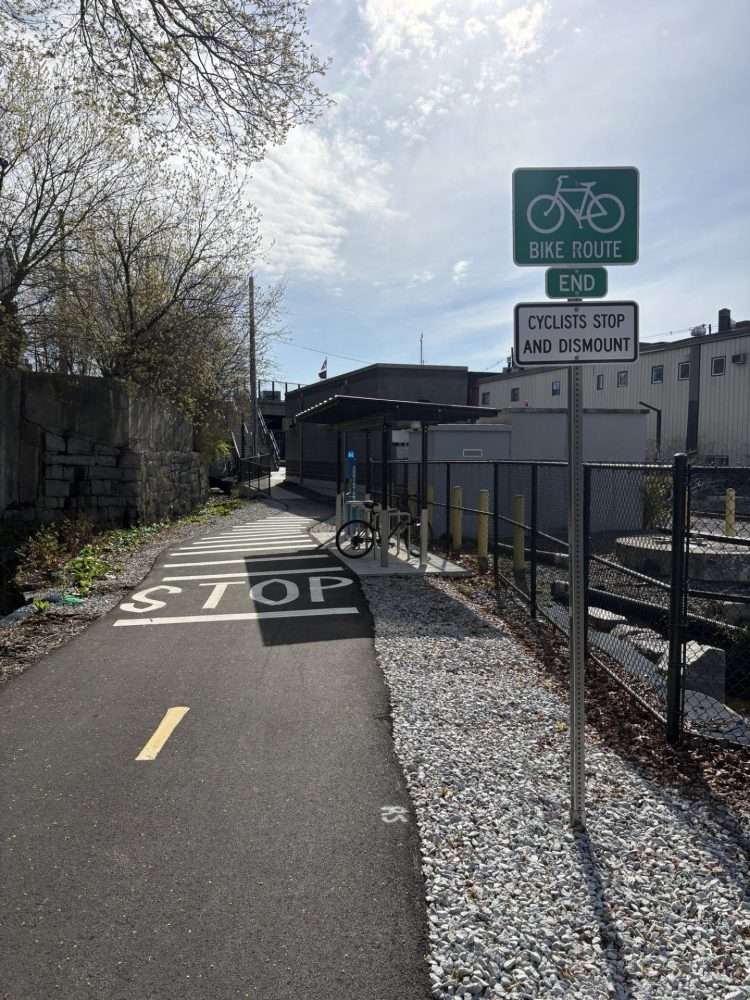
Rail trail at Natick Center train station
Rail trail extension to Natick Center station

 
The state has encouraged municipalities with access to public transportation to allow more housing to be built nearby commuter rail stations like those in Natick both to address the housing shortage and reduce reliance on motor vehicles (not that many moving into new housing don’t have cars). Multifamily housing has been going up left and right in Natick nearby the Natick Center station, though not technically under MBTA Communities zoning.

From the letter signed by Coughlin to the MBTA: “Since the newly accessible Natick Center station was reopened in 2025/2026, ridership has significantly increased. Through the MBTA’s Open Data Portal, average daily ridership in Spring 2012 was 1145; in Spring 2018, 1410, and in Fall 2024, prior to the new station opening, 824. The new station is very popular, and the MBTA’s investment in accessibility has clearly benefited all passengers in Natick Center. We are confident that ridership now exceeds 2018 levels, and will continue to grow in part because of multifamily housing that has been permitted in the station’s walkshed, consistent with the Healey-Driscoll Administration’s efforts to increase the supply of housing convenient to public transit.”

Coughlin acknowledges in the letter the challenges of changing schedules and the impact that can have on riders throughout the system.

“We are hopeful that with the new interlock at the Wellesley/Natick line, along with upgraded signals, the MBTA will be able to increase capacity so that an express train stop at Natick Center will not disadvantage riders originating or departing from stations to the west…,” she wrote, adding that town staff and the board are available to discuss this with the MBTA.

State legislators representing Natick are cc:ed on the letter.


  • Please send news tips, photos, ideas to natickreport@gmail.com
  • Stuck waiting for a train? Use that time wisely by making a tax-deductible donation to Natick Report
Filed Under: Transportation

Advertisement


Natick Select Board picks a lane on Main Street Improvement Project

September 10, 2026 by Bob Brown

After months of frequently impassioned public discussion on the possible future of Natick Center’s streets and sidewalks, the Select Board on Sept. 9 voted to recommend bringing a “hybrid” concept featuring dedicated bicycle infrastructure along Main Street to an initial design phase. This would involve accepting half a million dollars in state grant money for design work going toward a project not anticipated to hit the construction phase until the 2030s.

The board voted unanimously following a roughly 2-hour discussion that followed a recent 2-plus hour session on the topic, and numerous public forums before that. The board’s recommendation was in line with that of a working group that reviewed four options and reported back to the Select Board earlier this summer.

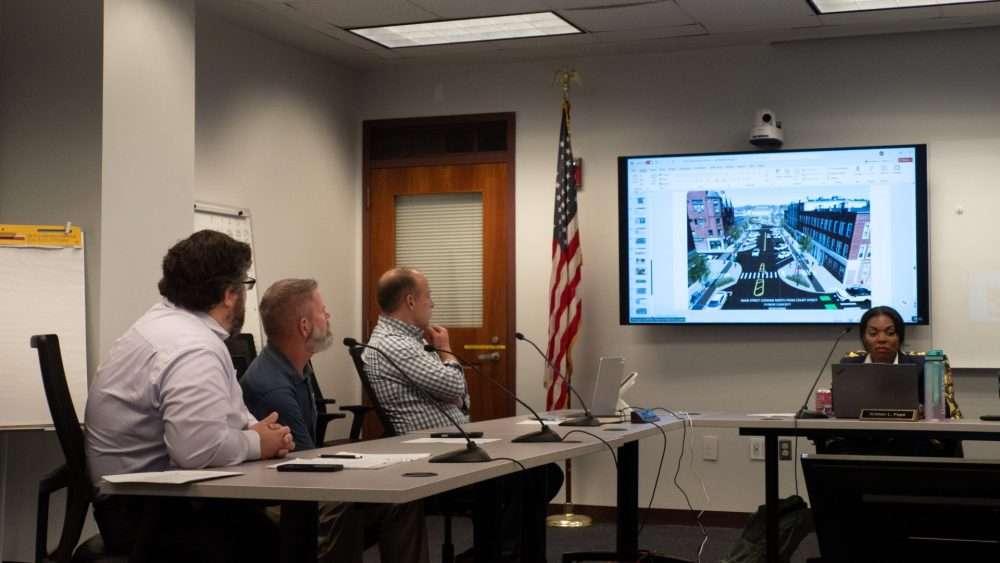
Town Engineer John Digiacomo, Highway & Sanitation Supervisor Brian Cassie, Town Administrator Jamie Errickson & Select Board member Kristen Pope
Town Engineer John Digiacomo, Highway & Sanitation Supervisor Brian Cassie, Town Administrator Jamie Errickson & Select Board member Kristen Pope (photo by Kevin Keane)

The board has bent over backwards stressing that the decision they were making was to bring one of four concepts to the 25% design phase. So some design work would be done, with consultants and town staff addressing a series of questions and concerns before a complete design and construction plan would be approved. Just because the hybrid concept at the outset describes dedicated bicycle infrastructure, doesn’t mean that the town couldn’t eventually go with a plan without such infrastructure after weighing results of the initial design work.

“This decision tonight is going to give direction to town administration, engineeering, and public safety as to what we want to see,” said Kathryn Coughlin, the board chair.

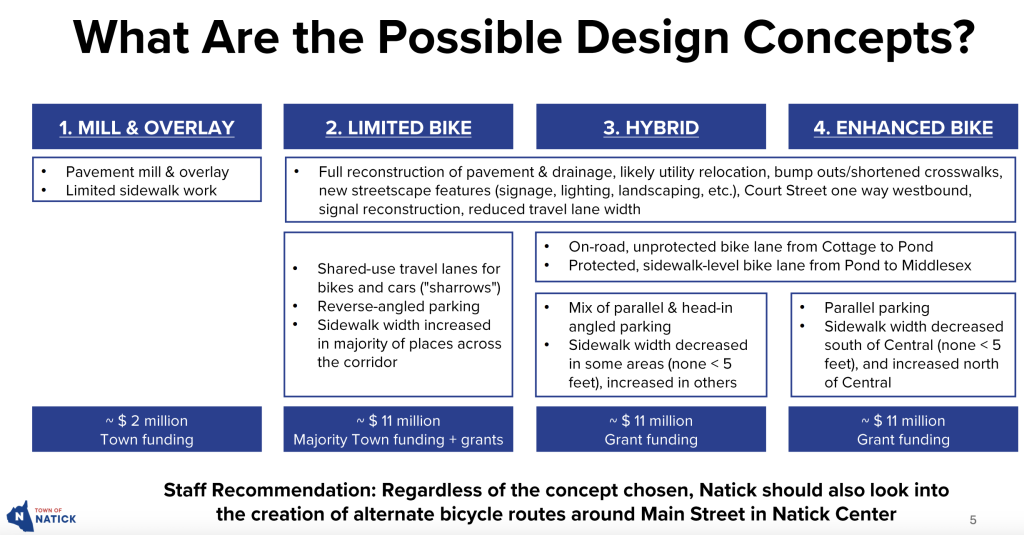
The $2m needed to just mill and repave the downtown stretch would come from town coffers. The more elaborate concepts, including the hybrid one and others with more or less bike infrastructure, are estimated to have $11m construction costs that would be covered via grants. One catch to certain funding involves having bike lanes, but there may be ways around that in light of rights of way/easement issues downtown that could dictate bike lanes that avoid Main Street.


You can help support Natick’s only dedicated daily news source with a tax-deductible donation of way less than $11 million.


Before voting on Wednesday, the board sought additional input from public safety departments in town that had expressed concerns about the hybrid concept. Reps from the police, public works and engineering had all voted against recommending the hybrid concept during the working group process.

Deputy police chief Brian Lauzon said his earlier “no” vote wasn’t for or against bike lanes, but rather the concept’s shortcomings in addressing overall pedestrian and vehicle (including bike) safety. Strategically placed blinking beacons and/or bump-outs that make it easier for drivers and cyclists to see pedestrians are key considerations for the police, Lauzon said. The deputy chief also cited a lack of planning for how delivery vehicles would navigate a redesigned Natick Center and consideration of police resources that would be needed to patrol potential increased use of e-bikes if new bike lanes are introduced. Emergency vehicle maneuvering in a redesigned downtown and the streets around it also warrants more thinking, the deputy chief said.

Another concern raised by Lauzon is what the expected traffic flow will be downtown under a redesign. He said speed isn’t the issue downtown, but that aggressive driving is seen on side streets as operators scheme to avoid getting stuck in the mess in the middle. One goal of the project has been to get ahead of what’s anticipated to be worsening traffic downtown. Of course the challenge with traffic analyses is that they are, as Town Administrator Jamie Errickson noted, part art and part science (and from what we’ve seen from various project development teams, part wishful thinking…).

Concerns were raised by the DPW’s Brian Caissie about squeezing the space in Natick Center and where the buffers would be for piling snow during and after storms if bike lanes are added. Separately, Town Engineer John Digiacomo talked about whether bike lanes would really be part of the optimal use of limited real estate downtown. Paying for town or third-party resources to manage snow removal in a redesigned downtown would also be something for Natick to figure out.

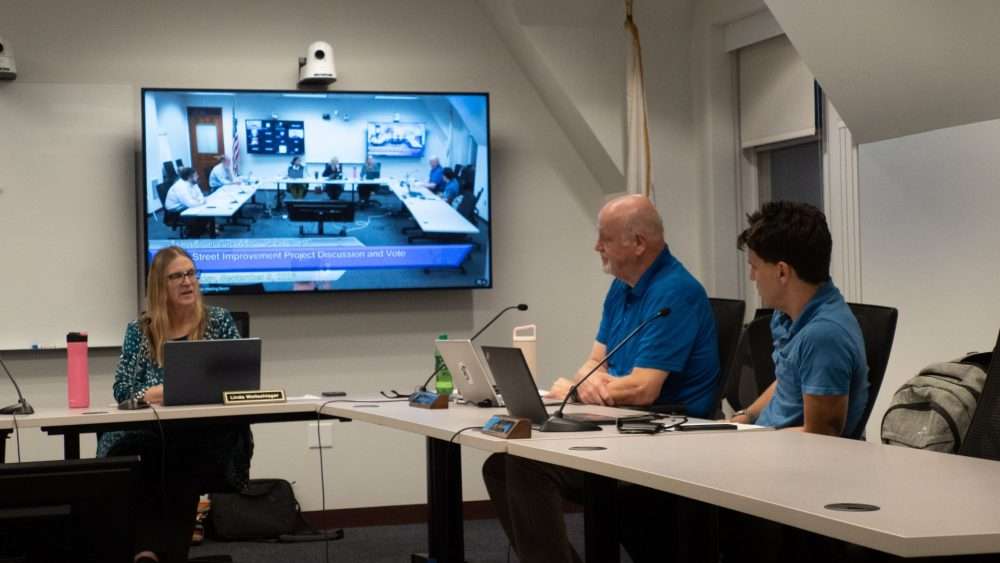
Select Board members Linda Wollschlager, Bruce Evans and Cody Jacobs at Sept 9 main st meeting
Select Board members Linda Wollschlager, Bruce Evans and Cody Jacobs (photo by Kevin Keane)

In deliberating, Select Board member Cody Jacobs favored the hybrid design, calling it a compromise approach, including the preservation of more parking spaces than the enhanced bike concept that has business owners upset about the likely loss of more than a dozen spaces. “The vast majority of the things proposed in the hybrid concept are things a lot of people want, are things that everybody wants…,” he said, adding that he sees getting big grant dollars for massive downtown improvements to be a big opportunity for Natick.

As members Kristen Pope and Bruce Evans said, after Coughlin asked about what the downsides of going forward with a 25% design might be, just getting going on concept will give the town options and the opportunity to address questions more specifically. Member Linda Wollschlager acknowledged the challenges of choosing a concept, and her issues with bike lanes, especially in light of rising e-bike use (state rules for e-bikes are on the way). Having said that, she said the board owes it to the town to explore some of the possible improvements, including updated traffic signals. Evans, on the bike lanes, expressed his concern about “unintended consequences” of introducing them on such a busy strip.

In the end, Coughlin said that what the town ends up with, regardless of which direction Natick goes, is a plan “that we’re not paying for that will lay out what we could be doing to improve downtown for businesses and residents…”


Please send news tips, photos, ideas to natickreport@gmail.com

Filed Under: Government, Transportation

Advertisements


Natick Select Board talks and talks about Main Street Improvement Project

August 25, 2026 by Bob Brown

Main Street Natick Center
Photo by Maureen L. Sullivan

 
The Natick Select Board spent more than two hours during its Aug. 19 meeting discussing the reasons for undertaking the Main Street Improvement Project, the pros and cons of different approaches, and possible next steps. While the town and board have hosted numerous sessions regarding potential Natick Center renovations, the elected body hadn’t had an opportunity to truly deliberate on the subject in keeping with open meeting laws.

The conversation included a back-to-basics summary of why the project is happening—roadway repair, safety for all users, economic development, etc.—and what the board will actually vote on. Board members also addressed public feedback such as concerns that the town is undertaking the project as a grant-chasing exercise in that the cost to the town for redoing Main Street includes options that would require town funds vs. grant funding (planning work to this date has come from state monies). Board Chair Kathryn Coughlin made clear at the start of the session that no decision had been made and that there wouldn’t be a vote that night despite that being listed as a possibility on the meeting agenda. She also reminded her colleagues and the public that the board adopted a vision and values in 2024 that it committed to considering when making major decisions.

A point of emphasis during this meeting, as well as previous ones, is that the board is voting initially just to get the first 25% of design underway on concepts that range from limited bicycle support to advanced cycling infrastructure (the most bare bones option would simply involve repaving and limited sidewalk work). In other words, adding bike lanes or not and other changes won’t be set in stone: Design work would start and project leaders will be required to address a handful of lingering questions and concerns raised by each of the concepts laid out to date as the town conducts further research on a handful of related issues from parking availability to cycling demand and habits. A working group reviewing the options reported back to the Select Board earlier this summer and recommended by an 8-7 vote going with a hybrid approach that would include bike lanes.

“One thing we have to do is choose a concept,” Coughlin said of the board. “Because we have to give the engineering team, and the transportation group, and town administration, and DPW, and public safety direction on what it is we want to see.”

main st comparison
See presentation sharing during Aug. 19 Select Board meeting

 
During the board’s deliberation, members were able to raise issues based on their individual research. For example, Coughlin described having read again through a lengthy FAQ on the project published by the town and it got her wondering whether there could be a way for the town to adopt a concept rerouting bikes around Main Street, citing rights of way/easement issues, without losing the chance for Massachusetts Department of Transportation support and federal Transportation Improvement Program (TIP) funding. The board further discussed the pros and cons of routing cyclists around Main Street, particularly those coming or going in a north or south direction along Rte. 27.

Coughlin and fellow member Linda Wollschlager separately shared efforts to research main street projects in other communities, including the college town of Northampton in western Massachusetts, even though it is different from Natick in many ways. Coughlin’s seeking to find out what businesses thought about the project, which is currently in one of those unpredictable-yet-predictable Eversource-inspired delays (something for Natick officials to file away whenever its project gets going). Wollschlager said depending on who you ask, businesses were for or against it. She added: “One of the things I wanted to know is countrywide are there any designs [for communities similar to Natick] like what we’re proposing, and the answer came back ‘no.'”

Morgan Griffiths, the Natick transportation/economic development planner heavily involved in the project, did point to the town of Wakefield, Mass., as a community undertaking a downtown project that looks to include sidewalk-level bike lanes and angle parking.

From here, the discussion segued into a discussion of different parking options, from parallel to angle to backing in (the latter, a hairy situation for those of us with older vehicles without backup cameras). Board member Kristen Pope noted that parking preferences can be influenced by where a person grew up and learned to drive. Fellow member Cody Jacobs raised the idea of having different parking types on opposite sides of the street to accomodate, say, bike lanes on one side.

Board members also lamented not having solid data yet on Natick’s overall parking situation, as one factor to consider with the different Main Street options is the loss or gain of parking spaces. Though Coughlin did state that building a parking garage is not an option due to the steep cost.
 

Addressing public concerns

 
Among the top concerns raised by the public has to do with the possible narrowing of Main Street and the impact that would have on traffic flow at the Rte. 27/135 intersection, statistically one of the state’s most dangerous. Narrower streets are known to slow down traffic, though as Jacobs pointed out, traffic signalization plays a big role in flow. The narrowing of the street and sidewalk bumpouts also reduce the time it takes for people to cross, improving vehicular traffic flow, Wollschlager said.

There are also questions about the true demand for commuter and recreational cycling to or through downtown, though as Pope said you need to look at least a few years out when thinking about this, and as Jacobs added, the town’s efforts to improve cycling infrastructure fits with numerous Natick planning efforts from its adoption of a Complete Streets Policy to its 2030+ Master Plan and Net Zero Action Plan.

Board member Bruce Evans noted the big differences between protected and unprotected bike lanes, and when it comes to bike lanes on Main Street, he said the town can’t take a “Field of Dreams” approach that assumes if Natick builds it, the cyclists will come, as he’s heard arguments for and against bike lanes from cyclists themselves. “Are we taking an existing traffic problem and potentially making it worse by introducing complexity… ?” he asked later during the meeting.

Wollschlager threw into the mix the rise of e-bikes as well, and how they could factor into Natick’s planning. State and local rules for different classes of e-bikes are emerging.

Not unrelated, Coughlin switched to talking to about Natick’s changing demographics over the years and what it might look like going forward based on U.S. Census, UMass, and other resources (Natick’s population is expected to grow 30% by 2050, and the 65+ age contingent is expected to grow by 50%.

“So when we think about the Main Street corridor and we think about our residents who are going to be living here, the first thing I thought of no matter what we do is we need bumpouts,” she said.  “We need pedestrian bumpouts so we don’t have people trying to walk from one corner of Main Street to the other corner diagonally across that huge thing and hustling.” (Bumpouts are a traffic calming design that extends the curb line and sidewalk into the roadway.)

Building on that, Coughlin said the town needs to prioritize making its streets as safe as possible for everyone, regardless of how they get around.

Jacobs said bike lanes would seem to be one way to make things safer, whereas cyclists today either ride on the street (as they are allowed to) or sidewalks, and don’t have a separate path of their own. How Natick might design buffers between parking spaces, bike lanes, and sidewalks is something Jacobs said he’d want to see in early design work, depending on which concept the board endorses.
 

About the cost…

 
Basic repaving is estimated to cost the town $2m, while more involved options are projected to have a construction cost of $11m, entirely grant funded (though increased snow removal costs can’t be overlooked).

Board member Evans said he was “disgusted” by claims that the town’s decision making on this is being driven by available grant funding. “We are being driven by what we think Natick needs” based on input from numerous constituencies, he said.

Wollschlager said “If we thought this was the wrong thing for downtown it wouldn’t matter if it was free or if they paid us money for it. However, we do need to consider the financial cost of any of these” options, she said.

Pope said “I see this as an opportunity to do improvements that we won’t have. There’s no forecast in the next five years that we’re going to have an additional $11 million lying around” to dedicate to such a project, she said.

Jacobs said: “We have a responsibility to the taxpayer to look at grants…”

Coughlin warned that Natick has “deferred maintenance to dangerous levels—levels that are going to cost us far more in the future than if we just did the common sense thing now.”

In the end, Coughlin returned to her main considerations as the board readies to vote. “Safety, safety, safety, safety, safety,” she repeated, in commenting on the potential for the hybrid concept, acknowledging flaws would need to be addressed.

The board agreed to add an agenda item on this topic to its Sept. 2 meeting, just to possibly sort out a few things in advance of a fuller discussion at a Sept. 9 meeting to be mainly devoted to the Main Street Improvement Project and a likely vote.


We unabashedly chase grants.If you’re with or know of an organization that’s thinking creatively about awarding grants—say to support student interns covering non-profit and other news in Natick—please let us know: natickreport@gmail.com

Filed Under: Government, Transportation

Advertisement


Friends of Natick Trails seeking new Board member

July 22, 2026 by Admin

Friends of Natick Trails (FoNT) is seeing a new Board member to replace a member who is stepping down after nine years of service. Specifically, FoNT is interested in bringing on a new Director to help lead the volunteer-driven organization.

The group’s mission is to promote community enjoyment of the Natick trail network and advance responsible, accessible recreation through education, volunteerism, and partnerships.

If you’re aligned with the mission, and have the skills and experience to serve, you can get started by submitting this form.

Cochituate Rail Trail, Natick

Not ready to step into a Director’s role? Volunteers are always welcome at FoNT! Check this signup form to get in touch. You could help out with All Aboard, an accessible and adaptive cycling program. Or become a Trail Keeper volunteer and help maintain the Cochituate Rail Trail during work days for planting, cleanup and other chores to spiff up the trail. Or help out at the annual Cochituate Rail Trail on New Year’s Eve event.

Filed Under: Community, Outdoors, Transportation

Advertisements

Potential improvements to Main Street, economic development discussed at Natick Select Board meeting

July 13, 2026 by Bob Brown

The Natick Select Board at its July 9 meeting continued to gather community input and share updates on a plan to improve the condition and usability of Main Street. The board, which is readying to vote on a Main Street Improvement Project design concept, started its latest session on this topic by taking questions from members of the public that touched on everything from safety to cost to tree preservation.

This meeting followed on the heels of a June 24 Select Board meeting agenda item (about 71 minutes in to the Natick Pegasus recording) on a presentation and report from the Main Street Working Group, which voted 8-7 in favor of what’s known as the “hybrid” concept that includes dedicated bike lanes. The introduction of dedicated bike lanes to Natick Center has been a point of contention between those worried this will hurt businesses and create safety problems, and those who feel bike lanes could help improve transportation options, benefit the environment, and address future needs as increased rail trail connectivity becomes reality. Some have raised concerns that the town could make its decision based more on grant funding stipulations than on which design is ultimately best for residents, businesses, and visitors, and favor a basic approach of just repairing aging roadway (the basic approach is estimated to cost about $2m in town funds, while some of the more involved concepts are expected to cost about $11m, though be covered by grants).

The June 24 session followed a June 10 update on the improvement project concepts, which have evolved since this process began in 2023. Once a decision on which way to go is made and the town eventually gets to the construction phase, the actual changes aren’t expected to happen until the mid-2030s.

main street concepts

At the July 8 meeting, Town Administrator Jamie Errickson responded to questions about cost differences between approaches, and emphasized that once you start redoing traffic signals, reworking sidewalks for accessibility bump-outs, etc., the project will be expensive regardless of whether dedicated bike lanes are included. But certain approaches would cost the town a lot less because of potential grant funding. He also addressed questions about investment in parking facilities, say a garage or lot, and said there are few grant funding options, leaving it to the town to fund what is a tough investment to recoup spending on.

The town has posted dozens of questions and answers online regarding the improvement project to try to address people’s concerns. But based on comments from some speakers at the meeting, skepticism remains about everything from the ability to trucks to maneuver through Natick Center to the possibility of improved traffic flow with streetscape changes to the reality of people actually cycling all that much in light of the snowy, cold, and rainy weather in these parts. Terms such as “destruction” and “ruin” were sprinkled into some of the angrier comments.

Select Board Chair Kathryn Coughlin acknowledged that this project is rife with pluses and minuses.

“This entire project, every single element of it, has a trade-off. There isn’t one element of this entire thing that you could point to and say ‘that’s a great idea…could we just do that one thing?’ There’s going to be trade-offs” she said.

There were some calls by members of the public for more data on current bike use downtown, though it was pointed out that the decision being made is forward looking, and that changes made to Main Street could encourage those too afraid to bike in Natick Center today to give it a whirl.

Resident Josh Ostroff, former chair of the town’s Transportation Advisory Committee, commented that he’s hoped for some time that Natick would undertake more town-wide planning on bicycle and pedestrian access, as well as access for people with mobility disabilities. “I feel that now we’re dealing with a very contentious project but don’t have the kind of visibility into what the demand is, what the needs are for people to get around safely on foot, on wheels throughout the town…,” he said. Having information on how many people bike for recreation vs. transportation, for example, could inform such a project, he said.

Cycling advocates had their say at the meeting, and one Needham resident who bikes frequently to and through Natick, encouraged listeners to consider the types of places they’d really like to spend time. He invited people to compare the feelings and experience of crossing Rte. 9 to visit the mall vs. the feelings and experience of something like Open Newbury Street in Boston, where vehicular traffic is banned on summer Sundays and at select other times. “Experience what it’s like being in an area that is prioritizing pedestrians,” he said.

Chair Coughlin said members of the public are welcome to continue asking questions and reaching out to the town in the weeks ahead, and that the board would be picking up on the topic again at its July 22 meeting.

Economic Development

The board meeting segued from the Main Street Improvement project to a related issue: economic development.

Former Select Board member and current Economic Development Committee (EDC) Chair Paul Joseph presented an economic development vision voted on by the EDC, an advisory body of the Select Board. He said his hope that the presentation will be the start of a community-wide dialogue on the issue. (Leading into the presentation, he noted that members of this group were asked early on to provide feedback as the Main Street Improvement Project emerged.)

Joseph began by stressing the importance of having a strong commercial tax base to help offset some of the residential burden, which has grown as property values have increased. Economic development also provides local jobs, and Joseph said a large percentage of Natick residents work in town, including many at big companies like Cognex and MathWorks. He pointed both to businesses lost and businesses gained, with the latter including Bosse and T Market.

The EDC chair credited town employees involved in economic development for doing a good job over the years, but also said “we have under-resourced the revenue-generating of this town pretty much since I’ve been active in town politics, which is almost 20 years.” He also cited the structure of Natick’s town government for limiting economic development efforts. Joseph expressed concern that the town isn’t moving fast enough strengthen its economic development in the face of local and macro challenges.

In looking ahead, Joseph said it’s important for leaders, residents, and businesses to make clear what they want, and this is where the vision statement fits. “The vision statement that we’ve developed basically is designed for providing an opportunity for the Select Board to now say what matters” when it comes to economic development and raising non-residential tax revenue. The statement reads in part: “Natick will be a resilient, opportunity-rich community that enables businesses to start-up, grow, and adapt eƯiciently and responsibly, while reinforcing the Town’s identity, inclusivity, and long-term prosperity.”

Joseph referenced examples of nearby communities, such as Framingham, Hudson, Marlborough, Needham, and Newton, that have taken ambitious approaches to economic development, some involving significant state funds and local business leadership. “We have competition coming from all around us because of the mechanisms and choices these communities have made,” he said. Natick and other MetroWest communities are at risk of being relegated to bedroom communities for Boston, Cambridge, and Worcester, so it’s important that the town pursue collaborative opportunities with its neighbors, he said.

The vision document shared by Joseph describes the need for the town to make it easier to do business here, having a strategy to retain and attract businesses, and continue embracing change (as the Mall has done in shifting to more experience-oriented tenants). Joseph acknowledged doing much of this will be expensive, but that spending and reuse is required for future growth.

For the EDC’s part, Joseph said a near-term goal is for members to be more present at town government meetings, to remind policymakers of the need to think about the potential for commercial opportunities as part of projects. Longer term, he said the EDC should probably be privatized to be more effective.


Shop LOCAL: Advertise your business or organization on Natick Report

Filed Under: Business, Government, Transportation

  • 1
  • 2
  • 3
  • …
  • 20
  • Next Page »

Tip us off!

Please send news tips, photos, ideas to natickreport@gmail.com

Please support your local news source with a tax-deductible donation by scanning the QR code or by clicking on it.

natick report QR code

Advertisements

Categories

  • Animals
  • Art
  • Bacon Free Library
  • Beyond Natick
  • Books
  • Boston Marathon
  • Business
  • Camps
  • Careers
  • Charity/Fundraising
  • Community
  • Construction
  • COVID-19
  • Education
  • Election
  • Embracing diversity
  • Employment/careers
  • Entertainment
  • Environment
  • Fashion
  • Fire
  • Food
  • Gardens
  • Government
  • Health
  • History
  • Holidays
  • Housing
  • Humor
  • Kids
  • Legal
  • Letters to the editor
  • Media
  • Military
  • Morse Institute Library
  • Music
  • Natick Election 2022
  • Natick Historical Society
  • Natick History Museum
  • Natick Mall
  • Natick Nest
  • Natick track
  • Neighbors
  • Obituaries & remembrances
  • Older adults
  • Opinion
  • Outdoors
  • Override
  • Parents
  • Police & crime
  • Real estate
  • Recycling Center
  • Religion
  • Residential property sales
  • Restaurants
  • Schools
  • Shopping
  • South Natick Dam
  • Sports
  • Technology
  • Theater
  • Town election 2021
  • Town Election 2023
  • Town election 2024
  • Town election 2025
  • Town Election 2026
  • Town government meetings
  • Town Meeting
  • Transportation
  • Travel
  • Uncategorized
  • Vacation
  • Veterans
  • Volunteering
  • Voting
  • Weather
lion publishers
  • Bluesky
  • Facebook
  • Instagram
  • Twitter

Sign up now for free email newsletter & stay in the Natick loop

* indicates required
Our newsletter is free, though we gladly accept contributions to support our work.

Most Read Posts

  • Natick Halloween happenings, 2026 edition
  • Business buzz: Natick Outdoor Store sold to longtime employee; Former car dealeship site on market; Donation supports Autism Welcoming Center
  • Scenes from Natick's Oldtown Fall Fair
  • Natick town government meetings for week of Oct. 5, 2026: School Committee covering improvement plans, budget process, enrollment
  • Private education opportunities at local Open House events near Natick

Click image to read The Swellesley Report

The Swellesley Report

Upcoming Events

Oct 10
4:00 pm - 5:00 pm

Free Children’s Concert: Peter & the Wolf—at Wellesley Hills Congregational Church

Oct 12
All day

Columbus Day/Indigenous Peoples Day

Oct 13
5:00 pm - 6:00 pm

Know your neighbor (community cider social)

Oct 13
6:30 pm - 7:30 pm

Natick Fall Annual Town Meeting orientation (online)

Oct 15
10:30 am - 2:30 pm

Natick community flu clinic

View Calendar

Privacy policy

© 2026 Natick Report
Site by Tech-Tamer · Login