
The Natick Select Board during its meeting this past Wednesday received its first Johnson Quarterly Report and got a data-packed update from Fire Chief Jason Ferschke on his department (see Natick Pegasus recording to review the meeting).
Town Communications Director Jay Poropatich presented a summary of the Johnson Future Use Project, which kicked off in April. Johnson Elementary School closed last year, and the town is now trying to figure out what to do with the property, with input from residents.
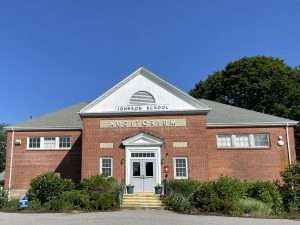 Former Johnson school building (Photo by Erica Noonan)
In addition to the monthly Johnson Speak, a platform for residents to voice ideas for the future of the Johnson property, the Select Board has committed to formalized updates on the project every three months. Most steps to date have involved preliminary surveys and planning. Much of the meeting centered on clarifying details and, more importantly, looking ahead at future opportunities for the board. A few possibilities were laid out for August-October, including a Select Board-led discussion, Johnson Office hours with a single Select Board member on-site to answer questions, and the formation of workshops for residents to hash out ideas.
More concretely, Town Administrator Jamie Errickson will be releasing answers to inquiries from the recent walking tour in coming weeks and the Select Board committed to their walking tour sometime in the future to determine if the building has “good bones” — some have worried because the building is not ADA compliant, among other things, it may not be salvageable at all.
One thing that the board was certain to make clear was that no discussion about the Johnson property’s future use has been had up until this point. They want this to be a “collaborative session.” A strong emphasis was placed on collecting public input, especially from residents close to Johnson (Precinct 9). Board members discussed using workshops to hone ideas ahead of forming any sort of advisory committee that would, for example, assess financial implications of whatever options for the property that the board considers. Members of the public spoke to the challenge of considering possible uses without knowing the potential costs.
Select Board Chair Kathryn Coughlin noted that while they’ve seen a “strong desire that the town not spend a lot of money on development,” whatever plan the town decides on now should not preclude it from doing more with the property in the future, if the town were to receive another grant or funding that would make a better plan possible.
One interesting idea proposed by a resident was to consider a land swap that might preserve open space on the Johnson property and allow affordable housing to be built on current open space elsewhere in town now protected under Chapter 97 of the Public Lands Preservation Act.
Board member Bruce Evans acknowledged: “We don’t have all the answers.” Residents were urged to “be creative.”
The target is to make a decision about the property by June 2027, with multiple project phases before then.
Fire department update
Fire Chief Ferschke outlined ways that the department is strengthening itself by partnering with other communities in the region and by investing in professional development even as it looks to increase hiring and replace old equipment.
The department has received 3,239 calls so far this year, up from 2,975 during the same period last year—an increase of 264 calls. Of those calls, around 65% were EMS-related and 35% were fire-related. Moreover, 82% of the time the department had multiple calls going on at the same time—something that’s becoming more and more common.
To better support the rise in calls, the department should be getting a new ladder by September or October and a new ambulance by November, with another ambulance and engine on order. This comes in addition to the four ambulances the department already has, including two primary ambulances and two retired reserve ambulances. Ferschke said their two primary ambulances are running steadily 24/7.
Chief Ferschke was also proud to present news on the department’s professional development, including:
- 92%+ of officers attended 2 hours of supervisor liability training
- 96%+ of officers attended an 8-hour company officer training focusing on their job and responsibilities/fire ground operations
- 3 officers attended the 8-hour man vs machine program, where they learned how to deal with injuries caused by industrial machinery
 The department has also made strides on member health and wellness. This year, they’ve introduced new screenings for esophageal and skin cancer. They’ve also introduced the Fire Fighter Heart Health Initiative including training at Newton-Wellesley Hospital. The department is in the process of replacing its turnout gear after old gear, which used PFAS (a chemical used to make equipment water-resistant), was linked to cancer and other health issues.
Despite positive professional and health/wellness developments for the department, staffing remains a struggle. The department is below the national average for staffing and is anticipating the retirement of four members each with some 30+ years of experience. Vacancies are proving to be an issue as many candidates still require significant training before they can be fully integrated.
While there may be a staffing shortage in Natick, the department still gives more mutual aid than it receives. Regionalization has been positive for the department on the training front. Chief Fershke cited the town’s dive team gaining more experience by responding to calls outside of Natick.
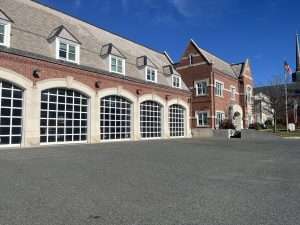
Moving forward, Ferschke says the department needs to assess a path toward more staffing. The department also has a plan for a three-phase study of Station 2—identify what’s ideal, what needs to be done, and what options are available.
Ferschke also wants to zero in on risk trends and strategies to reduce them, particularly the number of falls among residents.
Last on his list was a new information-sharing system, NERIS (National Emergency Response Information System). Currently, the department reports to the National Fire Incident Reporting System. However, it operates on a monthly basis, whereas NERIS updates live, making information more immediate and accessible.
The Select Board meets every other Wednesday evening at 6:30 PM in the Edward H. Dlott Meeting Room of Town Hall unless otherwise stated and can be streamed live via Natick Pegasus
If you’d like to support our intern program, please consider making a tax-deductible donation and put “intern” in the optional note area.
