
In November 1919, just months after returning from France, Natick’s Marion Louise Pooke addressed the Natick Woman’s Club with a talk titled With the A.E.F. in France. Drawing on her experiences overseas at the end of World War I, Marion offered her audience a vivid account of hardship, service, and the fragile hope that followed the war’s end. More than a century later, her words still bring that moment to life.
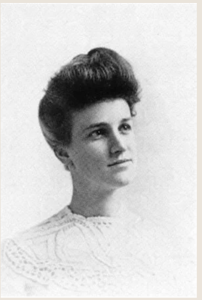 Marion Louise Pooke, Smith College yearbook portrait. Natick Historical Society Collections.
Marion Louise Pooke (1883–1975) was the youngest daughter of Charles Augustus Pooke and Georgette Custer Pooke of 26 Winnemay Street in Natick. The family was deeply rooted in the community, and Marion’s story is also closely connected to one of Natick’s most important educational institutions: Walnut Hill School. Marion and her sisters, Helen and Florence, attended Walnut Hill before going on to Smith College. For Marion, Walnut Hill formed part of the foundation of a life shaped by art, study, and wider horizons. She later continued her training at the Massachusetts Normal Art School and the School of the Museum of Fine Arts, Boston, and built a serious career as an artist.
But Marion’s life extended far beyond the studio. In the aftermath of World War I, she went to France, where she joined relief efforts connected with the American Expeditionary Forces. Her 1919 lecture reveals a woman who was observant, intelligent, and deeply affected by what she saw. Rather than offering only a patriotic summary, Marion described the war and its aftermath through lived experience: ruined landscapes, exhausted civilians, and the emotional strain of service. Her account adds an important local voice to the larger history of American women overseas during the war.
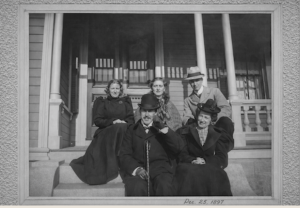 Pooke Family Group Portrait at 26 Winnemay Street, Christmas Day, 1897
The Natick Historical Society preserves a rich collection of Pooke family materials, including glass slides, decades of family correspondence, diaries, lectures, photographs, and travel negatives. Together, these materials document not only Marion’s wartime experience but also the broader story of a remarkable Natick family whose lives connected local history to international art, education, and travel. They reveal Marion as both an artist and a witness, while also preserving the voices and relationships that shaped the family across generations and continents.
Marion’s connection to Walnut Hill School makes her story especially meaningful in Natick. She was part of a generation of young women whose education prepared them to move confidently into artistic, intellectual, and public life. To share this extraordinary story more fully, the Natick Historical Society has published a new online feature on Marion Louise Pooke. The webpage includes photographs, family history, artwork, and selections from her manuscript With the A.E.F. in France, offering a fuller portrait of her life in Natick and abroad.
Readers can explore the full story at the Natick Historical Society website.
At the Natick Historical Society, stories such as Marion Pooke’s remind us that local history is never only local. Sometimes, from a house on Winnemany Street and classrooms at Walnut Hill, it reaches all the way to wartime France.
Please support local news with a tax-deductible donation to Natick Report
