Natick wrapped up a healthy fiscal year 2025, and is poised for a strong FY26, according to outgoing Director of Finance John Townsend’s farewell annual report and forecast. He shared a presentation with the Select Board on Sept. 17, and plugged the town’s quarterly financial dashboard.
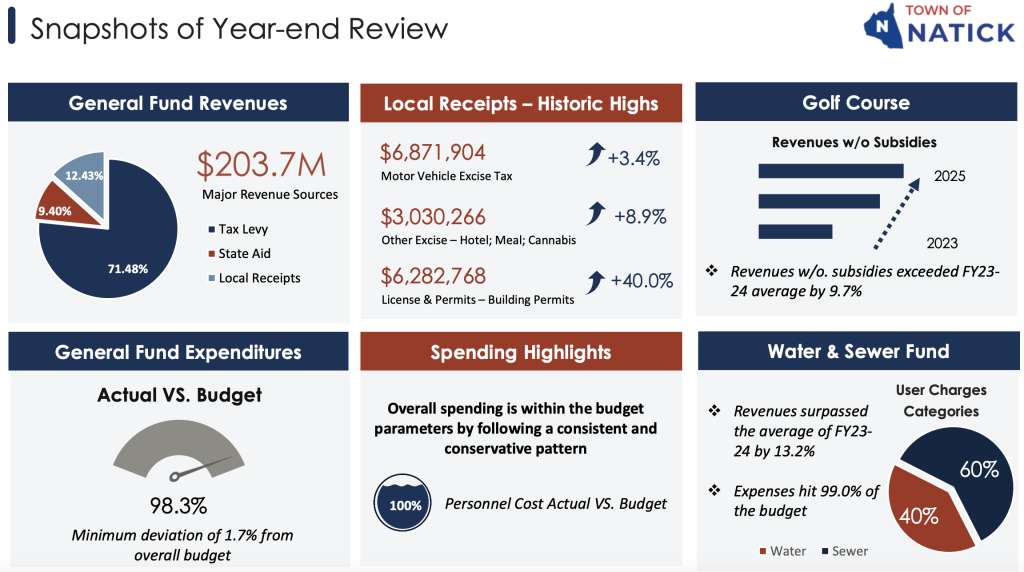
For FY25, the town pulled in nearly $204 million, up from $179 million in FY24.
Among the drivers were “historic highs” for local receipts, with vehicle excise tax and hotel receipts soaring, plus a big juicy $2 million MathWorks building permit fee for major work on their property.
Parking meter revenue and fines were up, too, and Natick received a sizable FEMA reimbursement, a one-time non-recurring boost. The town has also been cracking down on those behind on their taxes, so collected $2.3 million through its tax title process and another $400k in penalties.
Restaurant meals tax was actually under budget—while some restaurants opened and others closed, there’s also the issue of pricey menu items that might be keeping patrons away (our view). Otherwise, Townsend said, his team does see a robust local economy continuing.
Townsend said general expenditures came under budget, and he gave credit to department heads who headed warnings about this in light of the town’s successful campaign for a $7 million override.
From there he switched to the 5-year forecast, a sneak preview of possible revenue and expenses. It’s not a budget, he emphasized, and is based in part on a 10-year look back at financial data.
Again harkening back to budget scrutiny during the override discussions, Townsend shared some assumed operating expense increase but warned that the town would be wise not to continue filling gaps with free cash as it has been in the habit of doing for years. “It actually isn’t a very good practice for us,” he said, adding that the town will want to look at prioritizing free cash for reserve and capital funds.
Going forward, expenses are expected to increase at a steady pace for education and town services, though an actual decrease is projected for shared services, including paying for retirement benefits (the town should be fully funded for its pensions by FY31).
A huge component of shared services across departments is health care, and that’s tough to predict, Townsend acknowledged, as the town has seen both steep and moderate increases over the years.
“In looking at the bottom line” for the forecast, Townsend said, “you can definitely see that we did benefit from the $7 million override.”
In Board member comments after the presentation, Linda Wollschlager applauded the outlook but also cautioned that the forecast doesn’t include any big new initiatives by the town, like say with the new or renovated Memorial Elementary School or future of the former Johnson Elementary School property.

More good financial news: Now, thanks to our partnership with Tiny News Collective, you can make tax deductible contributions to support Natick Report’s work.