
Bill Spratt, executive director of the Department of Public & Facilities didn’t give the Natick Select Board a choice of hearing good news or bad news first—he went straight to the bad news. The town will need to build a likely $30m facility in the next two to three years to filter PFAS (aka, forever chemicals) out of Natick’s drinking water to comply with safety standards.
“The bottom line up front is that we’re facing some financial challenges,” Spratt said. “Our debt ratio is going to double.”
The town has received about $4m in settlement funds extracted from polluters via class action suits, but the reality is that ratepayers are going to keep taking hits on their water bills to cover rising PFAS treatment expenses. The Select Board continued its public hearing on water and sewer rates until April 29 to mull several rate options presented by Spratt and conceived in partnership with a consultancy.
(Rep. David Linsky, who spoke earlier during the Select Board meeting, acknowledged that paying for PFAS projects is a huge challenge in response to Town Administrator Jamie Errickson’s question about whether there might be ways for municipalities to get more time to comply with state rules.)
(Watch a recording of the April 15 public hearing, starting at around the 1-hour, 40-minute mark. Also, see Spratt’s presentation.)
As Spratt explained, the town’s water and sewer operation is an enterprise fund that it needs to match its revenue to expenses—it’s not a profit-making outfit. The challenge is that expenses are going to go way up due to the PFAS treatment needs, and the only ways to boost revenue are through rate and consumption increases—and it’s not like the town is going to encourage residents to all build swimming pools. Meanwhile, state-mandated water consumption restrictions during ongoing drought conditions have reduced consumption.
The Water & Sewer Division has taken steps in recent years to increase its fixed revenue using complex rate setting models that acknowledge water consumption can vary greatly depending on the weather. Natick, which delivers about 1 billion gallons of water a year, also has made steps to bring its retained earnings to a healthy level to allow for a cushion when emergency costs come up and investments need to be made.
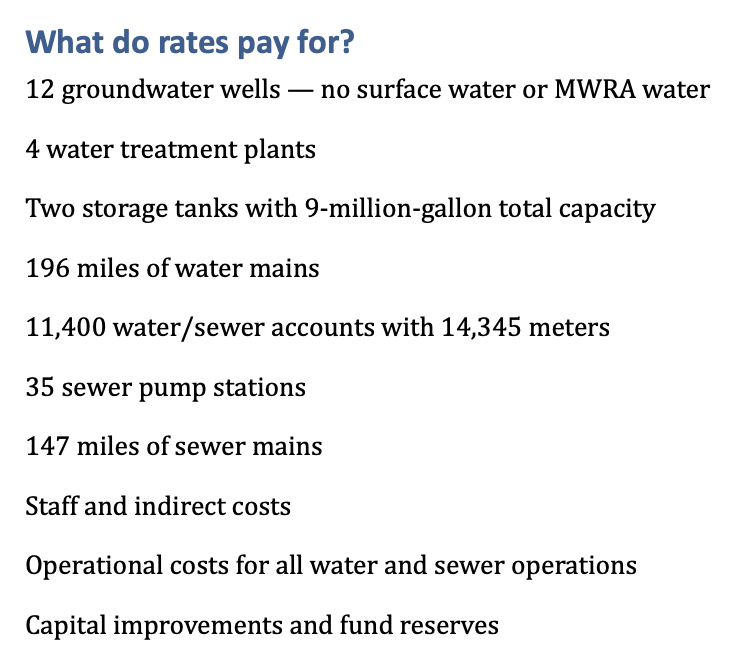 DPW presentation to Select Board (4/15/26)
Natick has already spent more than $5m on PFAS treatment, including for a permanent filtering system you can see on Rte. 9 east at the Springvale plant. That handles the H&T arm of the town’s water treatment plant, but the Tonka branch that can crank out 4 million gallons 0f water a day is the one that needs upgrading from a temporary PFAS filtering solution that Spratt refers to as being akin to “a giant Brita water filter” to a permanent system.
You can “GAC” out with Spratt over the treatment options by watching his presentation if you wish (GAC stands for granular activated carbon), as Natick is piloting different technologies.
Note that Natick also gets water from a well at Elm Bank Reservation, but it is reliant on the level of water in the Charles River. As a result, Natick is looking to supplement its supply from the Massachusetts Water Resources Authority, which delivers nice clean water, though at a premium.
Spratt laid out three water rate proposals for the Select Board to consider, with each offering differences in how the town approaches readying for big PFAS expenses to come. The first option is to keep things the same for now with knowledge that big increases would be on the horizon without increased retained earnings to buffer that.
The second option would be to keep the unpopular—but according to the town necessary—ready-to-serve (RTS) fee as is. But usage rates would go up by 7%.
The third choice focuses on increasing the RTS fee, with some nuances, and could result in quarterly bill increases of $5 to $50-plus depending upon usage.
Select Board members asked about issues such as the operational expenses that would come with whatever treatment facility is built (hard to say, as some filtering systems have higher or lower operational costs), how the Water & Sewer Division is viewing the moving target of environmental regulations, and how changes might be made more fair for very low-usage customers.
Note that in addition to the water rates, sewer rates have been rising steadily.
“I think no matter approach the Board takes, there’s going to be increases for the foreseeable future,” Errickson said. “It’s just how does the board want to prioritize how those rate increases need to be handled,” he added, citing up and down rates vs. more consistent ones.
Natick Reports accepts paid legal notices—and they might even get read here, unlike in other places where they are published to comply with outdated state law.


The polluters should pay for all of this!
The solution is to get Trump removed from office and restore federal funding to all areas he defunded. Pressure all states and their congressional and senate representatives to enact Amendment 25 immediately!
Wondering how PFAS gets into our water supply?
One source is artificial turf.
Do the research and think about what’s really important for our community’s health!
You can start here:
https://econatick.org/actions/just-say-yes-to-natural-playing-fields/
This town is infuriating. We passed the over ride to pay for the town’s excessive spending and passed an open space tax that has done nothing to increase open space. Now, when a genuine need arises like clean drinking water, residents are strapped. It’s amazing someone would even suggest the idea of delayed compliance. It’s time for the town to tighten its belt and cut taxes so residents can afford to pay for real priorities. This isn’t a third world country; we should be able to afford clean drinking water!
The polluters include drivers, homeowners, landscapers, firefighters, home builders and other construction workers and organizations, and many others. The ways in which these substances ended up in the environment are many and diverse and cannot be practically tracked back to allocate to each person responsible.
It is unclear to me what is inadequate about the filtering system that we already put in place. Explaining that would have been good reporting.
The current PFAS system for the Tonka arm of the Natick water supply system is a temporary system and not designed to last very long. A permanent solution would be more customizable to meet evolving safety standards.