
Research by Cindy Tripp, Written by Jennifer Richards
The story of St. Patrick’s Church is one of vision, sacrifice, and persistence — a project that unfolded over more than a decade and reflected the strength of Natick’s growing Catholic community.
While the Natick Historical Society does not hold original design drawings or construction plans for the present church, local records, newspaper accounts, and archival materials help tell the story of how one of Natick’s most recognizable landmarks came to be.
St. Patrick’s Parish was founded in 1856 by Father John Walsh. That same year, he purchased a church building from the Universalist Society on the site of what is now Natick Town Hall. That earlier structure served Natick’s Catholic residents until the parish was ready to build a larger and more permanent church.
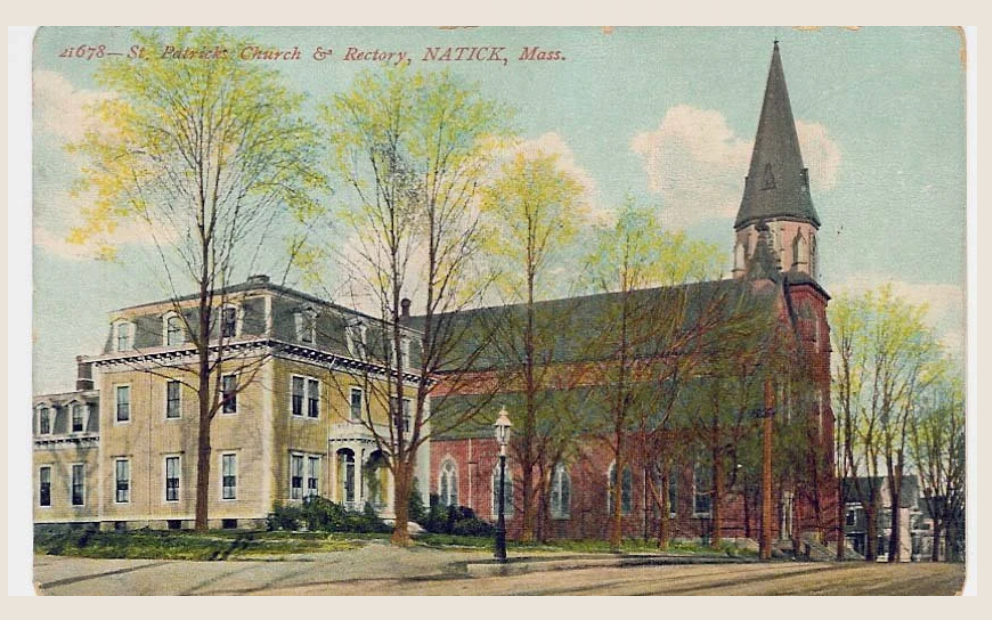 St. Patrick’s Church and Rectory, Natick, Mass., hand-colored postcard. NHS Collections.
A major turning point came after Father Walsh’s death in 1890, when Father Delaney became the parish’s second pastor. At just thirty-nine, he immediately began work toward the construction of the present St. Patrick’s Church.
A local newspaper reported in 1890 that James Murphy, “the celebrated ecclesiastical architect,” had been seen measuring the site east of the Catholic rectory and called it the most favorable location in town for a “grand church edifice.”
Murphy, of Providence, R.I., was one of New England’s leading church architects. Born in County Tipperary, Ireland, in 1834, he came to the United States as a young man and trained under Patrick Keely before establishing his own successful career.
Plans for St. Patrick’s were ambitious. An 1892 newspaper article described the building as Gothic in style, built of brick with Longmeadow stone and granite trim. It was planned at 152 feet long and 71.6 feet wide, with a tower and spire rising 172 feet. Its stained-glass windows were created by the Mayer Company of New York and Munich, Germany.
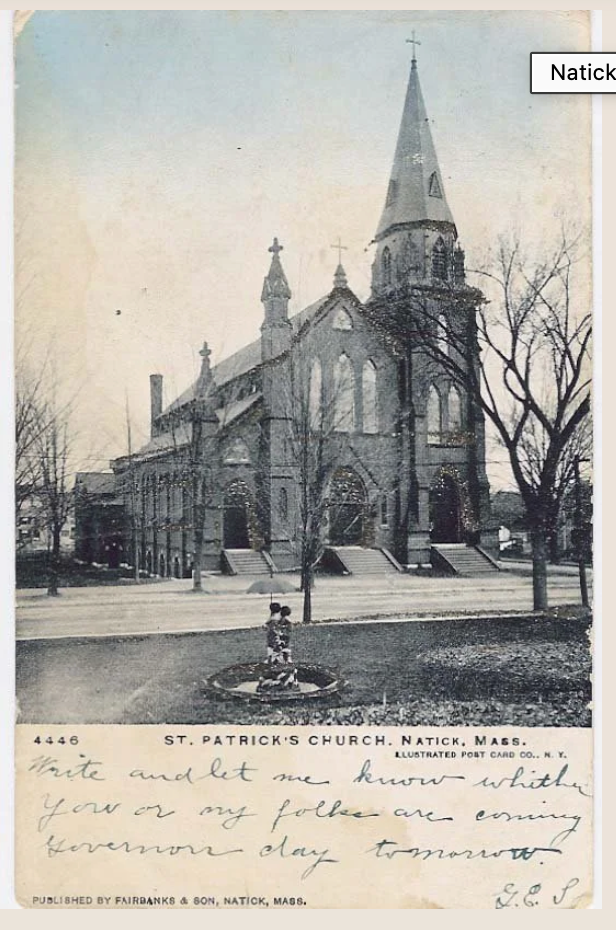 St. Patrick’s Church, Natick, postcard published by Fairbanks & Son of Natick. NHS Collections.
The cornerstone was laid on May 29, 1892. Made of polished Quincy granite and donated by John Whalen, it contained a copper box filled with parish artifacts, newspapers, coins, a donor roster, and a commemorative plate.
The project was funded through donations, and one of the most notable early supporters was Natick resident John Everett, whose $50 contribution was the largest recorded gift at the time. An Irish immigrant and one of the founders of St. Patrick’s Parish, Everett was presented with a solid silver trowel used during the cornerstone ceremony.
Construction proceeded in stages as funds became available. When financing ran short in 1893, the lower church was roofed over so Mass could still be celebrated there. The first Mass was held on June 18, 1893.
The upper church was finally completed and opened on October 12, 1902. Originally expected to cost $60,000, the final total reached $200,000.

Love this. More history please!