
The Natick Select Board at its July 9 meeting continued to gather community input and share updates on a plan to improve the condition and usability of Main Street. The board, which is readying to vote on a Main Street Improvement Project design concept, started its latest session on this topic by taking questions from members of the public that touched on everything from safety to cost to tree preservation.
This meeting followed on the heels of a June 24 Select Board meeting agenda item (about 71 minutes in to the Natick Pegasus recording) on a presentation and report from the Main Street Working Group, which voted 8-7 in favor of what’s known as the “hybrid” concept that includes dedicated bike lanes. The introduction of dedicated bike lanes to Natick Center has been a point of contention between those worried this will hurt businesses and create safety problems, and those who feel bike lanes could help improve transportation options, benefit the environment, and address future needs as increased rail trail connectivity becomes reality. Some have raised concerns that the town could make its decision based more on grant funding stipulations than on which design is ultimately best for residents, businesses, and visitors, and favor a basic approach of just repairing aging roadway (the basic approach is estimated to cost about $2m in town funds, while some of the more involved concepts are expected to cost about $11m, though be covered by grants).
The June 24 session followed a June 10 update on the improvement project concepts, which have evolved since this process began in 2023. Once a decision on which way to go is made and the town eventually gets to the construction phase, the actual changes aren’t expected to happen until the mid-2030s.
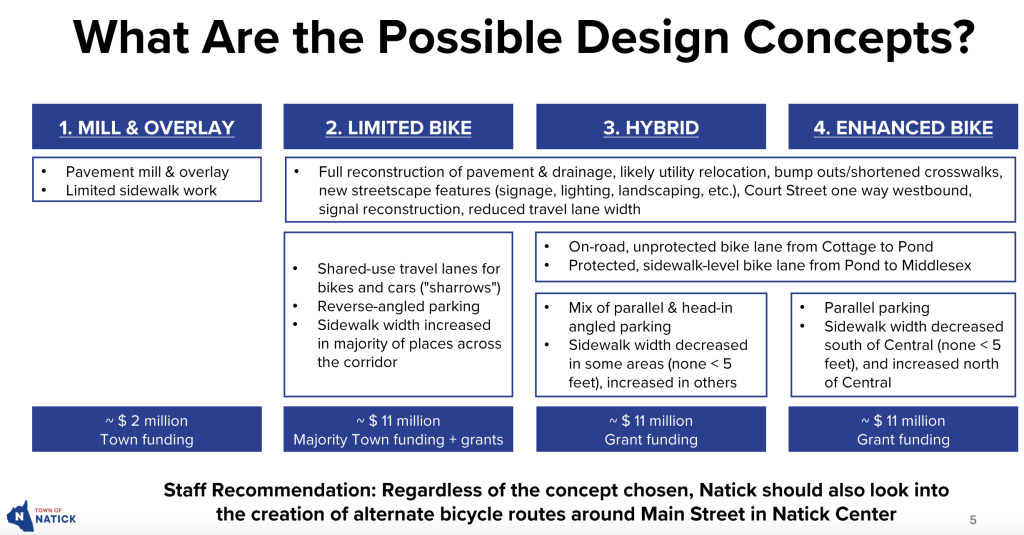
At the July 8 meeting, Town Administrator Jamie Errickson responded to questions about cost differences between approaches, and emphasized that once you start redoing traffic signals, reworking sidewalks for accessibility bump-outs, etc., the project will be expensive regardless of whether dedicated bike lanes are included. But certain approaches would cost the town a lot less because of potential grant funding. He also addressed questions about investment in parking facilities, say a garage or lot, and said there are few grant funding options, leaving it to the town to fund what is a tough investment to recoup spending on.
The town has posted dozens of questions and answers online regarding the improvement project to try to address people’s concerns. But based on comments from some speakers at the meeting, skepticism remains about everything from the ability to trucks to maneuver through Natick Center to the possibility of improved traffic flow with streetscape changes to the reality of people actually cycling all that much in light of the snowy, cold, and rainy weather in these parts. Terms such as “destruction” and “ruin” were sprinkled into some of the angrier comments.
Select Board Chair Kathryn Coughlin acknowledged that this project is rife with pluses and minuses.
“This entire project, every single element of it, has a trade-off. There isn’t one element of this entire thing that you could point to and say ‘that’s a great idea…could we just do that one thing?’ There’s going to be trade-offs” she said.
There were some calls by members of the public for more data on current bike use downtown, though it was pointed out that the decision being made is forward looking, and that changes made to Main Street could encourage those too afraid to bike in Natick Center today to give it a whirl.
Resident Josh Ostroff, former chair of the town’s Transportation Advisory Committee, commented that he’s hoped for some time that Natick would undertake more town-wide planning on bicycle and pedestrian access, as well as access for people with mobility disabilities. “I feel that now we’re dealing with a very contentious project but don’t have the kind of visibility into what the demand is, what the needs are for people to get around safely on foot, on wheels throughout the town…,” he said. Having information on how many people bike for recreation vs. transportation, for example, could inform such a project, he said.
Cycling advocates had their say at the meeting, and one Needham resident who bikes frequently to and through Natick, encouraged listeners to consider the types of places they’d really like to spend time. He invited people to compare the feelings and experience of crossing Rte. 9 to visit the mall vs. the feelings and experience of something like Open Newbury Street in Boston, where vehicular traffic is banned on summer Sundays and at select other times. “Experience what it’s like being in an area that is prioritizing pedestrians,” he said.
Chair Coughlin said members of the public are welcome to continue asking questions and reaching out to the town in the weeks ahead, and that the board would be picking up on the topic again at its July 22 meeting.
Economic Development
The board meeting segued from the Main Street Improvement project to a related issue: economic development.
Former Select Board member and current Economic Development Committee (EDC) Chair Paul Joseph presented an economic development vision voted on by the EDC, an advisory body of the Select Board. He said his hope that the presentation will be the start of a community-wide dialogue on the issue. (Leading into the presentation, he noted that members of this group were asked early on to provide feedback as the Main Street Improvement Project emerged.)
Joseph began by stressing the importance of having a strong commercial tax base to help offset some of the residential burden, which has grown as property values have increased. Economic development also provides local jobs, and Joseph said a large percentage of Natick residents work in town, including many at big companies like Cognex and MathWorks. He pointed both to businesses lost and businesses gained, with the latter including Bosse and T Market.
The EDC chair credited town employees involved in economic development for doing a good job over the years, but also said “we have under-resourced the revenue-generating of this town pretty much since I’ve been active in town politics, which is almost 20 years.” He also cited the structure of Natick’s town government for limiting economic development efforts. Joseph expressed concern that the town isn’t moving fast enough strengthen its economic development in the face of local and macro challenges.
In looking ahead, Joseph said it’s important for leaders, residents, and businesses to make clear what they want, and this is where the vision statement fits. “The vision statement that we’ve developed basically is designed for providing an opportunity for the Select Board to now say what matters” when it comes to economic development and raising non-residential tax revenue. The statement reads in part: “Natick will be a resilient, opportunity-rich community that enables businesses to start-up, grow, and adapt eƯiciently and responsibly, while reinforcing the Town’s identity, inclusivity, and long-term prosperity.”
Joseph referenced examples of nearby communities, such as Framingham, Hudson, Marlborough, Needham, and Newton, that have taken ambitious approaches to economic development, some involving significant state funds and local business leadership. “We have competition coming from all around us because of the mechanisms and choices these communities have made,” he said. Natick and other MetroWest communities are at risk of being relegated to bedroom communities for Boston, Cambridge, and Worcester, so it’s important that the town pursue collaborative opportunities with its neighbors, he said.
The vision document shared by Joseph describes the need for the town to make it easier to do business here, having a strategy to retain and attract businesses, and continue embracing change (as the Mall has done in shifting to more experience-oriented tenants). Joseph acknowledged doing much of this will be expensive, but that spending and reuse is required for future growth.
For the EDC’s part, Joseph said a near-term goal is for members to be more present at town government meetings, to remind policymakers of the need to think about the potential for commercial opportunities as part of projects. Longer term, he said the EDC should probably be privatized to be more effective.
Shop LOCAL: Advertise your business or organization on Natick Report
