• Sign up for free email newsletter
  • Advertise
  • Events calendar
  • Donate to support our work
  • About us (contact us)


Natick Report

Since 2020: More than you really want to know about Natick, Mass.

  • Restaurants, sponsored by Tama Sushi & Hibachi
  • Camps, sponsored by NEOC
  • Private Schools—sponsored by Fay School
  • Public schools, sponsored by Sexton
  • Preschools, sponsored by Longfellow, Wellesley
  • Letters to the editor
  • Guidelines for letters
  • Sports schedule & results
  • Embracing diversity
  • Charities/Community
  • Arts
  • Kids
  • Business
  • Environment
  • Top 10 things to do
  • History
  • Seniors
  • Deaths
  • Government meetings
  • Natick Center Cultural District—restaurants, shops, services

Top Stories

 
  • —Top 10 taxpayers
  •   —Anyone's Game readies to open in '27'
  • —What's open at Thanksgiving time


Advertisements


Natick Fall Annual Town Meeting night #2: Grass could get greener; Path paved for West Natick redevelopment

October 27, 2025 by Bob Brown

Natick Fall Annual Town Meeting on Thursday, Oct. 23 continued with its job as the town’s legislative body, where discussions and votes related to artificial vs. natural grass fields and west Natick redevelopment dominated (see meeting recording on Pegasus).


Grass could get greener

For the second year in a row, Fall Annual Town Meeting contemplated a citizen petition seeking a moratorium on new artificial turf fields in town, though this year’s motion called for an advisory to town departments rather than an actual ban on construction. This year’s article would not affect current artificial turf fields at the Cole Center, Memorial Field, or Kennedy Middle School. Like last year’s motion, this year’s was designed to give the town time to study the issue more thoroughly.

Fall Annual Town Meeting last year voted to refer the article back to the sponsor as well as several town bodies;  this year’s motion under Article 33 passed by a 78-28-3 margin. A motion to refer this year did not pass.
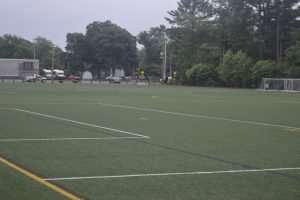
cole center field turf
Cole Center turf field

Some wondered why Town Meeting was bothering to discuss the topic at all since the motion merely called for an advisory to town departments, not a mandate (“Symbolism,” one member called it). But the article’s presence on the warrant sparked a healthy discussion lasting for about an hour. While potential dangers of artificial turf are acknowledged by many, there are also arguments that a balanced approach to field resources can provide more people with more opportunities to get outdoors and exercise. Speakers also referred to advances in both artificial and real grass field construction, with Tien Lum noting that in Marblehead they’re getting a much higher than typical 1,200 to 1,800 hours a year on grass fields thanks in part to improved drainage design.

“We’re not going to solve the debate tonight between artificial turf and natural grass, but I think that’s what the moratorium is for,” he said.

Bruce Evans, Select Board chair and a Town Meeting member, said Article 33 could “serve as a catalyst for discussion” within the context of a much broader field use study. It could push the Select Board to form a study committee comprising representatives from town government, sports leagues, and more.

Longtime Natick resident Dr. Roger Luckmann, professor emeritus at UMass Chan Medical School, kicked off the presentation of the motion, passage of which he said would allow discussions following last Fall Annual Town Meeting to continue. One focus of the proponents is to ensure $2.2m for fields in the capital budget plan will be spent based on broad consensus in town over what sorts of fields are best for Natick going forward (Town Administrator Jamie Errickson said there are no new field projects being considered under Natick’s capital program for the next three years).

While the rubber infill, those little pellets that get stuck to your skin and clothes when playing or sitting on artificial turf fields, get much of the attention in field safety discussions, Luckmann focused on the harmful chemicals in the top layer of grass blades. The blades break off and shed microplastics and PFAS, he said. “The fragments of plastic grass become tiny, forever poison pills that do not break down in the environment or the body,” he said.

Tracy Stewart, an elected Medway Water & Sewer Advisory Board member and former member of Tri-County Regional Vocational Technical High School’s School Committee, spoke of that school’s decision to stick with an all-grass campus in building a $286m school. She also said that Natick’s direction under Article 33 would align with safety measures moving through the state’s legislative process.

Town Meeting members also spoke to the health issues, citing artificial turf fields being endocrine disruptors that can negatively affect reproductive systems and separately, sometimes collectors of goose poop. “I think there are a lot of good reasons to not have more artificial turf, and let’s pause and do some of this additional good work and make a very thoughtful decision on what we do next,” said Town Meeting member Victoria Grafflin.

Town Meeting member Dan Sullivan said the turf vs. grass issue raises broader questions about a lack of town investment in playing fields overall, both in terms of building and maintaining them. As is, Natick’s very high levels of participation in youth and high school sports overtaxes existing playing fields and that that can take a heavy toll on the surfaces. As a parent of two teens, he says “I want less screen time and more turf time.” The town has an obligation to build into its capital plans more opportunities for its residents to use fields, he said.

Joe Zaino, president of Natick Youth Football & Cheer as well as a member of the town’s Recreation & Parks Commission, said data shows that the the availability of turf vs. grass fields isn’t even close, with artificial turf winning by a landslide. He said: “A playing surface is a construction material just like any other, like the roof of this building or the carpet we’re standing on, and when we decide whether we should use it, we should weigh it just like any other surface that we’re choosing to construct something on in the town.”

Chris Downe, who introduced himself as president of Natick youth soccer, said a lack of fields in town has numerous ramifications, including the program paying $100,000 a year to use and maintain grass fields at Elm Bank Reservation. Many matches at the recent Fall Classic Tournament needed to be canceled due to rain and a lack of available turf fields, which cost the organization money needed to help pay for equipment and to keep costs low enough for everyone who wants to play to be able to.

One last comment, before the vote, came from Town Meeting member Sara Hanna, who said she spent her career in hazardous waste site assessment and cleanup. She cautioned that we as a society commonly discover that seemingly great inventions years later prove to be dangerous, and that careful thought should be put into whatever the town decides on the subject of artificial vs. grass fields.


Local News: It’s the Playing Field for Democracy. Please consider supporting Natick Report with a tax-deductible donation.


Zoning bylaws

Article 20 provided a nice earthy segue from the turf discussion, updating the wording in a 1974 bylaw regarding the removal of earth products. The updated wording allows for removal or offsite storage of gravel, earth, or similar materials as part of a construction project, but not purely for sale of the materials (as in a gravel pit).

The motion under Article 20 passed by a 68-29-4 count, but not before member Julian Munnich made an appeal to refer the motion (this referral motion failed to pass). He argued for allowing more time for such proposals to make the rounds in town before Town Meeting, and in this case, he said the subject might even have been discussed in the context of Article 33, with the potential for soil to be reused in town for playing fields rather than shipped off to wherever.

The next few zoning articles went through Town Meeting quietly, until Article 24 hit the floor…

Redeveloping West Natick

Motions under Article 24 took up the last hour-plus of the second night’s session, with a focus on redevelopment of the stretch of Natick between the Framingham line on Rte. 135 and the dog park between Fisk Pond and Lake Cochituate past Speen Street, with the West Natick commuter rail station in between. The area is heavily developed already, though rundown in parts, and perhaps includes a perhaps underappreciated amount of open space and wetlands property.

Those in support of zoning changes see an opportunity to revitalize a stretch with a mix of housing, office, and commercial development, along with easier passage for pedestrians and cyclists. Those opposed to an immediate zoning change want to see more public discussion about possible impacts, from traffic to school enrollment. The stretch currently includes a mix of uses from a junkyard to commercial properties like the Roche Bros. grocery store, which is actually in a Single Residential-A zone.

Three motions were introduced under Article 24, and all passed. Two motions to refer motions back to the sponsor got shot down by Town Meeting. Motion A sparked the longest discussion by far after being introduced by Director of Community & Economic Development Amanda Loomis and quickly backed by Town Meeting and Planning Board member Andy Meyer. Loomis documented outreach efforts over the past couple of years with the public, including neighbors and commercial property owners.
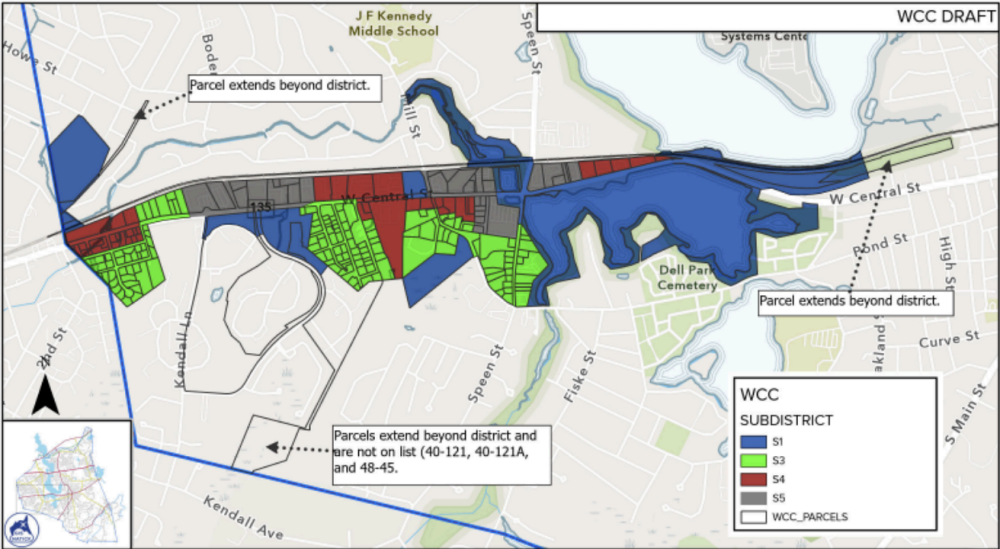
west natick corridor
West Central Corridor along Rte. 135

The West Central Corridor (WCC) and Limited Commercial zoning districts are designed to support a mix of uses, but in a more organized way than is the case now with the current mishmash of non-conforming lots and uses. The town has been updating its regulation use schedule, but these additional zoning changes would be designed to support more of a coordinated plan for development. Among the town’s visions is for a multi-use path along the side of Rte. 135 where sidewalks now don’t exist. Projects proposed along the route within numerous subdistricts under the revised zoning will be reviewed individually, but also within the context of surrounding developments, Loomis said.

Meyer described the proposed zoning changes as an effort to make sense of what exists and support logical growth that allows higher density in some parts and open space in others. “I don’t see much in here that scares me at all,” he said.

Town Meeting member David Coffey commended the plan as “thoughtful,” but still made a pitch for referring the first motion under Article 24 back to the sponsor, citing concerns about the plan being incomplete and a lack of follow-up communication with the broader community after some initial meetings. He pointed to the many meetings and online polls associated with the relatively small property containing the former Johnson Elementary School vs. the less intense communications process for this much larger swath of land.

Coffey raised concerns that maxing out the newly defined corridor could overwhelm the town’s schools, public safety resources, and transportation infrastructure. “Oh, and please don’t tell me all the people moving there are going to take the commuter rail. They’re not,” he said. He asked fellow Town Meeting members if they would support such redevelopment in their part of town (some later said yes).

Also raising concerns about the proposed zoning changes was Town Meeting member Munnich, who said that the Golden Triangle along Rte. 9 shows the benefits of good redevelopment, such as funding creation of the downtown complex including town hall and the fire station. The West Natick corridor has “tremendous promise” and the proposed zoning changes are a good first step, but he said redevelopment won’t succeed without density targets and controls on the intensity of development.

Town Meeting member Brian Lucenta closed out comments on the motion after further discussion by the body for and against it. He cited the number of multi-tenant residential units that have been built over the past 10 years and urged the town to see how that works before giving the go-ahead for a whole new batch of units and development.

Town Meeting member Cody Jacobs, who said he lives near the corridor in question, was supportive of the plan. He pointed out that generous setbacks are defined, and that site plan reviews are designed to protect against too much density and blocking of views. “I don’t think that [buildings] would be looming over us,” he said, then switched his focus to the economic development and other opportunities such a zoning change could bring. “I’m excited about this,” he said.

Select Board member Rich Sidney, speaking as a Town Meeting member, described the area currently as “a mixed up, messy area of town,” and said the comprehensive zoning changes could boost mixed-use development.

Town Meeting member Ed Doherty also spoke in favor of Article 24, citing the sort of economic redevelopment he saw as a former Needham Town Meeting member and the prospects of the sort of housing people like himself might want to downsize to in town as they get older.

Also supportive was Open Space Advisory Committee Chair Martin Kessel (Town Meeting member Rich spoke on her husband’s behalf, because of a voice issue he’s having).  The Committee has voted to support the article, she said, not necessarily to back increased density but because of the promise to increase the attractiveness of the area for pedestrian connections, and maybe even encourage development of pocket parks.


  • Fall Annual Town Meeting night #1: Memorial School funds; Regret over not becoming an architect; capital expenses; Select Board appointment cleanup
  • Fall Annual Town Meeting night #3: Community Preservation funds flow to 5 Auburn; Get ready for more downtown signs

 

Filed Under: Government, Town Meeting


Natick Art Association, Holiday Gift Fair

Natick Fall Annual Town Meeting night #1 recap: Memorial School funds; Regret over not becoming an architect; Capital expenses; Select Board appointment cleanup

October 24, 2025 by Bob Brown

During the first night of Natick Fall Annual Town Meeting, the School Committee got its $2.6m in funding for a Memorial Elementary School building project feasibility study and schematic design, capital funding for trucks and more was approved, and Select Board cleanups got OKs.

A recording of the Oct. 21 session is posted on Natick Pegasus.

An unofficial vote count is available online as well. Natick Town Meeting has up to 180 members, 18 per precinct, and the highest number of votes cast on night #1 per this tracker was 117 on the Memorial study funding.


We’ll be following up with night #2 coverage from Oct. 23.

Next Tuesday, Oct. 28, Town Meeting will feature discussion and voting on, among other things, Natick’s first ever distribution of Community Preservation Act funds for projects, including the big one—$750k requested for the proposed 5 Auburn St. housing development.


Memorial School funding & regret over not becoming an architect

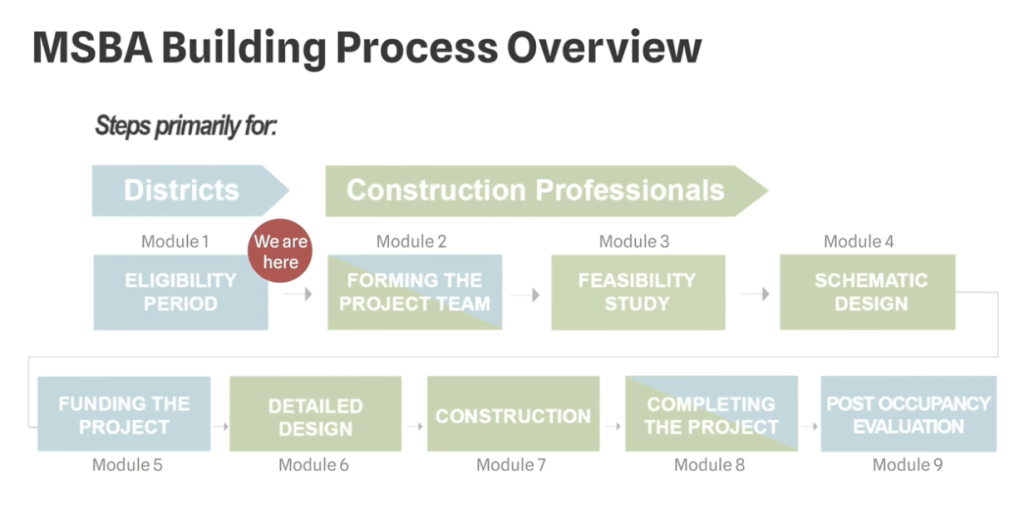
The first meaty topic undertaken by Town Meeting was Article 10, via which the School Committee sought $2.6m to fund a feasibility study and schematic design related to a proposed Memorial Elementary School building project. The School Committee and School Department are going through the exhaustive Massachusetts School Building Authority (MSBA) process that can score the town millions in renovating or rebuilding the outdated school building at Eliot Street. Supt. Dr. Melissa Spash and Memorial Principal Karen Ghilani were among those who made their case before Town Meeting that funding at this point is critical for Natick keeping its place in the MSBA process.

Spash cited the overcrowding and obsolete spaces within the current Memorial building that made the school system eligible for the MSBA process, and Ghilani added color, such as by detailing issues like a leaky roof and crumbling concrete.

Ghilani said the building, originally designed to handle up to 348 students, is now serving 436, and spaces have had to be stretched for different purposes. There’s a lack of space for multilingual learning and some special education programs.

The feasibility study would test designs to support 600 K-4 students and a pre-school, and look at the possibility of using geothermal for heating and cooling.

Assistant Superintendent for Finance Matt Gillis went over the numbers, including $1.8m of the requested $2.6m for an architect. Architects typically score about 10% of the overall project cost, he said.

The motion under Article 10 easily secured the required two-thirds vote with a 111-6 tally, though even supportive Town Meeting members did have a critical thing or two to say about the process.

Some Town Meeting members took issue with how reimbursement rates from the MSBA were displayed, and Gillis clarified this issue. Questions were also raised about the need for more school space in light of enrollment projections being flat to a slight decline, especially in light of enrollment data being used not long ago to justify closing Johnson Elementary School.

And then there was that $1.8m for the architect…

Town Meeting member Steve Merlino, whose daughter attended Memorial more than 20 years ago, said “I don’t need at $2.6m study to know the building is trash… and $1.8m for an architect? Boy, I wanna go back to school.” He asked if the study could be skipped, but was told no, the MSBA requires it, and the idea is that getting MSBA acceptance would more than pay off in the end.

memorial school


We don’t regret being journalists rather than architects. But you can help us to close the very wide salary gap by making a tax-deductible donation to Natick Report.


Another big ticket item: Capital equipment and improvement

Article 9 covered capital equipment and improvement, with requests totaling about $8.9m between two motions, which passed by votes of 112-2 and 111-3-1. Money is being targeted for a fire engine and police cruisers, a sander vehicle, water meter and main replacement, tree inventory (to identify possible issues—about 50 public shade trees go down per year), and more.

2011 sander
2011 sander to be replaced

Deputy Town Administrator Jon Marshall said the requests under this article adhere to a 5-year capital plan, and the town makes requests at both spring and fall Town Meetings. There were 27 projects left following spring Town Meeting, and the town came forward with 12 of them for the fall, in part because lead times on some vehicles has shrunk and in part because other funding sources were available to pay for roadway work.

Town Meeting member Frank Foss asked about what’s become of some of the $7m tax override money that was to be used to get capital spending back on track. Marshall said $1.2m is going to the capital stabilization fund, to which Foss expressed concern. “We’re kind of just banking this, we’re just saying we’re going to set this aside. When I buy something I want to get some production for it and I want to see it. I’m really expecting that we’re going to see a plan for next spring of where that $3m or so that we were expecting for capital is going to be spent, or there are going to be some serious questions of what’s going on.”

Another concern on capital spending was raised by Town Meeting member Julie McDonough about strategic investments in fields and playgrounds. “It feels like we’re only repairing those things that are in desperate need of repair,” she said, pointing to shrinking year-over-year investments.

Town Meeting member Julian Munnich raised concerns about the town’s tree planting strategy, envious of what he’s seen in other communities like Newton. He described tree plantings as being “grostesquely under-addressed in the town” as a defense against climate change locally.

Closest vote of Night #1 about a change to tech boards

The closest vote of the week at 66-40-3 was in favor of the motion under Article 12, through which the Select Board wants to have a combined Cable Advisory Board (CAB) and Information Systems Advisory Board (ISAB) since they have been co-appointing members for years.

This would involve removing the ISAB from the town by-law, and there was some argument against this because Town Meeting would be left out of the loop regarding future possible changes to the board. Select Board member Rich Sidney, in introducing the article, said this change would give the Board more flexibility around a combined board, such as allowing it to appoint more or fewer members based on the number of qualified candidates willing to take part. The Select Board’s Linda Wollschlager emphasized that not every committee (such as the Transportation Advisory Committee) for which the Select Board appoints members is within the bylaw and that the Board already has the ability to appoint ad hoc committees at any time.

Among Town Meeting members who said they would vote against this change was Dan Sullivan, who said given rising cybersecurity threats against municipal governments and requirements for digitalization, he would look to to bolster the ISAB rather than remove it from the bylaw.

Article 11, under which the Select Board sought to amend the bylaw regarding its appointments to committees required under law, also passed. The vote was 76-14-2. Among those supporting this was Town Meeting member and chair of the soon-to-be-sunsetted Charter & Bylaw Review Committee Paul Griesmer, who said “Hallelujah!” The table was “so outdated and riddled with errors,” he said, and now all the correct info is in one place. Some lamented that the process for updating the information wasn’t cleaner, and encouraged Town Meeting to vote for referral back to the sponsor; that motion failed to pass.

Following the votes on Article 11, Mr. Sidney raise to move that the nearly 3-hour meeting be adjourned, and it was.

More:

  • Night #2: Grass could get greener; Path paved for West Natick redevelopment
  • Night #3: Community Preservation funds flow to 5 Auburn; Get ready for more downtown signs

    Stay in the loop by signing up for our free weekday email newsletter

Filed Under: Government, Town Meeting

Advertisements


Natick affordable housing plan at 5 Auburn St. faces scrutiny over possible Charles River impact

October 23, 2025 by Bob Brown

Proponents of a proposed affordable housing development at 5 Auburn St. that has made it through Select Board, Zoning Board of Appeals, and other Natick approvals processes are now stating their case to the Conservation Commission.

Advocates for affordable housing have applauded Metro West Development Collaborative’s plan for a 32-unit complex combining restoration of the historic Eliot School and a separate new structure on a dead-end street off of Rte. 16 in South Natick. Many neighbors have urged the town and developer to scale down what they see as an oversized project that they fear will have negative implications for traffic and the environment, and others have asked the town to rethink whether there’s a more cost efficient way to address the housing shortage than what’s now escalated to  a $23m-plus project. Metro West scored the town-owned property at 5 Auburn St., which includes land now valued at about $2m, for $100 following a narrow 2023 Select Board vote in favor of the 40B project. (Disclosure: We live near South Natick.)

Other than by neighbors, largely overlooked in much of the ongoing discussion over 5 Auburn St. (including Metro West’s bid for $750k in additional funding to be debated at Fall Annual Town Meeting on Tuesday, Oct. 28) has been the project’s potential impact on the Charles River that it would abut. The site is just down river from the spillway (aka, waterfall) that’s set to be removed next summer to save the town money… and protect that same river, frequently referred to as sacred during the exhaustive dam removal decision process. Those who spoke so passionately about protecting the river during the dam discussions, such as the outside advocacy groups that glommed on, have been non-factors regarding this riverbank housing development. The Charles River Watershed Association, for example, says “We have not been tracking that project, as we just haven’t had the capacity to track that kind of development.” Mass Audubon, active during the dam discussions, has also not been involved, deeming this a local development issue.

This is where the Conservation Commission comes in, though at a later stage than some would like to see given that so many approvals have already been granted.

The Conservation Commission’s focus is on the proposed project’s possible impact on the environment. As one Concom member asked during an Oct. 15 public hearing: “Is this project consistent with what we’re fundamentally charged with as a commission?”

Or as a neighbor put it to the commission in writing: “Can you look at this hulking building looming over the river, entirely within the riverfront buffer zone, and say it is protective of Natick’s land, water and wildlife?”

Metro West earlier this month entered the Notice of Intent process with Concom that’s designed to ensure work in or near wetlands or riverfront areas meets environmental protection standards. The applicant is also seeking a major stormwater permit, and the project has been the subject of Conservation Commission public hearings on Oct. 2 and Oct. 15 as well as a site walk in between.

(Metro West went before the commission last year with an Abbreviated Notice of Resource Area Delineation filing. About a quarter of the just under 3-acre property is considered wetland resource area.)

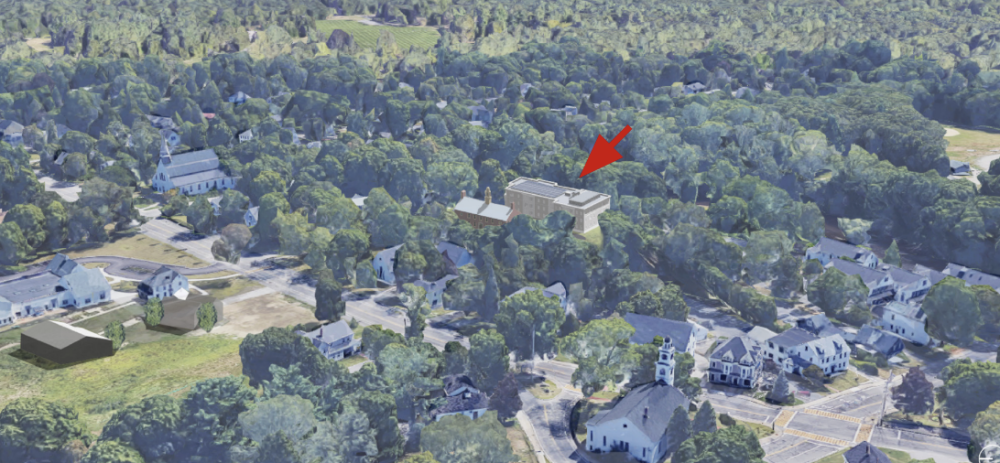
5auburn
Rendering of new (red arrow) and current buildings at 5 Auburn from ZBA filing in November
(some adjustments to footprint have been made since)

The project, construction on which could start by 2027, involves renovating the old Eliot School and erecting a new building. Metro West plans to install a state-of-the-art stormwater management system that it says will reduce phosphorus runoff considerably, whereas there isn’t stormwater control now.

Dana Altobello from Metro West’s engineering team said “We’ve kind of oversized these a little bit to make sure that we’re decreasing the peak rates of runoff from the site towards the Charles River.”

Engineers hired by Metro West says about 3% of the existing riverfront on the property is considered degraded, and that you’re allowed to go up to 10%, then even go beyond that if you take restoration or mitigation steps to offset disturbance. Native plantings and ongoing invasive management (largely knotweed removal) are in the plans.

Among the questions raised with Metro West’s team on Oct. 2 (see recording) was why the new building would be sited closer rather than further from the river. The original request for proposals encouraged keeping the green space along Rte. 16 for aesthetic/character reasons, a member of the Metro West team said, and the town’s Historical Commission has also supported retaining views of the historic building from the road. The design of the new building, Altobello said, has also changed from an L-shaped one to more rectangular to keep more of it out of the riverfront area.

Ecologically, it would be better to have the new structure away from the river, and the commission could have a say on this depending upon how this redevelopment project is defined. “We’re being handed a thoroughly baked plan that has gone through all kinds of different boards and committees at this point saying take it or leave it… and we’re not obligated to do that,” said commission Chair Matthew Gardner.

During the Oct. 15 meeting (see recording), following a site visit, commission members asked more questions, including about flooding (generally considered not an issue on Auburn Street, though it is an issue on neighboring streets), soil stability near the drop-off to the river behind the proposed new building, and the operational and financial plan for ongoing invasives management.

Where things got more interesting, or at least more technical, was when discussion focused on whether the commission should be reviewing this project under wetlands standards for new development—10.58(4)—or redevelopment—10.58(5)—of property already degraded with impervious surface.

Metro West is angling for 10.58(5) so that alternative site analysis isn’t required. It terms its plans “a betterment” for the area, and that it would mitigate any disturbed area at a 2-to-1 ratio.

The commission’s not so sure 10.58(5) is appropriate and plans to take a deeper dive into this at its next public hearing on this matter. As Gardner put it, “We need to see a real justification as to why something in the riverfront area is located where it’s located.” He called Metro West’s bid for 10.58(5) review “gutsy” considering that just 3% of the riverfront area is degraded. Another member referred to banking on the 3% as a possible “loophole” to avoid implementation of certain safeguards.

Perhaps most strongly, Concom member Mike Downey said: “There’s proposals within this plan that are inherently in conflict with what I think is supporting the function of the Charles River.”

There was also talk of getting outside counsel involved to help the commission ensure that it’s viewing this proposal through the right lens.

Discussion will continue at the Conservation Commission on Nov. 6. If you have questions or comments in the meantime, send to concom@natickma.org


Now, thanks to Natick Report’s partnership with Tiny News Collective, you can make tax deductible contributions to support our work.

Filed Under: Environment, Government, Housing

Advertisement


Natick arts news: TCAN will have first new director in 22 years; Baylee Bee clothing in art show

October 23, 2025 by Bob Brown

The latest Natick, Mass., arts news:

Basile succeeds Lavalley as TCAN director

 
The TCAN Board of Directors has appointed Erin Basile as the next executive director of The Center for Arts in Natick, effective Jan. 1. She succeeds David Lavalley, who has led the outfit for 22 years and has been named executive director emeritus in recognition of his contributions.

Basile has been with TCAN for 11 years, initially as theatre operations manager and currently as associate director of the venue, which attracts some 30,000 patrons per year to a variety of performances.

See also: Transformative changes underway at TCAN (published in 2024)

tcan
TCAN’s David Lavalley and Erin Basile


Expand your reach (and support local journalism) by advertising on Natick Report.


Baylee Bee clothing in art show

 Clothing from Natick’s Baylee Bee shop was recently featured in a photography exhibit in Southborough described as visual story telling through street signs and fashion. The exhibit was designed “to empower all women to use their voice to say what they want to say. Women have the power to say, STOP, ONE WAY- my way only, and many others.”

The exhibit, which was shown at Apothecary Artists Studio & Gallery in Southborough, was created by photographer Chelsea Bradway and fashion stylist Brooke Kanal.

Yield
Courtesy photo

Filed Under: Art

Advertisements

Natick community news: Service Council has new director; Your tax-deductible donations support local news; Affordable housing opportunities

October 22, 2025 by Bob Brown

The latest Natick non-profit news:
 

Natick Service Council has new director

 
The Natick Service Council has announced the appointment of Rachel Vingsness as its new executive director, beginning Dec. 1. Vingsness Rachel has been serving as director of operations at the council, which supports community members through programs including food assistance, case management, housing support, and workforce development.

Vingsness succeeds Dan Shea, who has served as director since 2020. Among other things, the council expanded its food pantry this year under Shea’s leadership. Shea says “I am retiring for real this time but will be volunteering around town once I take some time off to travel a little.”

Dan Shea and Rachel Vingsness of Natick Service Council
Dan Shea & Rachel Vingsness (courtesy photo)


Your tax-deductible donations support local news

 
We attended a New England Newsrooms meeting at Boston University last week along with many peers from other Massachusetts communities who are running dedicated local news sites like ours. The challenges are largely similar in terms of making these ventures sustainable, so many people expect to get their news for free these days. BU is helping us in a big way through its journalism program, which assigns students to work with publishers like us in covering our communities.

We generate revenue through advertising, grants, and reader donations. Increasingly, readers who value local reporting are supporting us through donor-advised funds and company matches.

Thanks to Natick Report’s partnership with Tiny News Collective, you can make tax deductible contributions to support our work. Please help us continue bringing the news to Natick about everything from non-profits to government to events to business.

New England Newsrooms meeting


Affordable housing opportunities

 
A handful of affordable housing opportunities have become available in Natick.

  • 21 Summer St. (2 1- or 2-bedroom apartments)
  • 45 E. Central St. (Stonegate/St. Patrick—Three rental units are available at 50% of area median income; 1 one bedroom, 1 two bedroom and 1 three-bedroom unit. Nine rental units are at 80% area median income: 4 one bedroom and 5 two-bedroom units)
  • 16 Village Way (2-bedroom condo—first come, first served)

Filed Under: Charity/Fundraising

  • « Previous Page
  • 1
  • …
  • 46
  • 47
  • 48
  • 49
  • 50
  • …
  • 375
  • Next Page »

Tip us off!

Please send news tips, photos, ideas to natickreport@gmail.com

Please support your local news source with a tax-deductible donation by scanning the QR code or by clicking on it.

natick report QR code

Advertisements

Categories

  • Animals
  • Art
  • Bacon Free Library
  • Beyond Natick
  • Books
  • Boston Marathon
  • Business
  • Camps
  • Careers
  • Charity/Fundraising
  • Community
  • Construction
  • COVID-19
  • Education
  • Election
  • Embracing diversity
  • Employment/careers
  • Entertainment
  • Environment
  • Fashion
  • Fire
  • Food
  • Gardens
  • Government
  • Health
  • History
  • Holidays
  • Housing
  • Humor
  • Kids
  • Legal
  • Letters to the editor
  • Media
  • Military
  • Morse Institute Library
  • Music
  • Natick Election 2022
  • Natick Historical Society
  • Natick History Museum
  • Natick Mall
  • Natick Nest
  • Natick track
  • Neighbors
  • Obituaries & remembrances
  • Older adults
  • Opinion
  • Outdoors
  • Override
  • Parents
  • Police & crime
  • Real estate
  • Recycling Center
  • Religion
  • Residential property sales
  • Restaurants
  • Schools
  • Shopping
  • South Natick Dam
  • Sports
  • Technology
  • Theater
  • Town election 2021
  • Town Election 2023
  • Town election 2024
  • Town election 2025
  • Town Election 2026
  • Town government meetings
  • Town Meeting
  • Transportation
  • Travel
  • Uncategorized
  • Vacation
  • Veterans
  • Volunteering
  • Voting
  • Weather
lion publishers
  • Bluesky
  • Facebook
  • Instagram
  • Twitter

Sign up now for free email newsletter & stay in the Natick loop

* indicates required
Our newsletter is free, though we gladly accept contributions to support our work.

Most Read Posts

  • What's open and closed at Thanksgiving time in Natick, 2026
  • Fire Pit Hosts welcomed to Cochituate Rail Trail for New Year's Eve
  • After much discussion, Natick retains a single tax rate
  • Learn about getting involved in Natick town government
  • Fueled by 4 Oliveira touchdowns, Natick beats Framingham 42-20 in Thanksgiving Day football game

Click image to read The Swellesley Report

The Swellesley Report

Upcoming Events

Notice
There are no upcoming events.

Privacy policy

© 2026 Natick Report
Site by Tech-Tamer · Login