
Natick held its annual tax classification hearing last week, and as usual, the Select Board voted to stick with a single tax rate. In other words, residential and commercial property owners pay the same rate.
There had been some calls during and after the $7m operating budget override process for the town to give residents a break and consider shifting more of the tax burden onto commercial property owners, and the Select Board has begun a deep dive into that subject in preparation for next year’s tax classification hearing (“We haven’t closed the door on a split tax rate,” Board Chair Bruce Evans said during the meeting). The thing is though that residential property taxes account for more than 82% of the pie, and any lowering of the residential property tax rate would have a disproportionate impact on commercial tax bills (for example, a 2% increase in residential rate would be offset by a 10% increase in the commercial rate). This is a complicated issue: for example, higher commercial taxes would make it even harder for owners of less desirable office space to find tenants.
Natick Director of Assessing Eric Henderson led the FY26 Tax Classification Hearing during the Nov. 19 Select Board meeting (see about 18 minutes into the Pegasus recording and review slides).
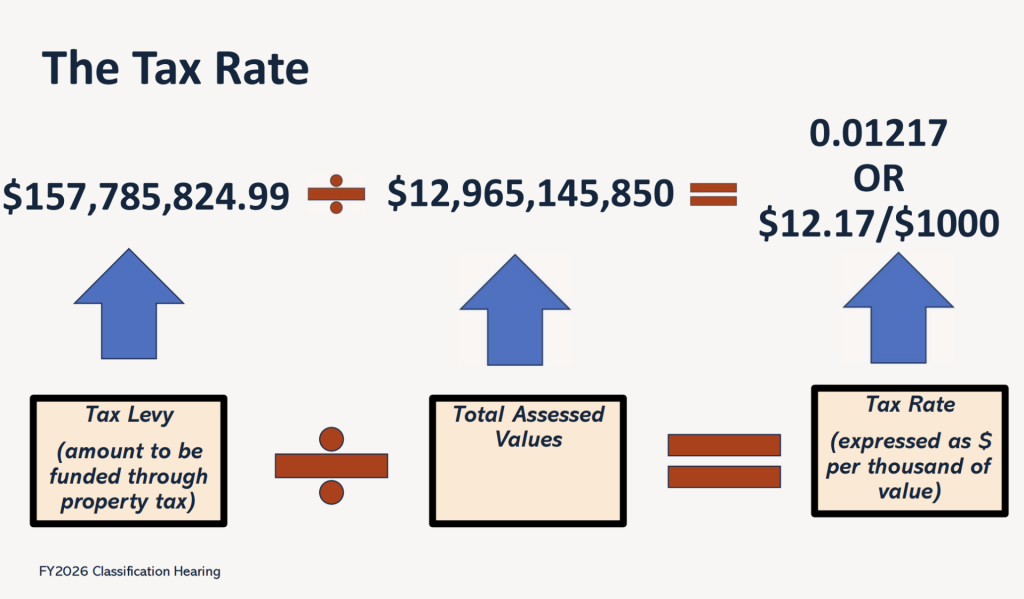
What everyone wants to know of course is the amount of the new property tax rate (taxes per $1,000 in property) and more importantly, how much their tax bills will increase. While tax rates in Natick have been falling in recent years, property valuations have been skyrocketing, so tax bills keep going up.
Before you get that next tax bill, please consider supporting your dedicated local news source with a tax-deductible donation by scanning the QR code or by clicking on it.

The town’s spending limit is based on the property taxes it collects, a few other funding sources, and now the $7m boost per year from the override.
The projected Natick tax rate after doing the math is $12.17, with the override accounting for 54 cents of that. With the median single family home valued at $838,600, that results in an FY26 tax bill of $10,206—up from $9,334 in FY25 when the tax rate was $11.96 (see also: “Natick tax rate history”). The override accounts for $453 of the FY26 property tax bill for the median single-family homeowner, and as Henderson noted, the override’s expected impact on property taxes “drove a lot of traffic to my office.”
The average property value and tax bill in Natick slots in above those for communities like Medway and Holliston and below those for Southborough and Medfield, showing Natick’s competitiveness on this front, Henderson said.
Total taxable property value for Natick is about $13 billion, over twice what it was 12 years ago.
Henderson called that “pretty remarkable… As someone who has been doing this for about 25 years, I’m still fascinated where we’re at.”
It wasn’t all about residential property values either, Henderson noted, pointing to a boost provided by commercial and industrial developments such as ABI-Lab 3, the Bosse pickleball complex at the Mall, and more. New growth boomed, adding $2m-plus to the levy. (See also: “Natick’s top 10 taxpayers for 2025.“)
For more details on why tax bills are divvied up as they are, check out the presentation.
For more on tax deferral and exemption programs, see the town website and review the meeting recording, as board members asked several questions about these programs.
Note that abatements (if you want to contest the assessment of your property) must be filed between mailing of the third quarter tax bill and the due date, which in 2026 will be Feb. 2.
Natick Report accepts letters to the editor.

Of course they did. Put residents first, for once
Natick needs to get control of their spending. The example above is a 9.3% tax increase. This is an unsustainable level of increase. How many Natick residents had their income go up 9.3%? Driving up taxes by such extreme amounts reduces discretionary income, which will reduce how much residents spend at the commercial businesses and reduce their income just as increasing their taxes will. It’s a double whammy for them, with increased taxes AND reduced business. The only solution is to control town taxes by controlling town expenditures.
Well said! Residents have to tighten their belts more every year and that hurts everyone including the local businesses. Meanwhile the town continues to find creative new ways to spend on things we don’t need. I just wish I knew where the money went because is sure as heck isn’t spent on fixing the roads!
thank g-d we moved